Best CPU for RX 7800 XT: Maximize AMD’s 1440p Champion (2026)

Quick Answer+
Quick Answer: The AMD Ryzen 7 7800X3D (~$386) is the best CPU for RX 7800 XT, delivering maximum gaming performance with zero bottleneck. For value builds, the Intel i5-14600K (~$312) offers excellent performance. Budget builders can use the Ryzen 5 7600X (~$178) with minimal bottleneck at 1440p.
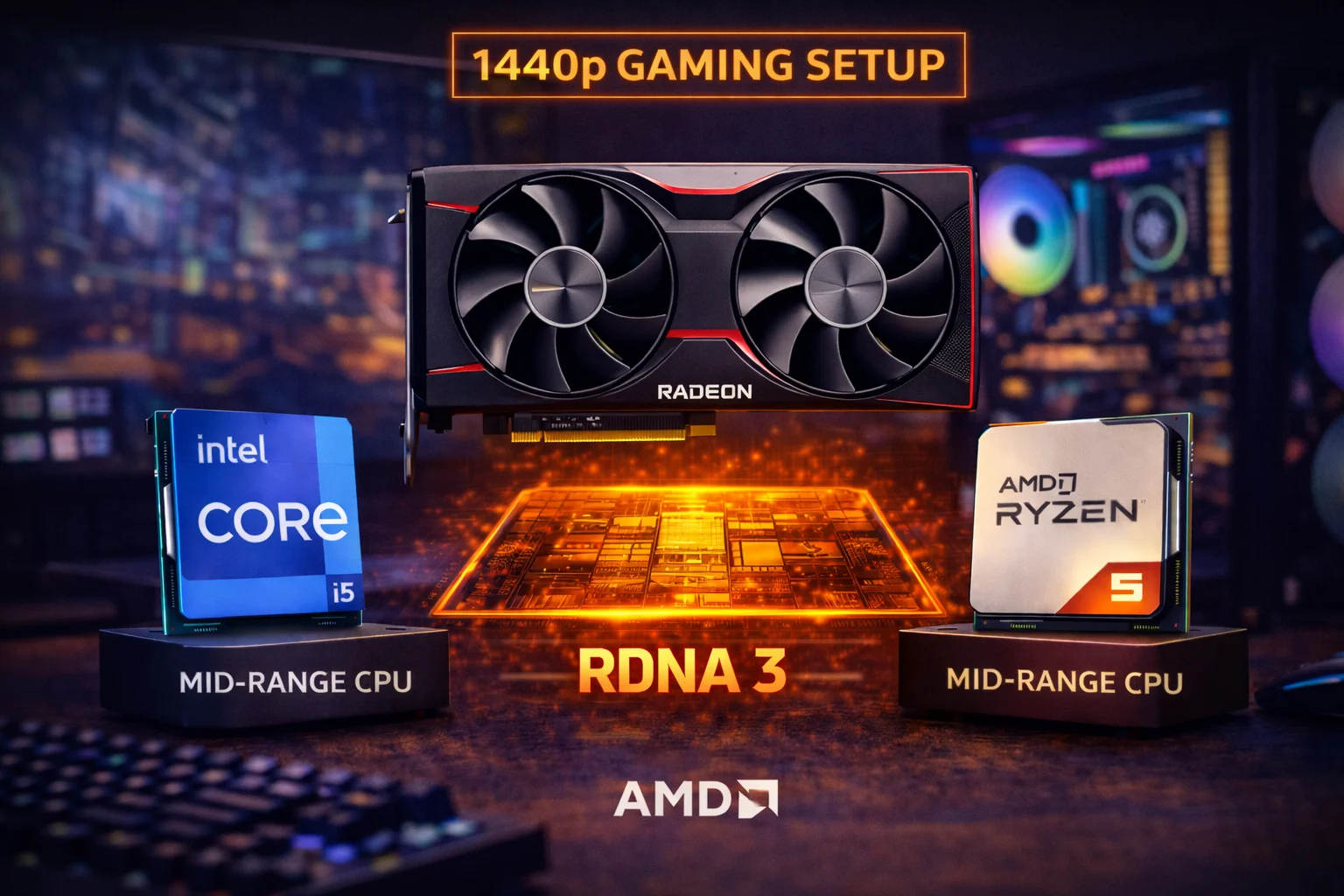
The AMD Radeon RX 7800 XT is the 1440p value champion. With 16GB of GDDR6 VRAM, excellent rasterization performance, and aggressive pricing around $500, it’s become one of the most popular GPUs for gamers who want quality 1440p gaming without paying NVIDIA’s premium.
Choosing the right CPU for the RX 7800 XT is straightforward—at this performance tier, mid-range processors pair perfectly. The GPU is typically the limiting factor at 1440p, meaning you can save on CPU without sacrificing gaming performance. Use our Bottleneck Calculator to verify your specific pairing, or check expected frame rates with our FPS Calculator before purchasing.
This guide analyzes the best CPU options for your RX 7800 XT across different budgets and use cases, with real-world bottleneck data to help you build the perfect AMD-powered gaming PC.
RX 7800 XT: Understanding the 1440p Value King
The RX 7800 XT represents AMD’s sweet spot for 1440p gaming. Built on RDNA 3 architecture with generous VRAM, it delivers excellent performance at a competitive price point.
RX 7800 XT Specifications
- Architecture: AMD RDNA 3
- VRAM: 16GB GDDR6
- Memory Bus: 256-bit
- Memory Bandwidth: 624 GB/s
- TDP: 263W
- FSR: Version 3 with Frame Generation
- Ray Tracing: 2nd Generation RT Accelerators
- PCIe: 4.0 x16
- Price: ~$480-550
Performance Expectations by Resolution
1440p Ultra (Sweet Spot): The RX 7800 XT excels at 1440p, delivering 80-110 FPS in demanding AAA titles at maximum settings. This is where the GPU shines, and mid-range CPUs handle the workload without bottlenecking.
1440p with FSR 3: Enable Frame Generation in supported titles and expect 130-180+ FPS. FSR 3 adoption continues growing, providing DLSS-like benefits for AMD users.
4K Gaming: Capable at medium-high settings, delivering 45-65 FPS in demanding titles. With FSR Quality, expect 60-85 FPS. For dedicated 4K gaming, consider the RX 7900 XTX or NVIDIA alternatives.
1080p High-Refresh: The 7800 XT pushes 140-200+ FPS at 1080p, making CPU bottlenecks more apparent. For competitive 1080p gaming, faster CPUs provide noticeable benefits.
Why 16GB VRAM Matters
The RX 7800 XT’s 16GB VRAM is a key advantage over competing NVIDIA cards at similar prices. At 1440p with maximum textures, many games approach 10-12GB usage. The extra headroom ensures smooth performance in VRAM-heavy titles and provides meaningful future-proofing as games become more demanding.
Best CPU for RX 7800 XT: Quick Recommendations
| Priority | Best CPU | Price | 1440p Bottleneck |
|---|---|---|---|
| Maximum Gaming | Ryzen 7 7800X3D | $386 | 0% |
| New Gen Gaming | Ryzen 9 9800X3D | $444 | 0% |
| Best Intel | i5-14600K | $312 | 0% |
| Intel Value | i5-14600KF | $243 | 0% |
| Budget Champion | Ryzen 5 7600X | $178 | 0-2% |
| Productivity + Gaming | i7-14700K | $367 | 0% |
Best Overall: AMD Ryzen 7 7800X3D
AMD Ryzen 7 7800X3D
8 Cores | 16 Threads | 5.0 GHz Boost | 96MB Cache | AM5
The ideal gaming CPU for RX 7800 XT. 96MB of 3D V-Cache delivers maximum frame rates at 1440p. Zero bottleneck ensures full GPU potential.
The AMD Ryzen 7 7800X3D is the perfect pairing for the RX 7800 XT. With 96MB of 3D V-Cache providing exceptional gaming performance, it ensures the GPU runs at its absolute maximum potential at all resolutions.
At 1440p, the 7800X3D provides zero CPU bottleneck with the RX 7800 XT. The GPU is always the limiting factor, meaning every dollar spent on the graphics card translates to actual gaming performance. At 1080p high-refresh, the X3D’s cache advantage delivers 10-15% better frame rates than non-X3D alternatives.
Staying within the AMD ecosystem provides additional benefits. Smart Access Memory (SAM) enables the CPU to access the full GPU memory, providing 3-8% performance gains in supported titles. The AM5 platform offers a clear upgrade path to future Zen generations.
Power efficiency is another advantage—the 7800X3D runs cooler than Intel alternatives, meaning quieter operation and simpler cooling requirements. A quality tower air cooler handles it easily.
7800X3D + RX 7800 XT Performance
| Game | 1440p Ultra | 1440p + FSR | 1080p Ultra |
|---|---|---|---|
| Cyberpunk 2077 | 75 FPS | 115 FPS | 100 FPS |
| Hogwarts Legacy | 85 FPS | 125 FPS | 110 FPS |
| Starfield | 65 FPS | 95 FPS | 85 FPS |
| Spider-Man Remastered | 95 FPS | 140 FPS | 130 FPS |
| Call of Duty MW3 | 140 FPS | 200+ FPS | 190 FPS |
When to Choose 7800X3D
Choose the 7800X3D if gaming is your primary focus, you want all-AMD ecosystem benefits like SAM, you play competitive games where high frame rates matter, or you value efficiency and quiet operation.
Best Value: Intel i5-14600K
Intel Core i5-14600K
14 Cores (6P+8E) | 20 Threads | 5.3 GHz Boost | 24MB Cache | LGA 1700
Outstanding gaming performance with productivity capabilities. Zero bottleneck with RX 7800 XT at 1440p. Excellent all-around value.
The Intel i5-14600K delivers excellent value for RX 7800 XT builds. At $312, it’s $74 cheaper than the 7800X3D while providing zero bottleneck at 1440p. Gaming performance is within 5-8% of X3D processors—a gap that’s barely noticeable in actual gameplay.
Where the i5-14600K excels is productivity. Its 14 cores (6P + 8E) outperform the 8-core 7800X3D by 25-40% in multi-threaded workloads. If you stream, edit videos, or do content creation alongside gaming, the 14600K offers better overall value.
The LGA 1700 platform supports both DDR4 and DDR5, giving you flexibility in build cost. DDR4 builds are significantly cheaper, while DDR5-6000+ provides 5-10% better gaming performance.
Note that you won’t get Smart Access Memory benefits with an Intel CPU and AMD GPU, but the performance impact (3-8%) is smaller than the price difference between CPUs.
Alternative: i5-14600KF
Intel Core i5-14600KF
14 Cores (6P+8E) | 20 Threads | 5.3 GHz Boost | No iGPU
Same gaming performance without integrated graphics. Save $70 for the same RX 7800 XT experience.
The i5-14600KF at $243 is the smart choice for dedicated gaming builds. Since you’re pairing with an RX 7800 XT, you don’t need integrated graphics. The $70 savings can go toward a better PSU, more storage, or simply staying under budget.
Budget Champion: Ryzen 5 7600X
AMD Ryzen 5 7600X
6 Cores | 12 Threads | 5.3 GHz Boost | 32MB Cache | AM5
Incredible value for RX 7800 XT builds. Only 0-2% bottleneck at 1440p. All-AMD ecosystem with SAM support.
The Ryzen 5 7600X at $178 is a revelation for RX 7800 XT builds. Despite costing $200+ less than the 7800X3D, it creates only 0-2% bottleneck at 1440p. You’re getting 98%+ of the GPU’s potential at less than half the CPU cost.
The all-AMD pairing enables Smart Access Memory, providing 3-8% performance boost in supported titles. This partially offsets the gaming performance gap compared to the 7800X3D, making the 7600X even more attractive for budget builds.
The AM5 platform offers a clear upgrade path. Start with the 7600X now, and upgrade to a 7800X3D or 9800X3D later if you want more gaming performance. This strategy maximizes immediate value while keeping future options open.
Power efficiency is excellent—the 7600X draws only 105W under full load. The included Wraith Stealth cooler handles stock operation adequately, saving additional budget.
7600X vs 7800X3D for RX 7800 XT
| Game (1440p Ultra) | 7600X | 7800X3D | Difference |
|---|---|---|---|
| Cyberpunk 2077 | 74 FPS | 75 FPS | -1% |
| Hogwarts Legacy | 83 FPS | 85 FPS | -2% |
| Starfield | 64 FPS | 65 FPS | -2% |
| Spider-Man Remastered | 93 FPS | 95 FPS | -2% |
| Call of Duty MW3 | 135 FPS | 140 FPS | -4% |
The difference at 1440p is minimal—not worth $208 extra for most gamers. The 7600X is the smart budget choice for RX 7800 XT builds.
New Generation: Ryzen 9 9800X3D
AMD Ryzen 9 9800X3D
8 Cores | 16 Threads | 5.2 GHz Boost | 104MB Cache | AM5
The absolute fastest gaming CPU. 5-10% faster than 7800X3D with improved efficiency. Future-proof for GPU upgrades beyond RX 7800 XT.
The Ryzen 9 9800X3D is 5-10% faster than the 7800X3D in gaming. For the RX 7800 XT at 1440p, both provide zero bottleneck—the extra $60 primarily benefits competitive 1080p scenarios or future GPU upgrades.
Choose the 9800X3D over the 7800X3D if you plan to upgrade to a faster GPU later (RX 8000 series or high-end NVIDIA), play competitive games at 1080p 240Hz+, or find both at similar prices during sales.
The Zen 5 architecture brings improved efficiency—the 9800X3D runs cooler than the 7800X3D while delivering more performance, beneficial for thermals and noise.
Productivity + Gaming: i7-14700K
Intel Core i7-14700K
20 Cores (8P+12E) | 28 Threads | 5.6 GHz Boost | 33MB Cache | LGA 1700
Excellent gaming with substantially better productivity. Zero bottleneck with RX 7800 XT. Ideal for streamers and content creators.
The i7-14700K makes sense for RX 7800 XT builds where productivity matters alongside gaming. With 20 cores and excellent single-threaded performance, it handles streaming, video editing, 3D rendering, and heavy multitasking while delivering gaming performance within 5% of X3D processors.
For content creators who also game, the i7-14700K offers the best of both worlds. Render times in Premiere Pro and DaVinci Resolve are 30-40% faster than the 7800X3D, while gaming remains excellent.
The main trade-off is higher power consumption. The 14700K can draw 200W+ under heavy load, requiring quality cooling. Factor this into your build budget and case airflow planning.
Bottleneck Analysis: RX 7800 XT
Understanding bottleneck percentages helps you make informed decisions. The RX 7800 XT pairs excellently with mid-range CPUs at 1440p.
| CPU | 1440p | 1080p | FSR 3 | Recommendation |
|---|---|---|---|---|
| Ryzen 9 9800X3D | 0% | 0% | 0% | Future-proof best |
| Ryzen 7 7800X3D | 0% | 0-2% | 0-2% | Best gaming pairing |
| i7-14700K | 0% | 0-2% | 0-3% | Productivity + gaming |
| i5-14600K | 0% | 2-5% | 3-6% | Best Intel value |
| Ryzen 5 7600X | 0-2% | 3-8% | 5-10% | Budget + SAM |
| i5-13400F | 2-4% | 6-10% | 8-12% | Budget Intel |
| Ryzen 5 5600 | 5-8% | 10-15% | 12-18% | Consider upgrade |
Smart Access Memory Impact
AMD’s Smart Access Memory (SAM) provides 3-8% performance gains when pairing an AMD CPU with an AMD GPU. This feature is exclusive to AMD platforms, giving Ryzen CPUs a slight edge when paired with the RX 7800 XT. The 7600X with SAM often performs similarly to an i5-14600K without SAM, despite the price difference.
Understanding Bottleneck Percentages
0% bottleneck: Perfect pairing. GPU runs at full potential.
0-2% bottleneck: Imperceptible. No action needed.
2-5% bottleneck: Minimal impact. Noticeable in benchmarks only.
5-10% bottleneck: Acceptable but noticeable in demanding scenarios.
10%+ bottleneck: Significant limitation. CPU upgrade recommended.
CPUs to Avoid with RX 7800 XT
Ryzen 5 5600 / i5-12400F: These older budget CPUs create 8-15% bottleneck with the RX 7800 XT at 1080p. They’re fine for mid-range GPUs, but waste potential on a $500 graphics card.
Ryzen 7 7700X (~$249): Poor value—costs $71 more than the 7600X with only 5-8% better gaming. Either save with 7600X or invest in 7800X3D.
i9-14900K (~$449): Gaming performance barely better than i7-14700K while costing $80+ more. The extra E-cores don’t help gaming—save money for GPU or monitor.
Any 4-core CPU: Quad-cores create severe bottlenecks (15%+) with the RX 7800 XT. Modern games need 6+ cores—avoid entirely.
Complete Build Recommendations
All-AMD 1440p Build (~$1,650)
- CPU: AMD Ryzen 7 7800X3D (~$386)
- GPU: RX 7800 XT (~$500)
- Motherboard: B650 DDR5 (~$180)
- RAM: 32GB DDR5-6000 (~$120)
- Storage: 1TB NVMe Gen4 (~$80)
- PSU: 750W Gold (~$100)
- Cooler: Tower air cooler (~$50)
- Case: Quality mid-tower (~$100)
- Total: ~$1,516
Maximum gaming performance with SAM benefits. The efficient 7800X3D needs only tower air cooling.
Value Intel Build (~$1,400)
- CPU: Intel i5-14600KF (~$243)
- GPU: RX 7800 XT (~$500)
- Motherboard: B760 DDR4 (~$120)
- RAM: 32GB DDR4-3600 (~$60)
- Storage: 1TB NVMe (~$70)
- PSU: 650W Gold (~$85)
- Cooler: Tower air cooler (~$45)
- Case: Mid-tower (~$80)
- Total: ~$1,203
Excellent performance with DDR4 savings. Zero bottleneck despite lower cost.
Budget AMD Build (~$1,300)
- CPU: AMD Ryzen 5 7600X (~$178)
- GPU: RX 7800 XT (~$500)
- Motherboard: B650 DDR5 (~$150)
- RAM: 32GB DDR5-5600 (~$100)
- Storage: 1TB NVMe (~$65)
- PSU: 650W Bronze (~$70)
- Cooler: Included Wraith (~$0)
- Case: Budget mid-tower (~$70)
- Total: ~$1,133
Maximum GPU focus with SAM benefits. AM5 allows CPU upgrade to X3D later.
RX 7800 XT vs RTX 4070 Super: CPU Requirements
Both GPUs have similar CPU requirements. The RTX 4070 Super is approximately 5-10% faster in rasterization and significantly stronger in ray tracing. CPU pairing recommendations are nearly identical for both cards.
The key difference: AMD CPUs gain SAM benefits with the 7800 XT, while NVIDIA GPUs work equally well with Intel or AMD processors. This makes the Ryzen 5 7600X particularly attractive for 7800 XT builds.
Frequently Asked Questions
The AMD Ryzen 7 7800X3D (~$386) is the best CPU for RX 7800 XT, delivering maximum gaming performance with SAM benefits. For value builds, the Ryzen 5 7600X (~$178) offers outstanding performance with SAM at half the price.
Barely. At 1440p, the Ryzen 5 7600X creates only 0-2% bottleneck with the RX 7800 XT. At 1080p, expect 3-8%. With SAM enabled, the 7600X is an excellent budget choice for this GPU.
AMD CPUs gain 3-8% from Smart Access Memory with the 7800 XT. The Ryzen 5 7600X with SAM often matches Intel i5-14600K without SAM. For all-AMD ecosystem benefits, choose Ryzen. For productivity, Intel offers more cores.
A 650W quality power supply is recommended. The RX 7800 XT draws up to 263W, and mid-range CPUs draw 65-125W. A 650W unit provides comfortable headroom. For overclocked builds, consider 750W.
Capable but not ideal. Expect 45-65 FPS at 4K medium-high, improving to 60-85 FPS with FSR Quality. For dedicated 4K gaming, the RX 7900 XTX or RTX 4080 Super is more appropriate.
The RTX 4070 Super is 5-10% faster with better ray tracing and DLSS. The RX 7800 XT offers 16GB VRAM (vs 12GB) at $100 less. Choose 7800 XT for value and VRAM, 4070 Super for RT and DLSS.
Not required. DDR4-3600 provides 95%+ of DDR5 gaming performance with the RX 7800 XT. AMD AM5 requires DDR5, but Intel allows DDR4 for significant cost savings.
Yes, especially for 1440p gaming. Modern titles at max textures approach 10-12GB VRAM at 1440p. The 16GB provides meaningful future-proofing compared to 12GB alternatives like the RTX 4070 Super.
Conclusion
The RX 7800 XT is AMD’s 1440p value champion, and it pairs excellently with a range of CPUs. For maximum gaming performance with SAM benefits, the AMD Ryzen 7 7800X3D (~$386) is the ideal match—its 96MB cache ensures the GPU runs at full potential.
For excellent value, the Intel i5-14600KF (~$243) delivers zero bottleneck at 1440p while offering DDR4 savings and superior productivity performance.
Budget builders should consider the Ryzen 5 7600X (~$178)—the 0-2% bottleneck at 1440p is imperceptible, and SAM provides free performance. The AM5 platform offers a clear upgrade path for future CPU improvements.
The key insight: for all-AMD builds, Ryzen CPUs gain SAM benefits that partially close the gap with higher-tier processors. The 7600X with SAM often performs similarly to more expensive Intel options, making it the budget king for RX 7800 XT builds.
Related Resources
- PC Bottleneck Calculator
- FPS Calculator
- Best CPU for RTX 4080 Super
- Best CPU for RTX 4070 Super
- Best GPU for Ryzen 7 7800X3D
- Best GPU for Ryzen 5 7600X
Last Updated: February 2026