Best GPU for Ryzen 9 7950X 2026: Optimal GPU Pairings Guide

Quick Answer+
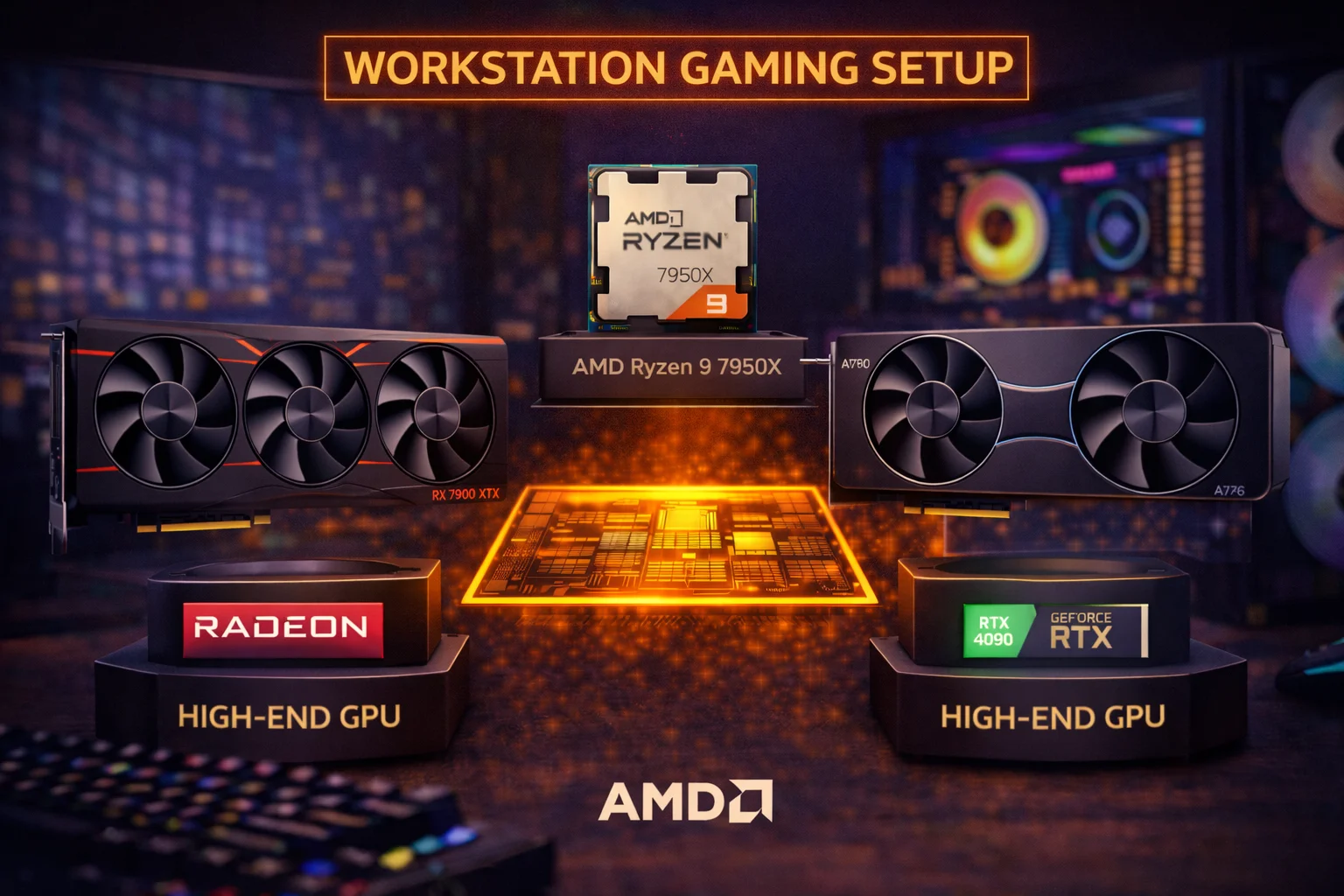
Quick Answer: The RX 7900 XTX (~$900) is the best GPU for Ryzen 9 7950X, offering excellent 4K performance with SAM benefits and 24GB VRAM for creative workloads. For NVIDIA workflows, the RTX 5080 (~$1,359) delivers maximum CUDA performance. Budget high-end builds can use the RTX 4070 Ti Super (~$800) with 0% bottleneck.
The AMD Ryzen 9 7950X is AMD’s productivity flagship—a 16-core, 32-thread monster designed for content creators, developers, and professionals who also want to game. With excellent multi-threaded performance and respectable single-threaded speeds, it handles video editing, 3D rendering, and streaming while still delivering solid gaming frame rates.
The 7950X isn’t the best pure gaming CPU—that crown belongs to the X3D processors. But for workstation builds that also game, it’s an excellent choice. The key is pairing it with a GPU that matches your workflow: AMD for SAM benefits and VRAM, NVIDIA for CUDA and professional applications. Use our Bottleneck Calculator to verify your specific pairing, or check expected frame rates with our FPS Calculator before purchasing.
This guide analyzes the best GPU options for your Ryzen 9 7950X across different budgets and use cases, with real-world bottleneck data to help you build the ultimate workstation gaming system.
Ryzen 9 7950X: Understanding AMD’s Productivity Champion
The Ryzen 9 7950X represents AMD’s highest core count in the mainstream AM5 platform. It’s designed for users who need massive multi-threaded performance for professional workloads while maintaining capable gaming performance.
Ryzen 9 7950X Specifications
- Architecture: AMD Zen 4
- Cores / Threads: 16 / 32
- Base Clock: 4.5 GHz
- Boost Clock: 5.7 GHz
- L3 Cache: 64 MB
- TDP: 170W
- Socket: AM5
- Memory Support: DDR5-5200
- PCIe: 5.0 x24
- Price: ~$425
Gaming Performance Reality Check
In pure gaming benchmarks, the 7950X is approximately 10-15% slower than the 7800X3D and 15-20% slower than the 9800X3D. This is because games rarely utilize all 16 cores—they benefit more from the massive L3 cache that X3D processors provide.
However, at 4K resolution, these differences shrink dramatically. The GPU becomes the limiting factor, and the 7950X delivers frame rates nearly identical to X3D processors. The gaming disadvantage primarily shows at 1440p and 1080p high-refresh scenarios.
Where the 7950X Excels
Video editing: 40-60% faster than X3D processors in Premiere Pro, DaVinci Resolve, and After Effects. The extra cores dramatically accelerate rendering and encoding.
3D rendering: Blender, Cinema 4D, and Maya benefit enormously from 16 cores. Render times can be half that of 8-core processors.
Streaming: CPU encoding at high quality while gaming remains smooth. The extra cores handle encoding without impacting gameplay.
Development: Compiling large codebases, running virtual machines, and containerized workflows all benefit from more cores.
Best GPU for Ryzen 9 7950X: Quick Recommendations
| Priority | Best GPU | Price | 1440p Bottleneck |
|---|---|---|---|
| Best AMD + SAM | RX 7900 XTX | $900 | 0% |
| Best NVIDIA | RTX 5080 | $1,359 | 0% |
| Value High-End | RTX 4080 Super | $1,100 | 0% |
| Creative Focus | RTX 4090 | $2,000+ | 0% |
| Budget High-End | RTX 4070 Ti Super | $800 | 0% |
| AMD Mid-Range | RX 7800 XT | $500 | 0% |
Best AMD + SAM: RX 7900 XTX
PowerColor Hellhound RX 7900 XTX
24GB GDDR6 | 384-bit | FSR 3 | PCIe 4.0 | 355W TDP
The ideal all-AMD pairing. 24GB VRAM for creative workloads. SAM provides 3-8% gaming boost. Excellent 4K gaming.
The AMD RX 7900 XTX is our top recommendation for all-AMD workstation gaming builds. At $900, it delivers excellent 4K gaming performance with SAM benefits, while the massive 24GB VRAM serves creative workloads exceptionally well.
For content creators, 24GB VRAM provides meaningful advantages. Video editing timelines with high-resolution footage, 3D scenes with complex textures, and GPU-accelerated effects all benefit from the extra memory. The 7900 XTX handles these workloads while also delivering excellent gaming.
Smart Access Memory adds 3-8% additional gaming performance—free performance just from staying within the AMD ecosystem. Combined with the 7950X’s productivity prowess, this creates a balanced workstation gaming system.
At 4K, expect 70-95 FPS in demanding AAA titles. With FSR 3 Frame Generation, push beyond 120 FPS in supported games. The 7950X handles the 7900 XTX without any bottleneck at this resolution.
RX 7900 XTX + 7950X Performance
| Game | 4K Ultra | 1440p Ultra | 4K + FSR |
|---|---|---|---|
| Cyberpunk 2077 | 78 FPS | 120 FPS | 115 FPS |
| Alan Wake 2 | 68 FPS | 100 FPS | 95 FPS |
| Hogwarts Legacy | 88 FPS | 135 FPS | 125 FPS |
| Starfield | 72 FPS | 105 FPS | 100 FPS |
| Call of Duty MW3 | 130 FPS | 200+ FPS | 180 FPS |
Why AMD GPU with 7950X
The 7950X is already an AMD processor, so pairing with an AMD GPU enables SAM. For workstation users, the RX 7900 XTX’s 24GB VRAM also matches common productivity needs. Unless you specifically need CUDA or NVENC, the all-AMD pairing offers excellent value.
Best NVIDIA: RTX 5080
NVIDIA GeForce RTX 5080 FE
16GB GDDR7 | 256-bit | DLSS 4 | PCIe 5.0 | 300W TDP
Maximum NVIDIA performance with DLSS 4. CUDA acceleration for creative apps. Excellent 4K gaming with no bottleneck.
The NVIDIA RTX 5080 is the best NVIDIA option for Ryzen 9 7950X builds. With Blackwell architecture, DLSS 4, and excellent CUDA performance, it delivers maximum gaming and creative acceleration for NVIDIA-dependent workflows.
For content creators using Adobe applications, DaVinci Resolve, or Blender with CUDA/OptiX, the RTX 5080 provides significant workflow advantages. NVENC encoding is superior for streaming and video export, and CUDA acceleration speeds up many professional applications.
At $1,359, the RTX 5080 is a premium investment. However, for professionals whose time has value, the productivity gains often justify the cost. The 7950X + RTX 5080 creates a capable workstation that also delivers outstanding gaming performance.
RTX 5080 + 7950X Performance
| Game | 4K Ultra | 4K + DLSS | 4K + RT |
|---|---|---|---|
| Cyberpunk 2077 | 95 FPS | 155 FPS | 85 FPS |
| Alan Wake 2 | 85 FPS | 140 FPS | 72 FPS |
| Hogwarts Legacy | 105 FPS | 175 FPS | 95 FPS |
| Spider-Man 2 | 110 FPS | 180 FPS | 100 FPS |
| Call of Duty MW3 | 155 FPS | 250+ FPS | 145 FPS |
Value High-End: RTX 4080 Super
ASUS TUF Gaming RTX 4080 Super
16GB GDDR6X | 256-bit | DLSS 3 | PCIe 4.0 | 320W TDP
Excellent 4K performance with DLSS 3. Strong CUDA for creative work. Better value than RTX 5080 if not needing latest.
The RTX 4080 Super offers excellent performance at $260 less than the RTX 5080. For workstation users who don’t need the absolute latest, it provides 85-90% of the 5080’s gaming performance with the same 16GB VRAM and excellent CUDA capabilities.
DLSS 3 is mature and widely supported. NVENC encoding quality matches the newer models. For most professional workflows, the 4080 Super delivers results indistinguishable from newer cards at a meaningful savings.
RTX 4080 Super + 7950X Performance
| Game | 4K Ultra | 4K + DLSS | 4K + RT |
|---|---|---|---|
| Cyberpunk 2077 | 78 FPS | 125 FPS | 68 FPS |
| Alan Wake 2 | 68 FPS | 110 FPS | 58 FPS |
| Hogwarts Legacy | 88 FPS | 145 FPS | 78 FPS |
| Spider-Man 2 | 92 FPS | 150 FPS | 82 FPS |
| Call of Duty MW3 | 130 FPS | 210 FPS | 120 FPS |
Creative Focus: RTX 4090
ASUS ROG Strix RTX 4090
24GB GDDR6X | 384-bit | DLSS 3 | PCIe 4.0 | 450W TDP
Maximum VRAM and CUDA performance. Best for professional 3D and video work. Overkill for pure gaming but unmatched for heavy creative workloads.
The RTX 4090 remains the ultimate choice for serious creative professionals. With 24GB VRAM and unmatched CUDA performance, it handles the most demanding 3D rendering, AI workloads, and video editing tasks. For professionals where GPU capability directly impacts income, the 4090 pays for itself.
For pure gaming, the 4090 is overkill—the 5080 or 4080 Super deliver excellent 4K performance at lower prices. But for workstation builds where 24GB VRAM and maximum CUDA cores matter, nothing else compares.
Budget High-End: RTX 4070 Ti Super
ASUS TUF Gaming RTX 4070 Ti Super
16GB GDDR6X | 256-bit | DLSS 3 | PCIe 4.0 | 285W TDP
Excellent 4K capable performance. 16GB VRAM handles most workloads. CUDA and NVENC for creators. Great value.
The RTX 4070 Ti Super delivers excellent performance at $800—creating 0% bottleneck with the 7950X. For workstation builds with moderate creative needs, it provides 16GB VRAM, full CUDA acceleration, and capable 4K gaming.
This pairing raises a question: if your GPU budget is under $800, would a 7800X3D or 9800X3D create a more balanced gaming build? For pure gaming, yes. But for workstation needs where the 7950X’s 16 cores matter, the 4070 Ti Super provides a budget-conscious GPU option.
RTX 4070 Ti Super + 7950X Performance
| Game | 4K Ultra | 4K + DLSS | 1440p Ultra |
|---|---|---|---|
| Cyberpunk 2077 | 58 FPS | 95 FPS | 95 FPS |
| Alan Wake 2 | 48 FPS | 82 FPS | 78 FPS |
| Hogwarts Legacy | 65 FPS | 108 FPS | 105 FPS |
| Spider-Man 2 | 68 FPS | 115 FPS | 110 FPS |
| Call of Duty MW3 | 95 FPS | 155 FPS | 165 FPS |
AMD Mid-Range: RX 7800 XT
PowerColor Hellhound RX 7800 XT
16GB GDDR6 | 256-bit | FSR 3 | PCIe 4.0 | 263W TDP
Excellent 1440p gaming with SAM benefits. 16GB VRAM for moderate creative work. Best value AMD option.
The RX 7800 XT creates 0% bottleneck with the 7950X while delivering excellent 1440p gaming and capable 4K performance. At $500, it’s the budget AMD option that still benefits from SAM while providing 16GB VRAM for creative workloads.
For workstation builds focused on productivity with moderate gaming, the 7800 XT provides excellent value. The savings versus higher-end GPUs can fund more RAM or storage for creative workflows.
Complete Build Example
Ultimate Workstation Gaming Build (~$3,500)
- CPU: Ryzen 9 7950X – $425
- GPU: RTX 5080 – $1,359
- Motherboard: X670E DDR5 – $350
- RAM: 64GB DDR5-6000 – $220
- Storage: 2TB NVMe Gen4 – $140
- PSU: 1000W 80+ Gold – $150
- Cooler: 360mm AIO – $180
- Case: Full-tower with airflow – $180
- Total: ~$3,004
This build delivers exceptional productivity performance with 16 cores, 64GB RAM, and RTX 5080 CUDA acceleration—plus outstanding 4K gaming with DLSS 4.
All-AMD Workstation Build (~$2,500)
- CPU: Ryzen 9 7950X – $425
- GPU: RX 7900 XTX – $900
- Motherboard: X670E DDR5 – $300
- RAM: 64GB DDR5-6000 – $220
- Storage: 2TB NVMe Gen4 – $140
- PSU: 1000W 80+ Gold – $150
- Cooler: 360mm AIO – $180
- Case: Full-tower with airflow – $150
- Total: ~$2,465
The all-AMD build saves $500+ while delivering SAM benefits and 24GB VRAM. Excellent for workflows not dependent on CUDA.
Frequently Asked Questions
The RX 7900 XTX (~$900) is the best GPU for Ryzen 9 7950X, offering excellent 4K performance with SAM benefits and 24GB VRAM for creative work. For NVIDIA, the RTX 5080 (~$1,359) delivers maximum performance with CUDA.
Good, but not the best. The 7950X is 10-15% slower than the 7800X3D in gaming. It excels for workstation + gaming builds where productivity matters. For pure gaming, choose X3D processors.
The 7950X3D offers 10-15% better gaming with similar productivity. However, it costs more. For pure productivity with good gaming, the 7950X offers better value. For gaming + productivity, the 7950X3D is superior.
Depends on workflow. AMD GPUs get SAM benefits (3-8% gaming boost). NVIDIA GPUs offer CUDA and NVENC for creative apps. Choose AMD for gaming value, NVIDIA for Adobe/DaVinci workflows.
A 1000W quality power supply is recommended. The 7950X draws up to 170W and the 7900 XTX draws up to 355W. A 1000W unit provides comfortable headroom for stability.
32GB minimum, 64GB recommended for heavy creative work. DDR5-6000 provides optimal performance. 64GB enables large video projects, 3D scenes, and running VMs alongside creative apps.
A 280mm or 360mm AIO is recommended. The 7950X runs hot at 170W TDP. Premium air coolers like Noctua NH-D15 work but run warmer than liquid cooling.
Yes, with 0% bottleneck. However, if your GPU budget is $800 or less, consider whether a 7800X3D might create a more balanced gaming build instead.
Conclusion
The Ryzen 9 7950X is AMD’s productivity champion, and it pairs best with high-end GPUs for workstation gaming builds. For all-AMD with SAM benefits, the RX 7900 XTX (~$900) delivers excellent 4K gaming with 24GB VRAM for creative workloads.
For NVIDIA workflows needing CUDA and NVENC, the RTX 5080 (~$1,359) offers maximum performance with DLSS 4. The RTX 4080 Super (~$1,100) provides excellent value for creators who don’t need the absolute latest.
The key insight: the 7950X is for workstation builds that also game, not gaming builds with some productivity. For pure gaming, the 7800X3D or 9800X3D offer 10-15% better performance at lower prices. Choose the 7950X when those 16 cores matter for your creative workflows.
Related Resources
- PC Bottleneck Calculator
- FPS Calculator
- Best GPU for Ryzen 9 9800X3D
- Best GPU for Ryzen 7 7800X3D
- Best CPU for RX 7900 XTX
- Best CPU for RTX 5080
Last Updated: February 2026