How Much Does a Terabyte Cost? Storage Pricing Explained

Whether you’re backing up family photos, building a media server, or expanding your gaming library, the first question is always the same: how much will storage actually cost me?
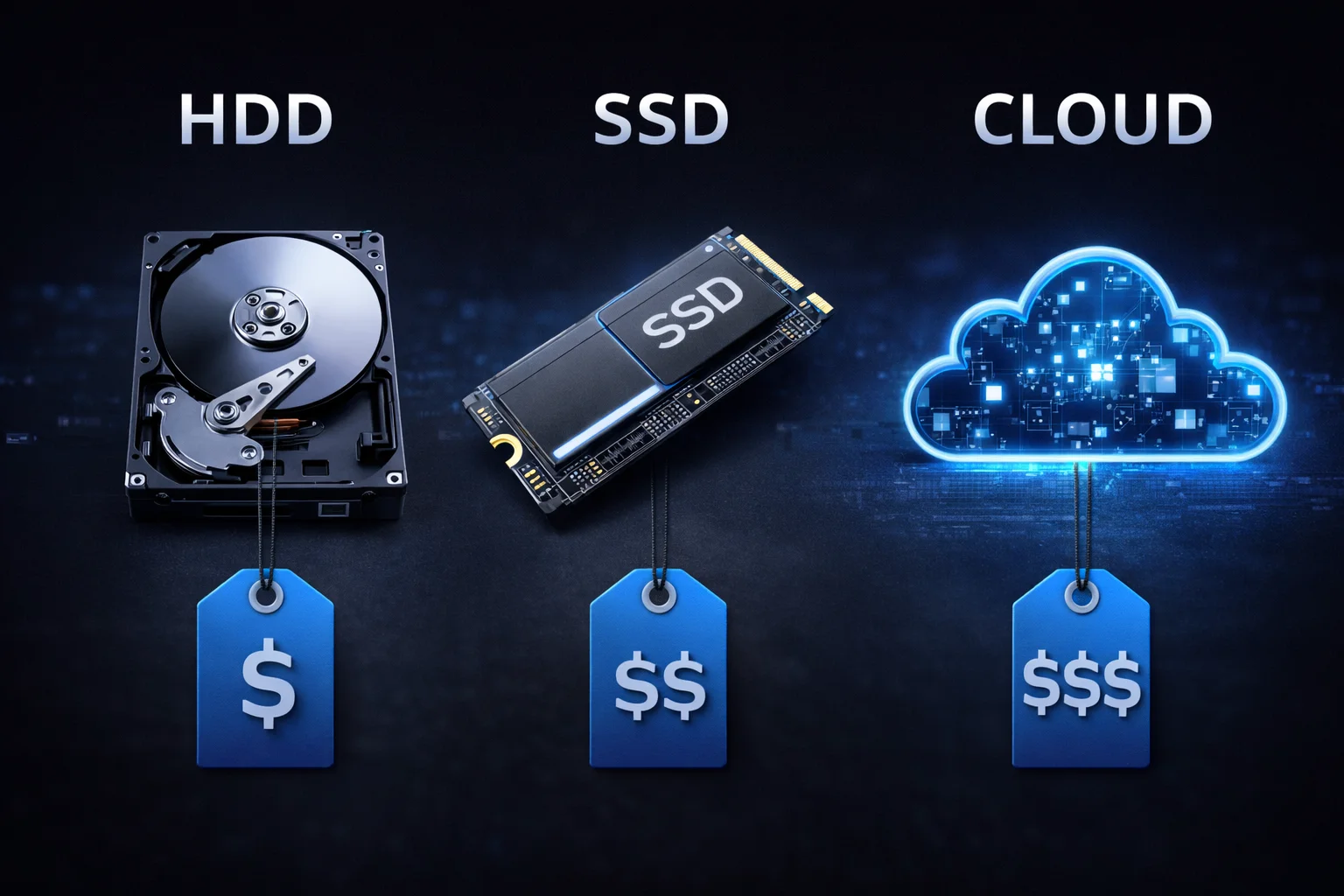
The answer depends entirely on what type of storage you choose. A terabyte of hard drive space might cost you $15, while the same capacity in a premium SSD could run $80 or more. Cloud storage? That’s a monthly commitment that adds up over time.
This guide breaks down exactly what you’ll pay for a terabyte of storage across every major option in 2026, so you can make the smartest choice for your budget and needs.
What Is a Terabyte?
Before diving into costs, let’s clarify what we’re measuring. A terabyte (TB) is a unit of digital storage equal to:
- 1,000 gigabytes (GB) using decimal notation (how manufacturers measure)
- 1,024 gigabytes (GB) using binary notation (how computers calculate)
This difference explains why your “1TB” drive shows only about 931GB of usable space in Windows—it’s not missing storage, just different math.
- 250,000+ photos (at 4MB average JPEG size)
- 500 hours of HD 1080p video
- 250 movies (at 4GB per film)
- 17,000 hours of music (MP3 format)
- 85 million Word documents
For most people, 1TB provides enough space for years of photos, a solid movie collection, and dozens of modern video games. It’s the sweet spot between “not enough” and “way more than I need.”
Current Terabyte Prices by Storage Type
Here’s what you’ll actually pay for a terabyte of storage in 2026:
| Storage Type | Price per TB | Best For |
|---|---|---|
| Internal HDD | $12–20 | Mass storage, NAS, backups |
| External HDD | $20–30 | Portable backup, media storage |
| Internal SATA SSD | $50–70 | Boot drives, general computing |
| Internal NVMe SSD | $60–90 | Gaming, video editing, fast workflows |
| External SSD | $70–100 | Portable fast storage |
| Cloud Storage | $36–120/year | Sync, backup, remote access |
These are typical prices for quality drives from reputable brands. You’ll find cheaper options, but reliability matters when your data is at stake.
Hard Drive (HDD) Costs Per Terabyte
Hard disk drives remain the most affordable option for bulk storage. If you need massive capacity without breaking the bank, HDDs are your answer.
Internal Hard Drives
Internal HDDs have hit historic lows in price per terabyte. Here’s what you can expect:
| Capacity | Typical Price | Price per TB |
|---|---|---|
| 2TB | $55–65 | $27–32 |
| 4TB | $75–95 | $19–24 |
| 8TB | $120–150 | $15–19 |
| 12TB | $180–220 | $15–18 |
| 16TB | $250–300 | $16–19 |
| 20TB | $350–400 | $17–20 |
The 8TB to 12TB range typically offers the lowest price per terabyte. Smaller drives (2TB-4TB) cost more per TB, while the largest drives (16TB+) carry a premium for cutting-edge capacity.
For NAS and server use, expect to pay a 20-30% premium for drives designed for 24/7 operation, like Seagate IronWolf or WD Red Plus. That extra cost buys you better reliability and longer warranties.
External Hard Drives
External HDDs cost slightly more than internal drives due to the enclosure and USB interface:
| Capacity | Typical Price | Price per TB |
|---|---|---|
| 1TB | $50–60 | $50–60 |
| 2TB | $65–80 | $32–40 |
| 4TB | $90–110 | $22–28 |
| 5TB | $110–130 | $22–26 |
| 8TB | $140–170 | $17–21 |
External drives make sense for backup and portable storage. The Seagate Expansion and WD Elements lines offer solid reliability at competitive prices.
SSD Costs Per Terabyte
Solid state drives cost more than HDDs but deliver dramatically faster performance. For your operating system, applications, and games, the speed difference is transformative.
SATA SSDs
SATA SSDs use the older interface but still offer massive speed improvements over hard drives:
| Capacity | Typical Price | Price per TB |
|---|---|---|
| 500GB | $40–50 | $80–100 |
| 1TB | $60–80 | $60–80 |
| 2TB | $100–140 | $50–70 |
| 4TB | $200–280 | $50–70 |
The Samsung 870 EVO remains a popular choice for SATA SSDs, offering excellent reliability and consistent performance. Budget options like the Crucial MX500 deliver similar real-world speeds for less.
NVMe SSDs
NVMe drives connect directly to PCIe lanes, delivering read speeds 5-7 times faster than SATA:
| Capacity | Typical Price | Price per TB |
|---|---|---|
| 500GB | $45–60 | $90–120 |
| 1TB | $70–100 | $70–100 |
| 2TB | $120–180 | $60–90 |
| 4TB | $250–350 | $62–88 |
Samsung 990 Pro 2TB
7,450 MB/s Read | PCIe 4.0 NVMe
Premium performance with excellent reliability. Ideal for gaming, content creation, and PS5 expansion.
For most users, PCIe Gen 4 NVMe drives hit the sweet spot of price and performance. Gen 5 drives exist but cost significantly more with minimal real-world benefit for typical workloads.
External SSDs
Portable SSDs have dropped considerably in price while speeds have increased:
| Capacity | Typical Price | Price per TB |
|---|---|---|
| 500GB | $55–70 | $110–140 |
| 1TB | $80–110 | $80–110 |
| 2TB | $130–180 | $65–90 |
| 4TB | $250–350 | $62–88 |
The Samsung T7 and SanDisk Extreme remain popular choices, offering USB 3.2 speeds up to 1,000 MB/s in pocket-sized enclosures.
Cloud Storage Costs Per Terabyte
Cloud storage works differently—you’re paying for ongoing access rather than a one-time purchase. Monthly fees add up, but you gain automatic backup, anywhere access, and no hardware to maintain.
Consumer Cloud Storage Pricing
Here’s what the major providers charge for approximately 1TB of storage:
| Provider | Plan | Monthly Cost | Annual Cost | Cost per TB/Year |
|---|---|---|---|---|
| Google One | 2TB | $9.99 | $99.99 | $50 |
| iCloud+ | 2TB | $9.99 | $119.88 | $60 |
| Dropbox Plus | 2TB | $11.99 | $119.88 | $60 |
| OneDrive | 1TB (with M365) | $6.99 | $69.99 | $70 |
| pCloud | 2TB | — | $99.99 | $50 |
| IDrive | 5TB | — | $69.65 | $14 |
Cloud storage is a recurring expense. Over 5 years, a $10/month plan costs $600—enough to buy a 4TB NVMe SSD or a 20TB hard drive outright. Consider whether you truly need cloud features or if local storage makes more financial sense.
Cloud Storage vs. Local Storage: 5-Year Cost Comparison
Let’s compare the total cost of ownership for 2TB of storage over five years:
| Option | Initial Cost | 5-Year Total | Notes |
|---|---|---|---|
| 2TB HDD | $65 | $65 | One-time purchase |
| 2TB SATA SSD | $120 | $120 | One-time purchase |
| 2TB NVMe SSD | $150 | $150 | One-time purchase |
| Google One 2TB | $0 | $500 | $100/year ongoing |
| Dropbox Plus 2TB | $0 | $600 | $120/year ongoing |
| iCloud+ 2TB | $0 | $600 | $120/year ongoing |
Cloud storage makes sense when you need remote access, automatic sync across devices, or off-site backup. For pure storage capacity, local drives offer dramatically better value.
Best Value Cloud Options
If you need cloud storage, these providers offer the best price per terabyte:
IDrive — $69.65/year for 5TB ($14/TB) with device backup included. Best overall value for personal cloud backup.
pCloud — $99.99/year for 2TB, or $399 lifetime for 2TB. The lifetime plan breaks even after 4 years versus annual billing.
Google One — $99.99/year for 2TB with family sharing for up to 5 people. Best value if you’re already in Google’s ecosystem.
What Affects Storage Prices?
Several factors influence how much you’ll pay per terabyte:
Technology Type
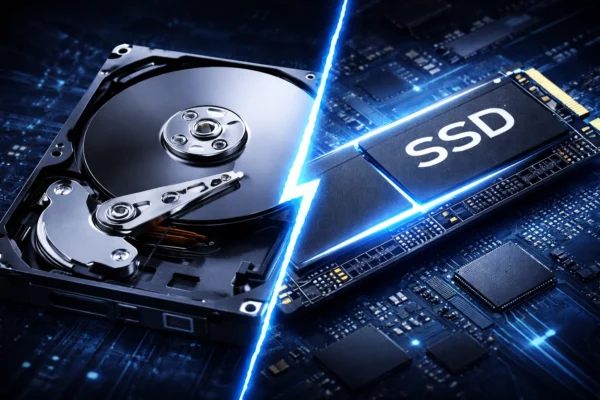
The underlying technology creates the biggest price differences. HDDs use spinning magnetic platters—mature, cheap technology. SSDs use flash memory chips—faster but more expensive to manufacture. The gap has narrowed significantly, but HDDs still win on raw $/TB.
Capacity
Larger drives typically offer better price per TB, up to a point. The sweet spots are:
Very large drives (16TB+ HDDs, 8TB SSDs) often carry premiums as cutting-edge products.
Performance Tier
Within each category, performance affects pricing:
- HDDs: 5400 RPM drives cost less than 7200 RPM
- SSDs: QLC flash costs less than TLC; TLC costs less than MLC
- NVMe: Gen 3 costs less than Gen 4; Gen 4 costs less than Gen 5
For most users, mid-tier options deliver the best balance of performance and value.
Brand and Warranty
Premium brands like Samsung and Western Digital command higher prices but typically offer better reliability and longer warranties. Budget brands save money upfront but may cost more in the long run if drives fail prematurely.
Market Conditions
Storage prices fluctuate based on:
- NAND flash supply and demand
- New technology releases
- Seasonal sales (Black Friday, Prime Day)
- Manufacturing disruptions
Timing your purchase around major sales can save 20-30% on the same drive.
How Much Storage Do You Actually Need?
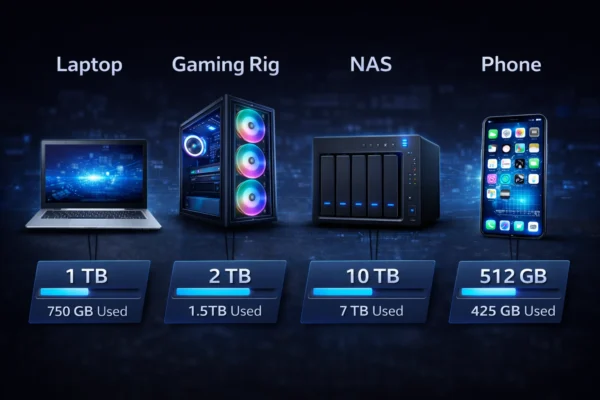
Before obsessing over price per TB, consider whether you need that capacity at all:
Light Users (500GB–1TB)
- Basic documents and spreadsheets
- A few thousand photos
- Light gaming (5-10 installed games)
- Streaming media (not local storage)
Recommendation: 1TB SATA or NVMe SSD ($60–80)
Average Users (1TB–2TB)
- Large photo libraries
- Some local video content
- Moderate gaming (10-20 games)
- Work files and projects
Recommendation: 2TB NVMe SSD ($120–150)
Power Users (4TB+)
- Professional photo/video work
- Large game libraries (50+ titles)
- Local media server
- Content creation workflows
Recommendation: 2TB NVMe SSD for speed + 8TB+ HDD for bulk storage
Data Hoarders (10TB+)
- Massive media collections
- Full system backups
- NAS or home server
- Video production archives
Recommendation: Multiple large HDDs in RAID or NAS configuration
Most users benefit from combining a smaller SSD (for speed) with a larger HDD (for capacity). A 1TB NVMe boot drive plus a 4TB HDD for storage costs around $150 total and gives you the best of both worlds.
Finding the Best Storage Deals
Storage prices change constantly. Here’s how to get the best value:
Track Prices Over Time
Use price tracking tools like Storage Disk Prices, CamelCamelCamel (Amazon) or PCPartPicker to see historical pricing and set alerts for price drops.
Buy During Sales Events
The best storage deals typically appear during:
- Black Friday/Cyber Monday (November)
- Amazon Prime Day (July)
- Back-to-school sales (August)
- End-of-year clearance (December)
Discounts of 25-40% are common on popular drives during these events.
Consider Previous Generation
Last-generation products often offer excellent value. A Gen 3 NVMe SSD costs less than Gen 4 while still delivering speeds that saturate most real-world workloads.
Compare Price Per TB
Always calculate the actual price per terabyte when comparing drives. A $200 4TB drive ($50/TB) is a better value than a $90 1TB drive ($90/TB), assuming you can use the extra capacity.
Frequently Asked Questions
For most people, yes. 1TB holds hundreds of games, thousands of photos, and plenty of documents. However, if you work with video or have large media libraries, you’ll likely want 2TB or more.
SSDs use NAND flash memory chips, which cost more to manufacture than the magnetic platters in HDDs. The price gap has shrunk dramatically—SSDs cost 10x more per TB a decade ago versus roughly 4x today.
Cloud storage makes sense for automatic backup, cross-device sync, and remote access. If you just need local storage capacity, buying a drive is far more cost-effective over time.
HDDs typically last 3-5 years with regular use. SSDs can last 5-10 years under normal conditions, as they have no moving parts to wear out. Both can fail earlier or last longer depending on usage and luck.
Multiple drives offer redundancy—if one fails, you don’t lose everything. For critical data, a two-drive setup (even without RAID) provides better protection than a single large drive.
The Bottom Line
Here’s the quick summary of what a terabyte costs in 2026:
- Cheapest option: Internal HDD at $12–20 per TB
- Best value for speed: NVMe SSD at $60–90 per TB
- Portable storage: External SSD at $70–100 per TB
- Cloud storage: $36–120 per year per TB (ongoing)
For most users, a 2TB NVMe SSD in the $120–150 range offers the best combination of speed, capacity, and value. If you need bulk storage for media or backups, supplement with an 8TB+ HDD at under $20 per terabyte.
The best time to buy storage is during major sales events, but prices are already at historic lows. Whatever you choose, the cost of a terabyte has never been more affordable.
Compare current storage prices and find the best deals →
Last Updated: February 2026