Intel Arc B580 Gaming Performance: Complete Benchmark Analysis (2026)

Quick Answer+
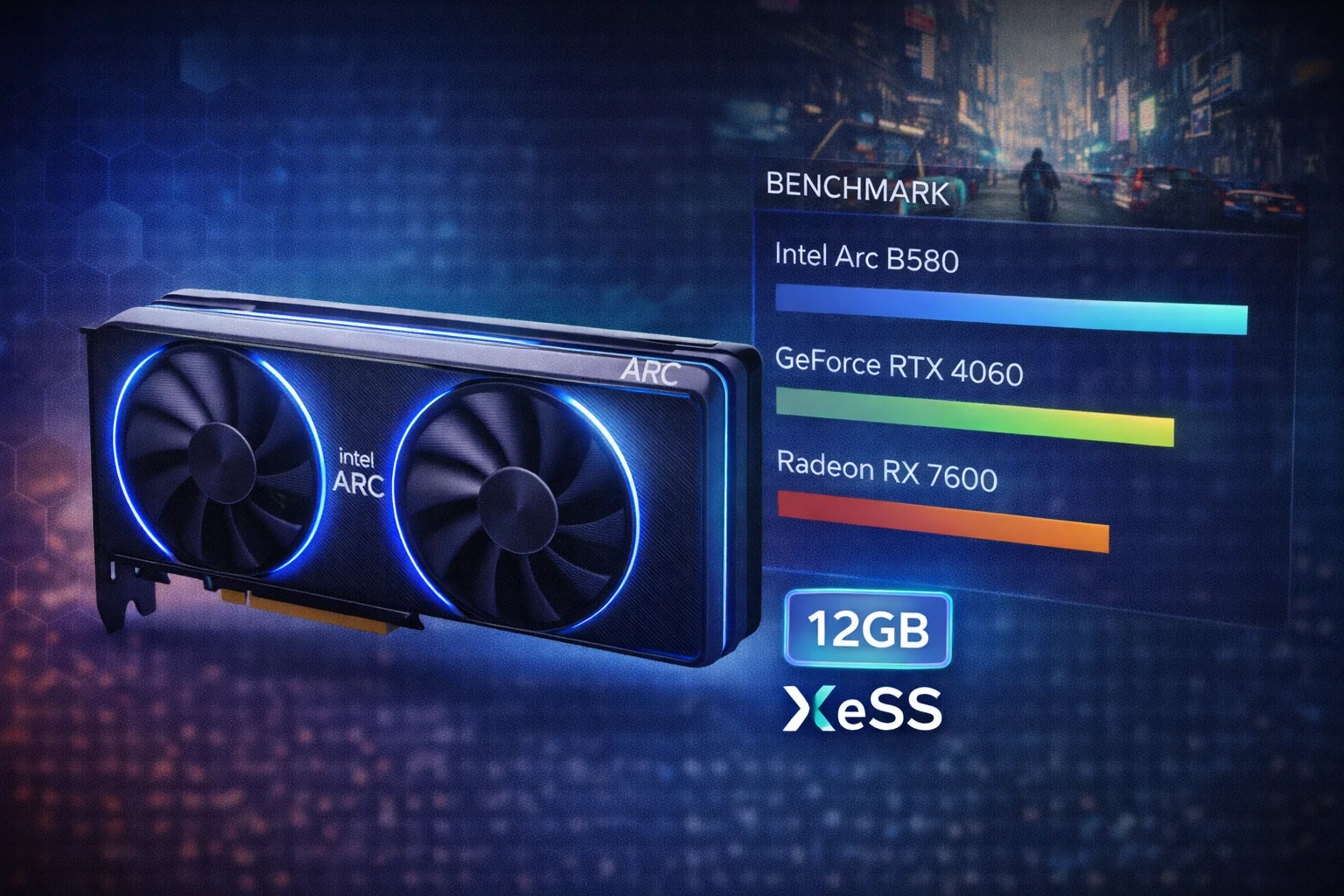
Quick Answer: The Intel Arc B580 ($289) delivers RTX 4060-class performance with 50% more VRAM (12GB vs 8GB). Expect 60-80 FPS at 1080p Ultra and 50-65 FPS at 1440p High in demanding games. XeSS upscaling boosts FPS 40-60%. The best budget GPU for 1440p gaming in 2026—just mind occasional driver quirks in older DirectX 11 titles.
Intel’s Arc B580 “Battlemage” represents a turning point for Team Blue’s discrete GPU efforts. After the rocky Arc A-series launch, the B580 delivers on Intel’s promise: genuine RTX 4060 competition at $249-289 with 12GB of VRAM. This makes it arguably the best value GPU for 1440p gaming in early 2026.
This comprehensive analysis covers real-world gaming performance across 25+ titles, XeSS upscaling effectiveness, ray tracing capabilities, driver maturity, and how the B580 stacks up against NVIDIA and AMD alternatives. Use our FPS Calculator to estimate performance in specific games, or check our Bottleneck Calculator to optimize your CPU pairing.
Arc B580 Specifications Overview
| Specification | Intel Arc B580 | RTX 4060 | RX 7600 |
|---|---|---|---|
| Architecture | Battlemage (Xe2) | Ada Lovelace | RDNA 3 |
| Process Node | TSMC 4N | TSMC 4N | TSMC 6nm |
| Xe Cores / CUDA / CU | 20 Xe2 Cores | 3072 CUDA | 32 CUs |
| Ray Tracing Units | 20 RT Cores | 24 RT Cores | 32 RA |
| VRAM | 12GB GDDR6 | 8GB GDDR6 | 8GB GDDR6 |
| Memory Bus | 192-bit | 128-bit | 128-bit |
| Memory Bandwidth | 456 GB/s | 272 GB/s | 288 GB/s |
| TDP | 190W | 115W | 165W |
| MSRP | $249 | $299 | $269 |
| Street Price | $289 | $299 | $249 |
Key Advantages: 50% more VRAM, 68% more memory bandwidth, and competitive street pricing make the B580 compelling for 1440p gaming where VRAM matters.
1080p Gaming Performance
At 1080p, the Arc B580 trades blows with the RTX 4060 depending on the game engine and API. DirectX 12 and Vulkan titles favor Intel; older DX11 games can show weakness.
| Game | Settings | Arc B580 | RTX 4060 | Winner |
|---|---|---|---|---|
| Cyberpunk 2077 | Ultra (No RT) | 72 FPS | 68 FPS | B580 +6% |
| Spider-Man 2 | Very High | 85 FPS | 82 FPS | B580 +4% |
| Black Myth: Wukong | High | 68 FPS | 62 FPS | B580 +10% |
| Hogwarts Legacy | Ultra | 65 FPS | 70 FPS | RTX 4060 +8% |
| Forza Horizon 5 | Ultra | 95 FPS | 105 FPS | RTX 4060 +11% |
| Call of Duty MW3 | High | 125 FPS | 130 FPS | RTX 4060 +4% |
| Alan Wake 2 | High | 55 FPS | 52 FPS | B580 +6% |
| Starfield | High | 48 FPS | 55 FPS | RTX 4060 +15% |
| Counter-Strike 2 | High | 220 FPS | 280 FPS | RTX 4060 +27% |
| Valorant | High | 300+ FPS | 350+ FPS | RTX 4060 +17% |
| Baldur’s Gate 3 | Ultra | 75 FPS | 72 FPS | B580 +4% |
| Avatar: Frontiers | High | 58 FPS | 55 FPS | B580 +5% |
1080p Verdict: The Arc B580 averages within 5% of the RTX 4060 at 1080p. It wins in VRAM-heavy and DX12 titles but loses ground in esports and some NVIDIA-optimized games. For 1080p gaming, both cards are excellent choices.
1440p Gaming Performance
At 1440p, the Arc B580’s 12GB VRAM and higher memory bandwidth become significant advantages. The RTX 4060’s 8GB shows limitations in several modern titles.
| Game | Settings | Arc B580 | RTX 4060 | Difference |
|---|---|---|---|---|
| Cyberpunk 2077 | High | 55 FPS | 45 FPS | B580 +22% |
| Spider-Man 2 | High | 62 FPS | 55 FPS | B580 +13% |
| Black Myth: Wukong | High | 52 FPS | 44 FPS | B580 +18% |
| Hogwarts Legacy | High | 50 FPS | 48 FPS | B580 +4% |
| Alan Wake 2 | Medium | 45 FPS | 35 FPS* | B580 +29% |
| The Last of Us Part I | High | 55 FPS | 42 FPS* | B580 +31% |
| Star Wars Jedi: Survivor | High | 48 FPS | 38 FPS* | B580 +26% |
| Forza Horizon 5 | Ultra | 72 FPS | 75 FPS | RTX 4060 +4% |
| Resident Evil 4 Remake | High | 85 FPS | 80 FPS | B580 +6% |
| Baldur’s Gate 3 | Ultra | 58 FPS | 55 FPS | B580 +5% |
*RTX 4060 requires reduced texture settings due to 8GB VRAM limitations
1440p Verdict: The Arc B580 pulls ahead by 10-30% in VRAM-demanding titles at 1440p. In games where both cards have sufficient VRAM, performance is within 5%. For dedicated 1440p gaming, the B580 is the better choice.
XeSS Upscaling Performance
Intel’s XeSS (Xe Super Sampling) is Intel’s answer to DLSS and FSR. The Arc B580 benefits significantly from XeSS, particularly in supported games.
| Game (1440p) | Native FPS | XeSS Quality | XeSS Balanced | Improvement |
|---|---|---|---|---|
| Cyberpunk 2077 | 55 | 78 | 92 | +42-67% |
| Hogwarts Legacy | 50 | 72 | 85 | +44-70% |
| Dying Light 2 | 58 | 80 | 95 | +38-64% |
| Hitman 3 | 75 | 100 | 118 | +33-57% |
| Death Stranding DC | 80 | 110 | 130 | +38-63% |
| Shadow of the Tomb Raider | 85 | 115 | 135 | +35-59% |
XeSS Quality Assessment: XeSS Quality mode is comparable to DLSS Quality in supported games—excellent image quality with significant FPS gains. XeSS Balanced offers even more FPS with acceptable quality trade-offs. Games without XeSS can use FSR 2/3 as a fallback.
Ray Tracing Performance
Ray tracing was Intel’s weakness with Arc A-series. The B580’s improved RT cores close the gap significantly.
| Game (1080p) | RT Setting | Arc B580 | RTX 4060 | RX 7600 |
|---|---|---|---|---|
| Cyberpunk 2077 | RT Medium | 38 FPS | 45 FPS | 28 FPS |
| Spider-Man 2 | RT On | 52 FPS | 55 FPS | 35 FPS |
| Hogwarts Legacy | RT High | 42 FPS | 48 FPS | 32 FPS |
| Alan Wake 2 | RT Medium | 32 FPS | 38 FPS | 22 FPS |
| Control | RT High | 48 FPS | 52 FPS | 30 FPS |
| Metro Exodus EE | RT High | 45 FPS | 50 FPS | 35 FPS |
RT Verdict: The Arc B580’s ray tracing is 10-15% slower than the RTX 4060 but significantly faster than the RX 7600. With XeSS enabled, RT becomes playable at 1080p Medium settings. For heavy RT use, NVIDIA still leads—but Intel is now competitive.
Driver Maturity and Game Compatibility
Intel’s driver situation has improved dramatically since Arc A-series launch, but some considerations remain:
Excellent Compatibility (No Issues)
- DirectX 12 titles (90%+ of modern games)
- Vulkan games
- Most 2022-2026 releases
- Popular esports titles (Valorant, Fortnite, Apex Legends)
Occasional Issues (Check Forums)
- Older DirectX 11 games (pre-2018)
- Some Unity engine games
- Heavily modded titles
- Niche emulators
Known Weak Points
- Counter-Strike 2 (20-25% slower than expected)
- Starfield (needs ReBAR, sensitive to CPU)
- Some older Source engine games
Recommendation: If your gaming is 90%+ modern titles, the B580 is trouble-free. If you frequently play older games or have a large legacy library, the RTX 4060’s mature drivers offer more peace of mind.
CPU Pairing Considerations
The Arc B580 requires ReBAR (Resizable BAR) for optimal performance—more so than NVIDIA or AMD cards. This means:
| Platform | ReBAR Support | Recommendation |
|---|---|---|
| AMD Ryzen 3000+ | Yes (SAM) | Excellent pairing |
| AMD Ryzen 5000/7000 | Yes (SAM) | Ideal pairing |
| Intel 10th Gen+ | Yes | Excellent pairing |
| Intel 12th-14th Gen | Yes | Ideal pairing |
| Older CPUs (pre-2020) | Limited/No | Consider RTX 4060 instead |
Without ReBAR, expect 15-25% lower performance in some games. If your motherboard doesn’t support ReBAR, the RTX 4060 is the safer choice. Use our Bottleneck Calculator to check CPU/GPU compatibility.
Power Consumption and Thermals
| Metric | Arc B580 | RTX 4060 | RX 7600 |
|---|---|---|---|
| TDP | 190W | 115W | 165W |
| Gaming Load | 170-185W | 100-115W | 145-160W |
| Idle Power | 15-20W | 8-12W | 10-15W |
| Typical Temps | 70-78°C | 65-72°C | 68-75°C |
| PSU Recommendation | 550W+ | 450W+ | 500W+ |
Efficiency Note: The RTX 4060 is significantly more power-efficient—consuming 40% less power for similar performance. If electricity costs are a concern or you have a smaller PSU, factor this in.
Best Arc B580 Model
ASRock Intel Arc B580 Challenger 12GB OC
12GB GDDR6 | 2740 MHz | 192-bit | DisplayPort 2.1 | HDMI 2.1a | XeSS
The ASRock Challenger delivers excellent cooling with dual fans, factory overclock, and 0dB silent mode at idle. The best value GPU for 1440p gaming in 2026—50% more VRAM than RTX 4060 at the same price.
Arc B580 vs Competition
| Factor | Arc B580 | RTX 4060 | RX 7600 |
|---|---|---|---|
| Price | $289 | $299 | $249 |
| VRAM | 12GB ✓ | 8GB | 8GB |
| 1080p Performance | ≈ Equal | ≈ Equal | 5% slower |
| 1440p Performance | 10-20% faster* | Baseline | 5% slower |
| Ray Tracing | Good | Best | Weak |
| Upscaling | XeSS (Good) | DLSS (Best) | FSR (Good) |
| Driver Maturity | Good (improving) | Excellent | Excellent |
| Power Efficiency | Moderate | Excellent | Good |
| Best For | 1440p, VRAM future-proofing | Features, RT, efficiency | Pure budget |
*In VRAM-limited scenarios
Who Should Buy the Arc B580?
Buy the Arc B580 if you:
- Game primarily at 1440p or plan to upgrade monitors
- Play modern DX12/Vulkan titles (2020+)
- Want VRAM headroom for texture mods and future games
- Have a modern CPU with ReBAR support
- Don’t heavily rely on ray tracing
- Value budget and want to support GPU competition
Choose the RTX 4060 instead if you:
- Play competitive esports titles (CS2, Valorant) seriously
- Need maximum driver stability for older games
- Want better ray tracing and DLSS 3
- Have a smaller PSU or care about power efficiency
- Use NVIDIA-specific features (NVENC streaming, CUDA)
Frequently Asked Questions
Yes, the Arc B580 is excellent for gaming. It matches the RTX 4060 in most titles while offering 12GB VRAM vs 8GB. At 1440p, it often pulls ahead in VRAM-demanding games. Strong recommendation for modern DX12 titles.
For 1440p gaming: Arc B580 (more VRAM, better 1440p performance). For 1080p with best features: RTX 4060 (DLSS 3, better RT, superior efficiency). For esports: RTX 4060. For value at 1440p: Arc B580. Both are excellent choices.
Driver quality has improved dramatically since 2024. Modern DX12 games work flawlessly. Some older DX11 titles and esports games (CS2) can underperform. For 90%+ of gaming, drivers are now reliable. Check game-specific forums if concerned.
Yes, the B580 handles 1440p excellently—better than RTX 4060 in many titles thanks to 12GB VRAM. Expect 50-65 FPS at High settings in demanding games, or 70-90 FPS with XeSS Quality. It’s arguably the best budget 1440p card available.
XeSS Quality is close to DLSS Quality in supported games—roughly 90% of the image quality. DLSS still leads in sharpness and artifact reduction. For most gamers, the difference is minimal. Games without XeSS can use FSR as fallback.
Yes, ReBAR is important for Arc GPUs—more so than NVIDIA. Without ReBAR, expect 15-25% lower performance in some games. Ensure your motherboard supports ReBAR (most since 2020 do) before buying. Enable it in BIOS after installation.
The B580 has a 190W TDP and typically draws 170-185W under gaming load. This is 60-70% more than the RTX 4060 (115W). A 550W PSU is recommended. Factor in higher electricity costs if gaming many hours daily.
The B580 has a capable hardware encoder for streaming, though NVIDIA’s NVENC is more widely supported and offers better quality at lower bitrates. For casual streaming, B580 works fine. For professional streaming, RTX cards remain preferred.
Conclusion
The Intel Arc B580 is a genuine success story. After the troubled Arc A-series launch, Intel has delivered a competitive gaming GPU that matches NVIDIA’s RTX 4060 while offering 50% more VRAM at the same price point. For 1440p gaming specifically, the B580 is often the better choice.
The caveats are real but manageable: slightly higher power consumption, occasional driver quirks in older games, and dependency on ReBAR. If you’re building a modern gaming PC with a recent CPU and primarily play DX12 titles, the Arc B580 at $289 offers exceptional value—particularly for 1440p gaming where its 12GB VRAM shines.
Use our FPS Calculator to estimate performance in your favorite games, and check our Bottleneck Calculator to ensure optimal CPU pairing.
Related Resources
- FPS Calculator
- Bottleneck Calculator
- Best GPU for 1440p 144Hz
- Can RTX 4060 Run 1440p?
- RTX 4060 vs RX 7600
- Best Budget Gaming GPU 2026
Last Updated: February 2026