NAP TS-264 vs Synology DS224+: Which 2-Bay NAS Wins in 2026?

Quick Answer+
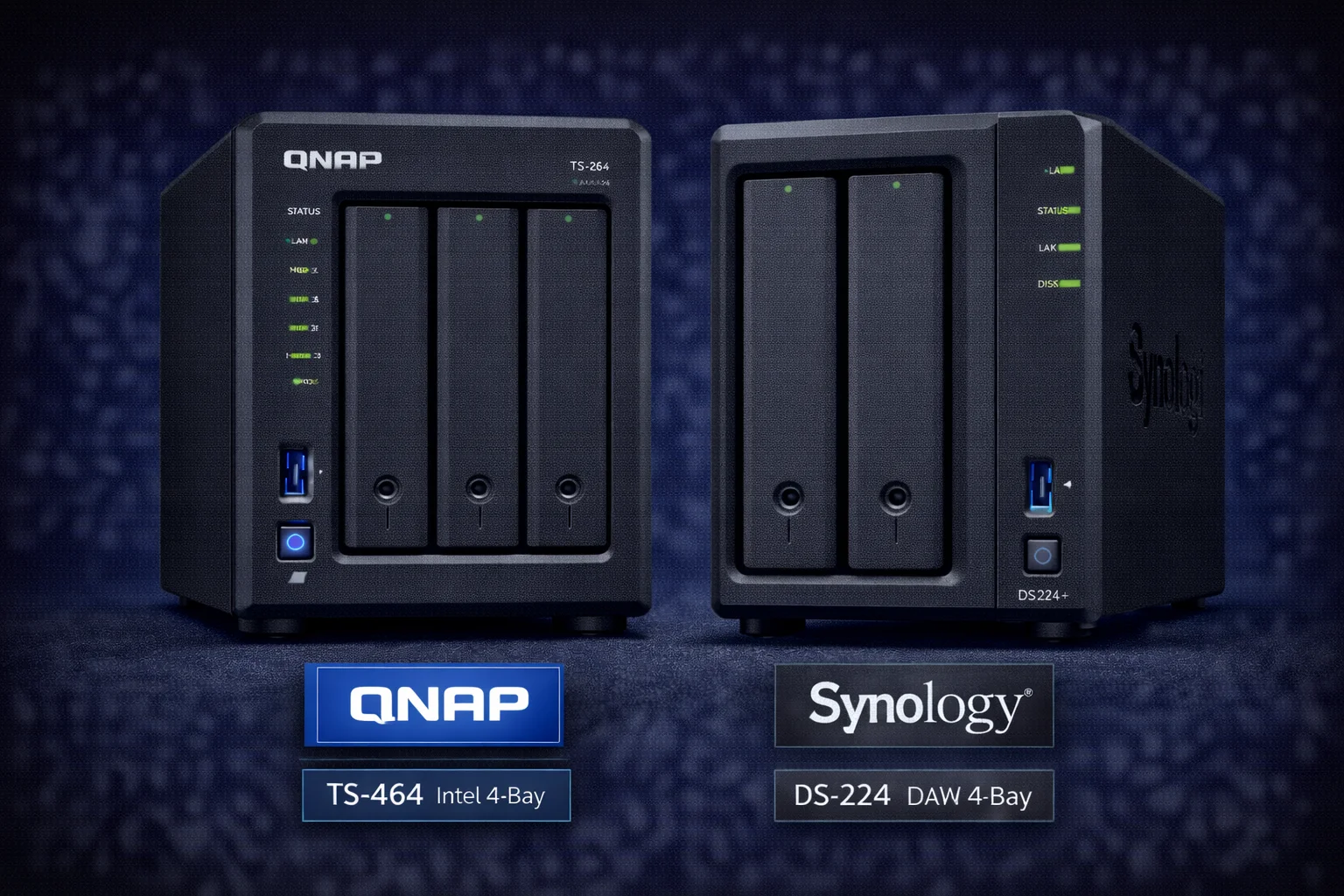
Quick Answer: The QNAP TS-264 ($449) offers better hardware: faster CPU, 4x more RAM (8GB vs 2GB), dual 2.5GbE, and HDMI output. The Synology DS224+ ($299) offers polished software, superior mobile apps, and better security track record. Choose TS-264 for hardware value and Docker. Choose DS224+ for ease of use and mobile experience. Verdict: TS-264 for power users; DS224+ for simplicity seekers.
The QNAP TS-264 and Synology DS224+ are the two leading 2-bay NAS units in 2026, each representing their brand’s approach to home storage. Both feature Intel processors with hardware transcoding and M.2 NVMe slots. But despite similar positioning, they differ significantly in hardware specs, software philosophy, and day-to-day experience. This comprehensive comparison helps you choose the right NAS ecosystem.
Quick Verdict
Choose the QNAP TS-264 if: You want more hardware for your money (faster CPU, 4x more RAM, dual 2.5GbE, HDMI), prioritize flexibility and customization, plan to run many Docker containers or VMs, or don’t mind a steeper learning curve.
Choose the Synology DS224+ if: You value polished, intuitive software that just works, want the best mobile apps in the business, prefer a simpler setup experience, prioritize ecosystem stability over raw specs, or need Synology’s excellent Hyper Backup for offsite backups.
Specifications Comparison
| Specification | QNAP TS-264 | Synology DS224+ |
|---|---|---|
| Price | $449 | $299 |
| CPU | Intel Celeron N5105 (4-core, 2.0-2.9GHz) | Intel Celeron J4125 (4-core, 2.0-2.7GHz) |
| CPU Generation | 10nm Jasper Lake (2021) | 14nm Gemini Lake Refresh (2019) |
| RAM (Default) | 8GB DDR4 | 2GB DDR4 |
| Max RAM | 16GB | 6GB |
| Drive Bays | 2x 3.5″/2.5″ SATA | 2x 3.5″/2.5″ SATA |
| M.2 Slots | 2x M.2 2280 NVMe PCIe Gen3 | 2x M.2 2280 NVMe |
| Network | 2x 2.5GbE | 2x 1GbE |
| USB Ports | 2x USB 3.2 Gen 2 (10Gbps) | 2x USB 3.2 Gen 1 (5Gbps) |
| HDMI | 1x HDMI 2.0 (4K 60Hz) | None |
| Hardware Transcoding | Yes (Intel Quick Sync) | Yes (Intel Quick Sync) |
| Virtualization | Yes (Virtualization Station) | Yes (Virtual Machine Manager) |
| Power Consumption | ~15W idle, ~25W active | ~14W idle, ~23W active |
| Operating System | QTS 5.x | DSM 7.x |
| Warranty | 2 years | 2 years |
Hardware summary: The TS-264 costs $150 more but delivers substantially better hardware: faster CPU, 4x the default RAM, higher max RAM, dual 2.5GbE vs 1GbE, faster USB, and HDMI output. The DS224+ can’t match these specs at any price — the question is whether you need them.
Processor Comparison: N5105 vs J4125
Both use Intel Celeron processors with Quick Sync transcoding, but the TS-264’s N5105 is a generation newer.
Intel Celeron N5105 (TS-264)
- Architecture: 10nm Jasper Lake (2021)
- Cores/Threads: 4 cores, 4 threads
- Clock Speed: 2.0GHz base, 2.9GHz boost
- Graphics: Intel UHD Graphics (24 EUs)
- TDP: 10W
Intel Celeron J4125 (DS224+)
- Architecture: 14nm Gemini Lake Refresh (2019)
- Cores/Threads: 4 cores, 4 threads
- Clock Speed: 2.0GHz base, 2.7GHz boost
- Graphics: Intel UHD Graphics 600 (12 EUs)
- TDP: 10W
CPU Benchmark Comparison
| Benchmark | TS-264 (N5105) | DS224+ (J4125) | Advantage |
|---|---|---|---|
| Geekbench 5 Single | ~870 | ~660 | TS-264 32% faster |
| Geekbench 5 Multi | ~2,800 | ~2,200 | TS-264 27% faster |
| PassMark CPU | ~4,700 | ~3,400 | TS-264 38% faster |
| 7-Zip Compression | ~8,500 MIPS | ~6,200 MIPS | TS-264 37% faster |
| Quick Sync Quality | Excellent | Very Good | TS-264 slight edge |
| Transcoding Efficiency | Better (more EUs) | Good | TS-264 for heavy loads |
The N5105 is approximately 30-35% faster than the J4125 in most workloads. Both handle typical NAS tasks well, but the TS-264 has more headroom for demanding workloads and multi-tasking.
Memory: The Hardware Gap
| RAM Spec | TS-264 | DS224+ |
|---|---|---|
| Default RAM | 8GB DDR4 | 2GB DDR4 |
| Maximum RAM | 16GB | 6GB |
| Upgrade Cost | ~$50 (to 16GB) | ~$35 (to 6GB) |
| Post-Upgrade Total | 16GB | 6GB |
The TS-264 ships with 4x more RAM and supports 2.6x more maximum RAM. This significantly affects Docker containers (TS-264 runs 10+, DS224+ limited to 3-4), virtual machines (meaningful on TS-264, barely usable on DS224+), and multi-user performance.
Network Performance
TS-264: Dual 2.5GbE
- 2.5x faster: ~280 MB/s vs ~112 MB/s per connection
- Link aggregation: Combine for failover or multi-user bandwidth
- Future-proof: 2.5GbE switches now affordable ($50-80)
DS224+: Dual 1GbE
- Standard speed: ~112 MB/s per connection
- Link aggregation: Available but limited benefit at 1Gbps
- Universal compatibility: Works with any network
Transfer Speed Comparison
| Scenario | TS-264 | DS224+ |
|---|---|---|
| Large file transfer | ~280 MB/s | ~112 MB/s |
| Transfer 100GB | ~6 minutes | ~15 minutes |
| Transfer 1TB | ~60 minutes | ~2.5 hours |
| Multi-user (3 streams) | ~240 MB/s total | ~100 MB/s total |
If you regularly transfer large files, the 2.5GbE advantage is significant. For basic use (streaming, backup overnight), 1GbE is perfectly adequate.
Plex Media Server Comparison
Both units feature Intel Quick Sync for hardware transcoding, making them excellent Plex servers.
| Plex Scenario | TS-264 | DS224+ |
|---|---|---|
| 4K HDR → 1080p (1 stream) | ✅ Smooth (~15% CPU) | ✅ Smooth (~20% CPU) |
| 4K HDR → 1080p (2 streams) | ✅ Smooth (~30% CPU) | ✅ Smooth (~45% CPU) |
| 4K HDR → 1080p (3 streams) | ✅ Smooth (~45% CPU) | ⚠️ Occasional stutter (~70% CPU) |
| 4K Direct Play (5+ streams) | ✅ Excellent | ✅ Excellent |
| HDR Tone Mapping | ✅ Full support | ✅ Full support |
| Subtitle Burn-in | ✅ Hardware accelerated | ✅ Hardware accelerated |
Plex verdict: Both are excellent Plex servers. The TS-264 has more headroom for simultaneous transcodes (3+ streams), while the DS224+ handles 1-2 streams with ease. For typical household use, both perform well. Heavy Plex users with multiple remote streams should favor the TS-264.
Software: QTS vs DSM
Software is where these NAS units differ most dramatically. Each represents a distinct philosophy.
QNAP QTS 5.x
Philosophy: Maximum features and flexibility, power-user focused.
- Pros: More features, more customization, more settings to tweak
- Pros: Better Docker integration (Container Station is excellent)
- Pros: HDMI output with HD Station for direct TV connection
- Pros: More aggressive feature development
- Cons: Interface can feel cluttered
- Cons: Steeper learning curve
- Cons: Mobile apps less polished than Synology
- Cons: Historical security concerns (improved, but reputation lingers)
Synology DSM 7.x
Philosophy: Simplicity, reliability, polish over features.
- Pros: Beautiful, intuitive interface that just works
- Pros: Best-in-class mobile apps (DS file, DS photo, DS cam)
- Pros: Excellent documentation and community support
- Pros: Rock-solid stability and security track record
- Pros: Hyper Backup is exceptional for offsite backups
- Cons: Fewer features than QTS
- Cons: Less customization possible
- Cons: Docker support more limited (Container Manager)
App Ecosystem Comparison
| Category | QNAP (QTS) | Synology (DSM) |
|---|---|---|
| Photo Management | QuMagie (good) | Synology Photos (excellent) |
| Mobile Apps | Functional | Best-in-class |
| Backup | HBS 3 (very good) | Hyper Backup (excellent) |
| File Sync | Qsync (good) | Synology Drive (excellent) |
| Docker | Container Station (excellent) | Container Manager (good) |
| Surveillance | Surveillance Station (excellent) | Surveillance Station (excellent) |
| Virtual Machines | Virtualization Station (good) | Virtual Machine Manager (good) |
| Media Streaming | Video Station + Plex | Video Station + Plex |
Docker and Container Support
QNAP Container Station
QNAP’s Docker implementation is more mature and feature-rich:
- Better UI: More intuitive container management
- More RAM: 8GB default allows 10+ containers
- LXC support: Run lightweight Linux containers alongside Docker
- Docker Compose: Full support for complex stacks
Synology Container Manager
Synology’s Docker is functional but more limited:
- Simpler UI: Less overwhelming for beginners
- Less RAM: 2GB default limits to 3-4 containers
- Docker Compose: Supported but less integrated
- DSM 7 improvements: Better than DSM 6, still behind QNAP
Container Capacity Comparison
| Configuration | TS-264 (8GB) | DS224+ (2GB) | DS224+ (6GB) |
|---|---|---|---|
| Light containers | 12-15 | 3-4 | 6-8 |
| Medium containers | 8-10 | 2-3 | 4-5 |
| Home Assistant | ✅ With room to spare | ⚠️ Tight | ✅ Comfortable |
| Pi-hole + HA + Nginx | ✅ Easy | ⚠️ At capacity | ✅ Works |
HDMI Output
TS-264: Includes HDMI 2.0 supporting 4K at 60Hz. Connect directly to TV for:
- HD Station with Kodi, Plex, Chrome, YouTube
- Photo slideshows
- Surveillance monitoring
- HTPC replacement
DS224+: No HDMI output. Media must be streamed to separate devices. This is a clear advantage for QNAP if you want direct TV connection.
Security Considerations
Security deserves honest discussion:
QNAP: Has had several high-profile security incidents in recent years (Deadbolt ransomware, QSnatch malware). QNAP has responded with improved security features, faster patching, and better defaults. Current QTS versions are significantly more secure, but the reputation damage persists.
Synology: Generally stronger security reputation with fewer major incidents. DSM is perceived as more “locked down” which limits attack surface. Synology’s conservative approach to features may contribute to security.
Best practices for both: Never expose admin port to internet, use VPN for remote access, enable 2FA, keep firmware updated, disable unused services, and use strong passwords.
Mobile App Experience
Synology clearly wins here:
Synology Mobile Apps
- DS file: Beautiful, responsive file manager with offline access, sharing, and multi-account support
- Synology Photos: Excellent photo backup and viewing with AI face recognition, timeline view, and smart albums
- Synology Drive: Dropbox-like sync that works seamlessly across devices with selective sync
- DS cam: Surveillance viewing that’s responsive and feature-rich
- DS video: Clean media streaming interface
QNAP Mobile Apps
- Qfile: Functional file manager but less polished than DS file
- QuMagie: Photo management works but interface is dated
- Qsync: File sync that works but less intuitive than Synology Drive
- QVR Pro: Surveillance app is functional but complex
If mobile app experience is important to you, Synology’s polish and ease of use is a meaningful advantage.
Backup Solutions
Synology Hyper Backup
Hyper Backup is widely considered industry-leading for NAS backup:
- Multi-version backup: Keep multiple versions with deduplication
- Encryption: Client-side encryption before upload
- Cloud targets: AWS S3, Azure, Google Cloud, Backblaze B2, and more
- Integrity checks: Automatic verification of backup integrity
- Intuitive interface: Easy to set up and monitor
QNAP HBS 3 (Hybrid Backup Sync)
HBS 3 is comprehensive but more complex:
- Backup + Sync + Replication: All-in-one solution
- Cloud targets: Similar cloud service support
- QuDedup: Server-side deduplication
- Steeper learning curve: More options but more complex
Both solutions work well, but Hyper Backup is easier to set up and manage. For critical offsite backup, Synology’s implementation has a slight edge in reliability and user experience.
Photo Management Deep Dive
Synology Photos
Synology Photos (successor to Photo Station and Moments) is excellent:
- AI-powered: Face recognition, scene detection, object tagging
- Timeline view: Beautiful chronological browsing
- Mobile backup: Automatic photo upload from phones
- Shared spaces: Family sharing with permission controls
- Album creation: Smart albums based on criteria
QNAP QuMagie
QuMagie is capable but less refined:
- AI features: Face/scene/object recognition (requires more CPU)
- Timeline view: Available but less polished
- Faster indexing: With TS-264’s better CPU
- Functional: Gets the job done, less refined UI
For serious photo management, Synology Photos is more polished. However, the TS-264’s faster CPU indexes large libraries more quickly with QuMagie.
Expansion and Future-Proofing
TS-264 Expansion Options
- RAM: 8GB → 16GB upgrade available
- M.2 NVMe: 2 slots for SSD caching or storage
- USB expansion: 10Gbps ports for external storage
- Expansion units: TR-004 or similar via USB
- Network: Already has 2.5GbE, ready for faster networks
DS224+ Expansion Options
- RAM: 2GB → 6GB (modest upgrade)
- M.2 NVMe: 2 slots for SSD caching
- USB expansion: 5Gbps ports
- Expansion units: DX517 via eSATA (limited)
- Network: Limited to 1GbE without USB adapter
The TS-264 offers significantly more expansion headroom, especially for RAM and network speed. If you anticipate growing needs, the QNAP is better positioned for the future.
Surveillance Station Comparison
Both brands have excellent surveillance solutions:
| Feature | TS-264 | DS224+ |
|---|---|---|
| Free Camera Licenses | 2 | 2 |
| Max Cameras (practical) | 6-8 | 4-6 |
| Recording Quality | Excellent | Excellent |
| AI Analytics | Available (faster) | Available |
| Mobile App | QVR Pro (functional) | DS cam (polished) |
| Additional Licenses | ~$40 each | ~$50 each |
Both work well for home surveillance. The TS-264 handles more cameras due to faster CPU, while DS cam provides a better mobile viewing experience.
Total Cost Analysis
Base System Cost
| Configuration | TS-264 | DS224+ |
|---|---|---|
| NAS Unit | $449 | $299 |
| RAM Upgrade | — | $35 (to 6GB) |
| Comparable Config | $449 (8GB) | $334 (6GB) |
| Difference | — | $115 less |
Complete Build (8TB Usable)
| Component | TS-264 Build | DS224+ Build |
|---|---|---|
| NAS Unit | $449 | $299 |
| RAM Upgrade | — | $35 |
| 2x IronWolf 8TB | $400 | $400 |
| Total | $849 | $734 |
| Difference | — | Save $115 |
What the $115 Premium Gets You (TS-264)
- 30-35% faster CPU
- 2GB more RAM (8GB vs 6GB upgraded)
- 10GB more max RAM (16GB vs 6GB)
- Dual 2.5GbE vs Dual 1GbE
- HDMI 2.0 output (4K 60Hz)
- Faster USB ports (10Gbps vs 5Gbps)
Use Case Recommendations
Choose QNAP TS-264 For:
- Power users: More hardware headroom for demanding tasks
- Docker enthusiasts: Better container support, more RAM
- Fast file transfers: 2.5GbE is 2.5x faster than 1GbE
- HTPC replacement: HDMI output for direct TV connection
- Heavy Plex use: More transcoding headroom
- Tinkerers: More customization options
- VM users: 16GB max RAM enables meaningful virtualization
Choose Synology DS224+ For:
- Simplicity seekers: DSM is more intuitive and polished
- Mobile users: Best-in-class mobile apps
- Photo management: Synology Photos is excellent
- Backup focus: Hyper Backup is industry-leading
- Security conscious: Better security track record
- Budget conscious: $115-150 savings
- Non-technical users: Easier setup and maintenance
- Existing Synology users: Ecosystem consistency
Frequently Asked Questions
Both are excellent Plex servers. The TS-264 has more transcoding headroom (3+ simultaneous 4K transcodes vs 2-3 on DS224+). For typical home use with 1-2 streams, either works great. Heavy Plex users should lean toward TS-264.
Depends on your needs. For basic file storage and backup, the DS224+ is plenty. For Docker, VMs, fast transfers, HDMI output, or heavy Plex use, the TS-264’s superior hardware justifies the premium. The hardware gap is substantial.
Synology DSM is more polished with better mobile apps and simpler interface. QNAP QTS is more powerful with more features and customization. DSM wins for ease of use; QTS wins for flexibility.
Synology has a better security track record. QNAP has had more publicized incidents (Deadbolt, QSnatch) though they’ve improved significantly. Both require proper security practices. Synology is safer for less technical users.
Data migrates but settings don’t. You can move drives between brands (data is accessible), but RAID arrays must be recreated, and all apps/settings need reconfiguration. It’s not a trivial switch.
QNAP TS-264. More RAM (8GB vs 2GB), better Container Station interface, and more features. The DS224+ can run Docker but is more limited, especially at default 2GB RAM.
Synology, clearly. DS file, Synology Photos, and Synology Drive are best-in-class. QNAP’s mobile apps are functional but less polished. If mobile experience matters, Synology wins.
Final Verdict
QNAP TS-264: The hardware champion. Better CPU, 4x more RAM, 2.5GbE networking, HDMI output — it’s objectively more capable hardware. Choose this if you want maximum performance, Docker/VM capability, or fast file transfers. Accept that software is less polished than Synology.
Synology DS224+: The software champion. DSM is more intuitive, mobile apps are superior, and the ecosystem is polished. Choose this if you value ease of use, want excellent mobile apps, or prefer Synology’s security track record. Accept the hardware limitations.
Our recommendation: Power users and tinkerers should choose the TS-264 for its hardware advantages. Users who want a NAS that “just works” with minimal fuss should choose the DS224+. Both are excellent 2-bay NAS units — the right choice depends on whether you prioritize hardware capability or software polish.
Where to Buy
QNAP TS-264 8GB
Intel N5105, 8GB RAM, 2x 2.5GbE, 2x M.2 NVMe, HDMI 2.0, Hardware Transcoding
Superior hardware at every spec point. Faster CPU, 4x more RAM, 2.5GbE networking, HDMI output. Best for power users, Docker, VMs, and demanding workloads.
Synology DS224+
Intel J4125, 2GB RAM (6GB max), 2x 1GbE, 2x M.2, No HDMI
Best-in-class software experience. DSM is intuitive, mobile apps are excellent, security track record is strong. Best for users who value simplicity and polish.
Related Comparisons
- QNAP TS-264 Review — Full review
- QNAP vs Synology — Brand comparison overview
- TS-264 vs TS-233 — QNAP Intel vs ARM
- TS-464 vs DS423+ — 4-bay cross-brand comparison
- Best QNAP NAS 2026
- QNAP Compatible Hard Drives
Last Updated: February 2026