QNAP TS-264 vs TS-262: Should You Upgrade to the New 2-Bay NAS?

Quick Answer+
Quick Answer: The QNAP TS-264 ($449) is a massive upgrade over the discontinued TS-262: double the CPU cores (4 vs 2), double the RAM (8GB vs 4GB), dual 2.5GbE (vs single), and 150% faster multi-threaded performance. New buyers should only consider the TS-264. TS-262 owners should upgrade if hitting CPU/RAM limits. Verdict: TS-264 is the only choice for new purchases.
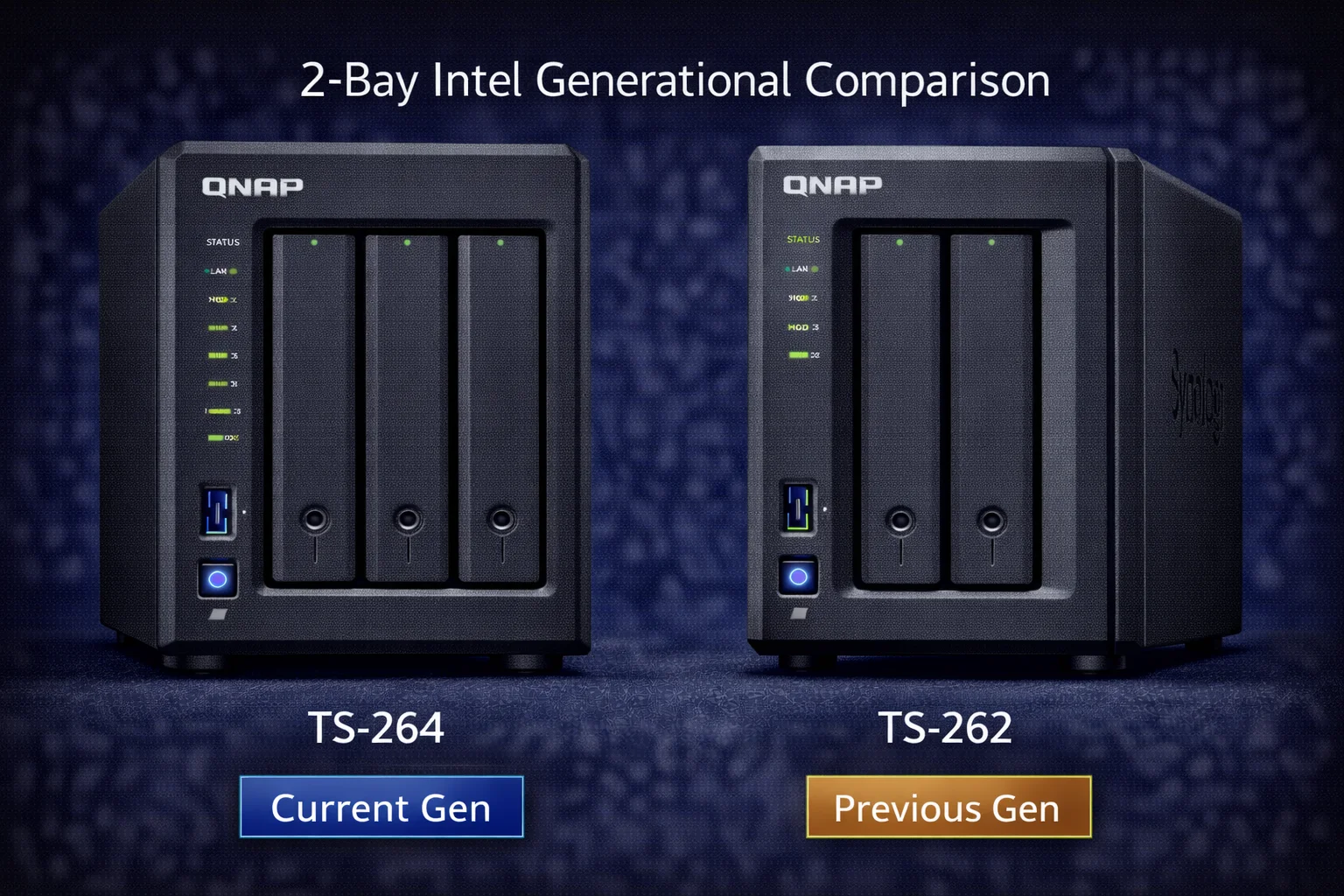
The QNAP TS-264 replaced the TS-262 as QNAP’s premium 2-bay Intel NAS. Both feature Intel Celeron processors with Quick Sync transcoding, but the TS-264 brings significant upgrades: a newer quad-core CPU (vs dual-core), double the default RAM, improved networking, and better expansion options. This comparison helps current TS-262 owners decide if upgrading is worthwhile and helps new buyers understand why the TS-264 is the better choice.
Quick Verdict
For new buyers: Choose the TS-264. It’s the current-generation model with significantly better specs at similar pricing. The TS-262 is discontinued and shouldn’t be purchased new.
For TS-262 owners: The TS-264 is a meaningful upgrade if you need more CPU power (quad-core vs dual-core), more RAM, faster networking, better transcoding performance, or M.2 NVMe caching. If your TS-262 meets your needs, there’s no urgent reason to upgrade — it remains a capable NAS.
Specifications Comparison
| Specification | QNAP TS-264 (New) | QNAP TS-262 (Old) |
|---|---|---|
| Status | Current Model | Discontinued |
| Release Year | 2022 | 2020 |
| Original MSRP | $449 | $399 |
| CPU | Intel Celeron N5105 (4-core, 2.0-2.9GHz) | Intel Celeron J4025 (2-core, 2.0-2.9GHz) |
| CPU Architecture | 10nm Jasper Lake | 14nm Gemini Lake |
| CPU Cores | 4 cores, 4 threads | 2 cores, 2 threads |
| RAM (Default) | 8GB DDR4 | 4GB DDR4 |
| Max RAM | 16GB | 8GB |
| Drive Bays | 2x 3.5″/2.5″ SATA | 2x 3.5″/2.5″ SATA |
| M.2 Slots | 2x M.2 2280 NVMe PCIe Gen3 | 2x M.2 2280 NVMe PCIe Gen2 |
| Network | 2x 2.5GbE | 1x 2.5GbE |
| USB Ports | 2x USB 3.2 Gen 2 (10Gbps) | 1x USB 3.2 Gen 2 + 2x USB 3.2 Gen 1 |
| HDMI | 1x HDMI 2.0 (4K 60Hz) | 1x HDMI 2.0 (4K 60Hz) |
| Hardware Transcoding | Yes (Quick Sync, 24 EUs) | Yes (Quick Sync, 12 EUs) |
| QuTS hero (ZFS) | Supported | Not supported |
| Power Consumption | ~15W idle, ~25W active | ~14W idle, ~22W active |
| Warranty | 2 years | 2 years |
Key Differences Explained
CPU: 4 Cores vs 2 Cores — The Biggest Upgrade
The most significant upgrade is the CPU. The TS-264’s N5105 has double the cores of the TS-262’s J4025:
| CPU Attribute | N5105 (TS-264) | J4025 (TS-262) |
|---|---|---|
| Cores/Threads | 4 / 4 | 2 / 2 |
| Base Clock | 2.0 GHz | 2.0 GHz |
| Boost Clock | 2.9 GHz | 2.9 GHz |
| Architecture | 10nm Jasper Lake | 14nm Gemini Lake |
| L3 Cache | 4MB | 4MB |
| GPU Execution Units | 24 | 12 |
| TDP | 10W | 10W |
Performance Benchmarks
| Benchmark | TS-264 (N5105) | TS-262 (J4025) | Improvement |
|---|---|---|---|
| Geekbench 5 Single | ~870 | ~600 | 45% faster |
| Geekbench 5 Multi | ~2,800 | ~1,100 | 155% faster |
| PassMark CPU | ~4,700 | ~2,100 | 124% faster |
| 7-Zip Compression | ~8,500 MIPS | ~3,800 MIPS | 124% faster |
| AES-256 Encryption | ~2.5 GB/s | ~1.2 GB/s | 108% faster |
| Quick Sync Transcoding | 24 EUs | 12 EUs | 2x capacity |
The TS-264 is approximately 45% faster in single-threaded tasks and 150%+ faster in multi-threaded workloads. This translates to dramatically better performance when running multiple applications simultaneously, faster photo indexing, quicker backups, and more transcoding headroom.
Memory: Double the Capacity
The TS-264 ships with 8GB RAM (vs 4GB) and supports up to 16GB (vs 8GB):
| RAM Spec | TS-264 | TS-262 |
|---|---|---|
| Default RAM | 8GB DDR4 | 4GB DDR4 |
| Maximum RAM | 16GB | 8GB |
| Memory Slots | 1 SO-DIMM | 1 SO-DIMM |
This matters for Docker containers (more RAM = more containers), virtual machines, photo indexing performance, and multi-user scenarios.
Network: Dual 2.5GbE vs Single
The TS-264 adds a second 2.5GbE port:
- TS-264: 2x 2.5GbE ports — link aggregation, failover, or network separation
- TS-262: 1x 2.5GbE port — single connection only
The second port enables failover redundancy, multi-network setups (management + data separation), or increased aggregate bandwidth for multiple simultaneous users.
M.2 Slots: PCIe Gen3 vs Gen2
Both have two M.2 slots, but the TS-264’s Gen3 slots offer double the theoretical bandwidth:
- TS-264: PCIe Gen3 x1 (~985 MB/s per slot)
- TS-262: PCIe Gen2 x1 (~500 MB/s per slot)
For SSD caching, the faster M.2 slots mean better cache performance and more responsive random I/O.
Plex Transcoding Comparison
Both support hardware transcoding via Intel Quick Sync, but the TS-264 handles it significantly better due to double the cores and GPU execution units:
| Plex Scenario | TS-264 | TS-262 |
|---|---|---|
| 4K HDR to 1080p (1 stream) | Smooth (~15% CPU) | Smooth (~25% CPU) |
| 4K HDR to 1080p (2 streams) | Smooth (~30% CPU) | Some strain (~55% CPU) |
| 4K HDR to 1080p (3 streams) | Smooth (~45% CPU) | Struggling (~80% CPU) |
| 1080p to 720p (4 streams) | Smooth (~35% CPU) | Likely buffering (CPU maxed) |
| HDR Tone Mapping | Full support | Full support |
| Subtitle Burn-in | Hardware accelerated | Hardware accelerated |
| Background Tasks | Minimal impact | Noticeable impact |
The TS-264’s 24 GPU execution units (vs 12) and 4 CPU cores (vs 2) mean significantly more transcoding headroom. For single-stream Plex use, both work well. For households with multiple users or remote streaming to several devices, the TS-264 handles the load much better.
Docker and Container Performance
| Docker Scenario | TS-264 (8GB) | TS-262 (4GB) | TS-262 (8GB) |
|---|---|---|---|
| Lightweight containers | 12-15 | 5-8 | 8-10 |
| Medium containers | 8-10 | 3-5 | 5-7 |
| Home Assistant + add-ons | Full capability | Limited add-ons | Still CPU limited |
| Media stack (Plex+Sonarr+etc) | Comfortable | Tight | Tight (CPU limited) |
| Multi-container startup time | Fast | Slow | Slow (CPU bottleneck) |
| Container responsiveness | Excellent | Adequate | Good |
The TS-264’s 4 cores and 8GB RAM make it significantly better suited for Docker workloads. The TS-262’s dual-core CPU becomes a bottleneck when running multiple containers, especially during startup or updates — even with upgraded RAM.
Real-World Performance Scenarios
Scenario 1: Basic File Storage + Single Plex Stream
TS-262: Works well for single-stream Plex and file storage. Adequate for most basic home users.
TS-264: Overkill for this use case, but provides headroom for future needs.
Scenario 2: Multi-User Household + Remote Streaming
TS-262: Struggles with 2+ simultaneous transcodes. Background tasks (backup, indexing) impact streaming quality.
TS-264: Handles 3+ transcodes while running other services. Background tasks have minimal impact on streaming.
Scenario 3: Docker-Heavy Workload (5+ Containers)
TS-262: Limited to 3-5 containers before performance degrades. Dual-core CPU is the primary bottleneck.
TS-264: Runs 10+ containers comfortably. Quad-core handles multi-container workloads easily.
Scenario 4: Large Photo Library Management
TS-262: QuMagie indexing is slow. Large libraries (20,000+ photos) may timeout on face recognition tasks.
TS-264: 2-3x faster indexing. Handles large photo libraries without timeout issues.
Feature Comparison
| Feature | TS-264 | TS-262 |
|---|---|---|
| QTS Support | Full (latest) | Full (may end sooner) |
| QuTS hero (ZFS) | Supported | Not supported |
| Virtualization Station | Up to 16GB RAM | Up to 8GB RAM |
| Container Station | Excellent | Good (limited by specs) |
| HD Station (HDMI) | 4K 60Hz | 4K 60Hz |
| Surveillance Station | 8-10 cameras | 4-6 cameras |
| Qtier Auto-Tiering | Supported | Supported |
| SSD Cache | Gen3 (faster) | Gen2 |
The TS-264 supports QuTS hero (ZFS-based OS) which the TS-262 does not. This is significant for users who want enterprise-grade data protection features like inline deduplication, compression, and self-healing storage.
Network Transfer Performance
| Scenario | TS-264 | TS-262 |
|---|---|---|
| Single client, sequential | ~280 MB/s | ~280 MB/s |
| Encrypted transfer (AES) | ~260 MB/s | ~210 MB/s |
| Multi-client (3 users) | ~250 MB/s total | ~240 MB/s total |
| Network redundancy | Dual port failover | Single point of failure |
| Link aggregation | Available | Not available |
Sequential speeds are similar since both have 2.5GbE, but the TS-264’s faster AES encryption hardware provides better encrypted transfer performance. The second network port adds redundancy and flexibility.
Power Consumption
| State | TS-264 | TS-262 |
|---|---|---|
| Idle (drives spinning) | ~15W | ~14W |
| Idle (drives sleep) | ~10W | ~9W |
| Active (file transfer) | ~22W | ~19W |
| Maximum load | ~28W | ~24W |
| Annual cost ($0.12/kWh) | ~$16/year | ~$15/year |
The TS-264 uses slightly more power due to the faster quad-core CPU, but the difference is minimal — about $1/year at typical idle usage.
Should TS-262 Owners Upgrade?
Upgrade if:
- Need more CPU power: Quad-core is 150%+ faster in multi-threaded tasks
- Need more Docker capacity: TS-264’s 4 cores and 8GB+ RAM handle significantly more containers
- Multi-stream Plex use: TS-264 handles 3+ transcodes without strain
- Network redundancy matters: Second 2.5GbE port provides failover
- Photo library is large: Much faster QuMagie indexing
- Want QuTS hero (ZFS): Only available on TS-264
- Planning virtualization: 16GB max RAM vs 8GB
Keep your TS-262 if:
- Basic file storage + backup: TS-262 handles this fine
- Single-stream Plex: Works well for one user
- Light Docker use: 2-4 containers work fine
- Budget constraints: TS-262 remains a capable NAS
- No performance issues: If it works for your needs, why change?
Upgrade Cost Analysis
For TS-262 owners considering an upgrade:
| Factor | Consideration |
|---|---|
| TS-264 cost | $449 |
| TS-262 resale value | $150-200 (used) |
| Net upgrade cost | $250-300 |
| Drive migration | Drives transfer directly |
| Config migration | Some reconfiguration needed |
Drives can migrate directly to the new NAS. Settings can be backed up and restored, but some reconfiguration is typically needed. The $250-300 net cost buys double the cores, double the RAM, and dual networking.
Surveillance Station Comparison
Both NAS units support QNAP Surveillance Station for home security camera recording:
| Feature | TS-264 | TS-262 |
|---|---|---|
| Free Camera Licenses | 2 | 2 |
| Max Recommended Cameras | 8-10 | 4-6 |
| 1080p Recording (simultaneous) | 8+ streams | 4-5 streams |
| 4K Recording (simultaneous) | 4-5 streams | 2-3 streams |
| AI Analytics | Faster processing | Slower, limited |
| Motion Detection | Hardware accelerated | Software only |
For basic home surveillance (2-4 cameras), both work adequately. For more cameras or AI-powered features, the TS-264’s quad-core processor handles the workload significantly better.
Photo Management with QuMagie
QuMagie (QNAP’s AI photo management) performance varies significantly between models:
| Task | TS-264 | TS-262 |
|---|---|---|
| Initial 10,000 photo indexing | ~2-3 hours | ~6-10 hours |
| Face recognition (1,000 photos) | ~15 minutes | ~40-60 minutes |
| Object/scene detection | Fast, responsive | Slow, may timeout |
| Thumbnail generation | Quick | Noticeable delay |
| Large library (50,000+ photos) | Handles well | May struggle significantly |
If you have a large photo library or want quick AI-powered face recognition, the TS-264’s quad-core CPU makes a dramatic difference.
Backup Capabilities
Both units support HBS 3 (Hybrid Backup Sync) for comprehensive backup:
- Local backup: To external USB drives
- Remote backup: To another QNAP NAS
- Cloud backup: AWS S3, Azure, Google Cloud, Backblaze B2
- Rsync: Standard rsync to any compatible server
The TS-264’s faster CPU and dual 2.5GbE networking enable significantly faster backup operations, especially for initial large backups. The faster encryption hardware also means quicker encrypted cloud backups.
QuTS hero (ZFS) — TS-264 Exclusive
The TS-264 supports QuTS hero, QNAP’s ZFS-based operating system, which the TS-262 does not. This provides:
- Inline deduplication: Save storage space by eliminating duplicate data
- Inline compression: More efficient storage utilization
- Self-healing: Automatic corruption detection and repair
- Near-instant snapshots: Copy-on-write for better backup
- Enterprise reliability: Battle-tested ZFS filesystem
If data integrity is paramount or you work with many similar files (VMs, backups), QuTS hero’s deduplication can significantly reduce storage requirements.
Virtualization Comparison
Both support Virtualization Station, but with different capabilities due to RAM limits:
| VM Scenario | TS-264 (16GB max) | TS-262 (8GB max) |
|---|---|---|
| Ubuntu Server (2GB) | Excellent | Good |
| Windows 10 (4GB) | Usable | Marginal |
| Multiple VMs | 2-3 light VMs | 1 light VM |
| VM + NAS apps | Comfortable | Tight |
The TS-264’s 16GB max RAM and quad-core CPU make virtualization much more practical. The TS-262’s dual-core and 8GB max limit VM usability.
SSD Caching Performance
Both units support M.2 NVMe SSD caching, but with different performance:
| Cache Specification | TS-264 | TS-262 |
|---|---|---|
| PCIe Generation | Gen3 x1 | Gen2 x1 |
| Max Throughput (per slot) | ~985 MB/s | ~500 MB/s |
| Practical Cache Speed | ~800 MB/s | ~400 MB/s |
| Read Cache Benefit | Significant | Moderate |
| Write Cache (RAID 1) | Excellent | Good |
The TS-264’s Gen3 M.2 slots provide approximately double the cache bandwidth, resulting in better random I/O performance for applications like Plex library browsing, Docker containers, and database workloads.
Recommended Cache SSDs
- WD Red SN700: Purpose-built for NAS caching, excellent endurance
- Samsung 990 PRO: Maximum performance for demanding workloads
- Crucial P3 Plus: Budget-friendly option with good performance
USB Device Compatibility
USB port differences affect external device usage:
| USB Feature | TS-264 | TS-262 |
|---|---|---|
| USB 3.2 Gen 2 (10Gbps) | 2 ports | 1 port |
| USB 3.2 Gen 1 (5Gbps) | 0 ports | 2 ports |
| External SSD Speed | Up to ~1,000 MB/s | Up to ~450 MB/s |
| External HDD Speed | ~200 MB/s (HDD limited) | ~200 MB/s (HDD limited) |
| USB Hub Support | Yes | Yes |
For external SSD backup drives, the TS-264’s faster USB ports provide significantly better transfer speeds. For traditional HDDs, both perform similarly as the drive speed is the bottleneck.
Noise and Thermal Performance
| Metric | TS-264 | TS-262 |
|---|---|---|
| Idle Noise | ~22 dB | ~21 dB |
| Active Noise | ~28 dB | ~26 dB |
| CPU Temperature (idle) | ~45°C | ~40°C |
| CPU Temperature (load) | ~65°C | ~55°C |
| Fan Profile | Quiet by default | Quiet by default |
The TS-264 runs slightly warmer due to the faster quad-core CPU, resulting in marginally higher fan speeds under load. Both remain quiet enough for living room or office placement. Hard drive noise is typically the dominant sound source.
Migration Process from TS-262 to TS-264
If you decide to upgrade, here’s what to expect:
What Transfers Automatically
- Storage pool and volume configurations
- All data on drives
- RAID configurations
- Shared folder structures
What May Need Reconfiguration
- Network settings (IP address, hostname)
- Some app settings and containers
- Surveillance Station camera assignments
- User permissions (verify after migration)
Migration Steps
- Back up QTS configuration on TS-262
- Power down TS-262 and remove drives
- Install drives in TS-264 in same order
- Power on and follow migration wizard
- Restore configuration backup
- Verify apps and settings
The process typically takes 30-60 minutes depending on configuration complexity.
Frequently Asked Questions
Absolutely yes. The TS-264 offers double the cores, double the RAM, dual 2.5GbE, faster M.2 slots, and QuTS hero support. The performance improvement is substantial — 150%+ in multi-threaded tasks — for a minimal price increase.
Yes. QNAP allows drive migration between compatible models. Your storage pool and data transfer directly. Some settings may need reconfiguration, but the process is straightforward.
Only if significantly discounted. At $150 or less, a used TS-262 offers reasonable value for basic NAS use. Above that price, the TS-264’s improvements justify buying new.
TS-264, significantly. The quad-core CPU and double the GPU execution units handle more transcodes with less strain. For single-stream use, both work fine; for multi-stream, the TS-264 is substantially better.
Likely 3-5 more years. QNAP typically supports NAS units for 5-7 years. The TS-262 (2020) should receive QTS updates through 2025-2027. Security patches may continue longer.
No. QuTS hero requires certain hardware specifications that the TS-262 doesn’t meet. The TS-264 supports QuTS hero for users who want ZFS-based storage.
The quad-core CPU. Going from 2 cores to 4 cores provides 150%+ improvement in multi-threaded performance, enabling more Docker containers, smoother multi-tasking, and better Plex transcoding under load.
Final Verdict
For new buyers: The QNAP TS-264 is the clear choice. It offers double the CPU cores, double the RAM, dual 2.5GbE networking, faster M.2 slots, and QuTS hero support for only $50 more than the TS-262’s original price. The TS-262 is discontinued and should only be purchased used at significant discount.
For TS-262 owners: The TS-264 is a worthwhile upgrade if you’re hitting performance limits — struggling with multiple Plex streams, running out of container capacity, or needing more RAM for demanding applications. If your TS-262 handles your workload fine, there’s no urgent need to upgrade, but the generational improvement is substantial when you’re ready.
Bottom line: The TS-264 represents a significant generational leap over the TS-262. The quad-core CPU is the headline improvement — 150%+ faster in multi-threaded workloads. Combined with doubled RAM and dual networking, it addresses all the TS-262’s limitations. For anyone buying new, it’s the only logical choice.
Where to Buy
QNAP TS-264 8GB
Intel N5105 Quad-Core, 8GB RAM (16GB max), 2x 2.5GbE, 2x M.2 NVMe Gen3, HDMI 2.0, QuTS hero Support
The current-generation 2-bay NAS. Double the cores, double the RAM, and dual networking over the TS-262. The only choice for new buyers.
Related Comparisons
- QNAP TS-264 Review — Full review
- TS-264 vs TS-233 — Intel vs ARM comparison
- TS-264 vs Synology DS224+ — Cross-brand comparison
- TS-464 vs TS-453D — 4-bay generational comparison
- Best QNAP NAS 2026
- QNAP Compatible Hard Drives
Last Updated: February 2026