RTX 4070 Super vs RX 7800 XT 2026: Complete GPU Comparison

Quick Answer+
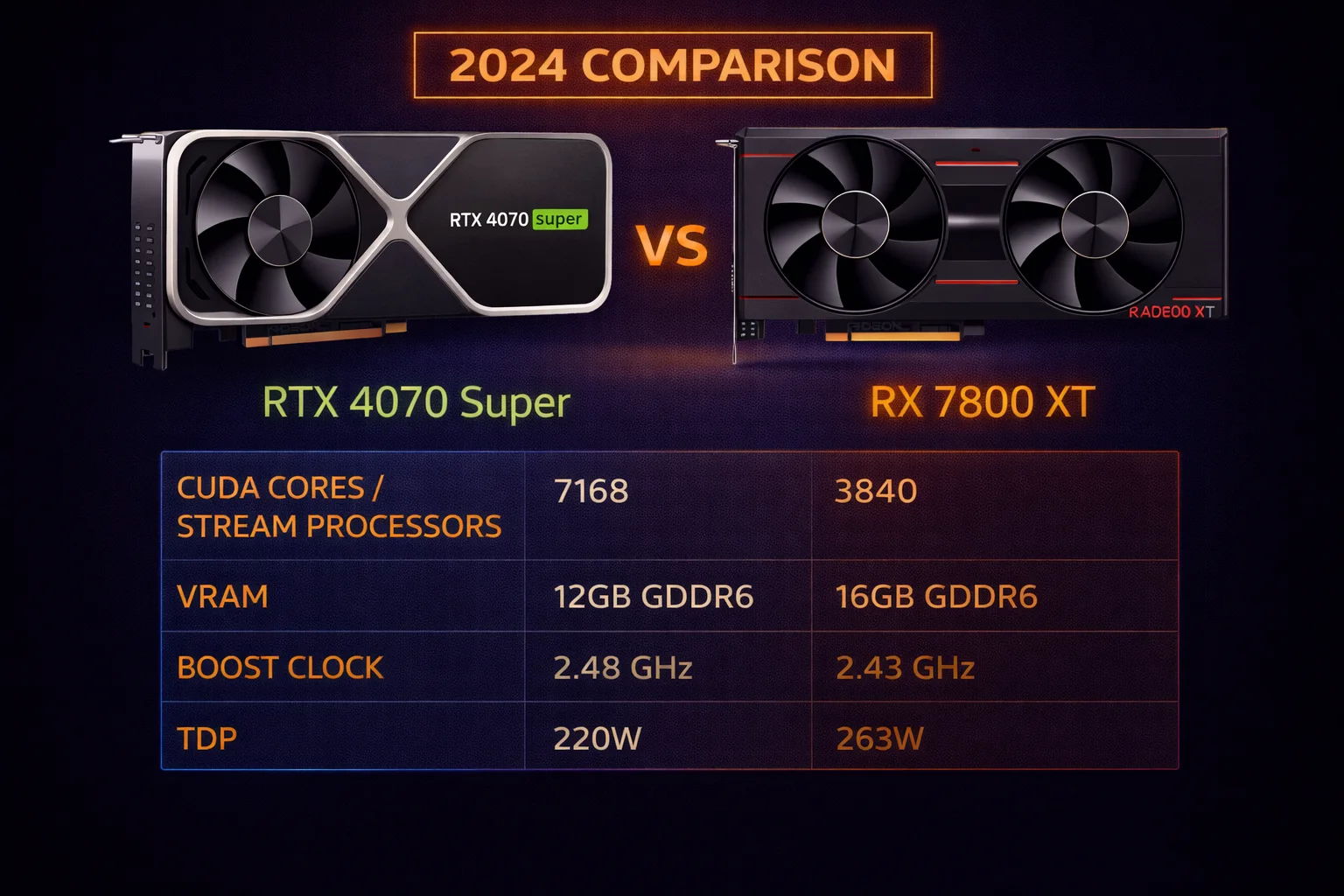
Quick Answer: The RX 7800 XT (~$480) wins on value with 16GB VRAM, 3-5% faster rasterization, and $100 less cost. The RTX 4070 Super (~$600) wins on features with 30-50% better ray tracing, superior DLSS 3 quality, and better power efficiency. Choose AMD for raw value; choose NVIDIA for ray tracing and content creation.
The RTX 4070 Super and RX 7800 XT represent the fiercest competition in the 1440p GPU market. Both deliver excellent performance for high-refresh gaming, but they take fundamentally different approaches—NVIDIA prioritizes advanced features and power efficiency while AMD focuses on raw performance value and VRAM capacity.
This comprehensive comparison examines every aspect: rasterization performance, ray tracing capability, upscaling technology, power efficiency, content creation, and real-world value. By the end, you’ll know exactly which GPU fits your specific gaming priorities and workflow needs. Use our FPS Calculator to estimate performance in your favorite games, or check our Bottleneck Calculator to ensure optimal CPU pairing.
The GPUs at a Glance
ASUS Dual RTX 4070 Super EVO OC
12GB GDDR6X | 192-bit | DLSS 3 | PCIe 4.0 | 220W TDP
NVIDIA’s feature-rich 1440p champion. Superior ray tracing, DLSS 3 Frame Generation, and excellent NVENC encoding. Best for RT enthusiasts and content creators.
PowerColor Hellhound RX 7800 XT
16GB GDDR6 | 256-bit | FSR 3 | PCIe 4.0 | 263W TDP
AMD’s value-focused 1440p powerhouse. 16GB VRAM for future-proofing, slightly faster rasterization, and SAM benefits with AMD CPUs. Best for pure gaming value.
Specifications Comparison
| Specification | RTX 4070 Super | RX 7800 XT |
|---|---|---|
| Architecture | Ada Lovelace (TSMC 4nm) | RDNA 3 (TSMC 5nm) |
| Stream Processors/CUDA Cores | 7,168 CUDA Cores | 3,840 Stream Processors |
| RT Cores / Ray Accelerators | 56 RT Cores (3rd Gen) | 60 Ray Accelerators (2nd Gen) |
| Tensor Cores / AI Accelerators | 224 Tensor Cores | 120 AI Accelerators |
| VRAM | 12GB GDDR6X | 16GB GDDR6 |
| Memory Bus | 192-bit | 256-bit |
| Memory Bandwidth | 504 GB/s | 624 GB/s |
| Base Clock | 1,980 MHz | 1,295 MHz |
| Boost Clock | 2,475 MHz | 2,430 MHz |
| TDP | 220W | 263W |
| Recommended PSU | 650W | 700W |
| Power Connectors | 1x 16-pin (or adapter) | 2x 8-pin |
| Ray Tracing | 3rd Gen RT Cores | 2nd Gen Ray Accelerators |
| Upscaling | DLSS 3 + Frame Gen | FSR 3 + Frame Gen |
| Encoder | NVENC (8th Gen) | VCN 4.0 |
| MSRP | $599 | $499 |
| Street Price | ~$600 | ~$480-500 |
Key Specification Analysis
VRAM: 12GB vs 16GB – AMD’s 33% VRAM advantage becomes increasingly important at 4K and with heavily modded games. For 1440p gaming in 2026, 12GB handles most titles, but 16GB provides more headroom for future releases and texture mods.
Memory Bandwidth: 504 vs 624 GB/s – AMD’s 24% higher bandwidth, combined with more VRAM, contributes to its stronger 4K performance and handles high-resolution textures more efficiently.
Power Draw: 220W vs 263W – NVIDIA’s Ada architecture delivers meaningfully better efficiency. The 4070 Super achieves similar rasterization performance while consuming 43W less power—that’s 16% less electricity for comparable frame rates.
Rasterization Performance
In traditional rasterization without ray tracing, these GPUs trade blows with the RX 7800 XT holding a consistent but small advantage.
1440p Performance Benchmarks
| Game (1440p Ultra) | RTX 4070 Super | RX 7800 XT | Difference |
|---|---|---|---|
| Cyberpunk 2077 | 72 FPS | 75 FPS | +4% AMD |
| Hogwarts Legacy | 78 FPS | 82 FPS | +5% AMD |
| Spider-Man 2 | 82 FPS | 85 FPS | +4% AMD |
| Call of Duty MW3 | 125 FPS | 130 FPS | +4% AMD |
| Starfield | 65 FPS | 68 FPS | +5% AMD |
| Alan Wake 2 | 58 FPS | 55 FPS | +5% NVIDIA |
| Fortnite | 160 FPS | 155 FPS | +3% NVIDIA |
| Black Myth: Wukong | 52 FPS | 55 FPS | +6% AMD |
| Avatar: Frontiers | 48 FPS | 52 FPS | +8% AMD |
| Baldur’s Gate 3 | 95 FPS | 92 FPS | +3% NVIDIA |
| Counter-Strike 2 | 350 FPS | 340 FPS | +3% NVIDIA |
| Valorant | 450 FPS | 435 FPS | +3% NVIDIA |
The RX 7800 XT averages 3-5% faster in most rasterization workloads at 1440p. This advantage is consistent but not dramatic—both GPUs deliver excellent 1440p gaming experiences. NVIDIA shows slight advantages in some esports titles and Alan Wake 2 (which is heavily NVIDIA-optimized).
4K Performance Benchmarks
| Game (4K Ultra) | RTX 4070 Super | RX 7800 XT | Difference |
|---|---|---|---|
| Cyberpunk 2077 | 38 FPS | 42 FPS | +11% AMD |
| Hogwarts Legacy | 42 FPS | 48 FPS | +14% AMD |
| Spider-Man 2 | 45 FPS | 50 FPS | +11% AMD |
| Call of Duty MW3 | 72 FPS | 80 FPS | +11% AMD |
| Starfield | 35 FPS | 40 FPS | +14% AMD |
| Black Myth: Wukong | 28 FPS | 32 FPS | +14% AMD |
At 4K, AMD’s advantage grows to 11-14% due to higher VRAM and memory bandwidth. Neither card is truly a 4K Ultra GPU—both require upscaling or reduced settings for playable frame rates. However, if 4K is your target, the RX 7800 XT handles it better.
1080p Performance (Esports Focus)
| Game (1080p Competitive) | RTX 4070 Super | RX 7800 XT | Difference |
|---|---|---|---|
| Counter-Strike 2 | 520 FPS | 495 FPS | +5% NVIDIA |
| Valorant | 650 FPS | 615 FPS | +6% NVIDIA |
| Fortnite (Performance) | 380 FPS | 360 FPS | +6% NVIDIA |
| Apex Legends | 290 FPS | 275 FPS | +5% NVIDIA |
| Overwatch 2 | 420 FPS | 400 FPS | +5% NVIDIA |
At 1080p in esports titles, NVIDIA shows a 5-6% advantage. For competitive gamers targeting 240Hz+ monitors at 1080p, the RTX 4070 Super has a slight edge. At these frame rates, both GPUs are CPU-limited in most scenarios.
Ray Tracing Performance
Ray tracing is where these GPUs diverge dramatically. NVIDIA’s third-generation RT cores deliver significantly better performance than AMD’s second-generation ray accelerators.
| Game (1440p RT On) | RTX 4070 Super | RX 7800 XT | Difference |
|---|---|---|---|
| Cyberpunk 2077 RT Ultra | 42 FPS | 28 FPS | +50% NVIDIA |
| Alan Wake 2 RT High | 38 FPS | 25 FPS | +52% NVIDIA |
| Hogwarts Legacy RT | 52 FPS | 38 FPS | +37% NVIDIA |
| Spider-Man 2 RT | 55 FPS | 42 FPS | +31% NVIDIA |
| Call of Duty MW3 RT | 85 FPS | 62 FPS | +37% NVIDIA |
| Fortnite RT | 78 FPS | 55 FPS | +42% NVIDIA |
| Control RT | 58 FPS | 38 FPS | +53% NVIDIA |
| Metro Exodus Enhanced | 62 FPS | 42 FPS | +48% NVIDIA |
The RTX 4070 Super delivers 30-53% higher frame rates with ray tracing enabled—a massive, game-changing advantage. In demanding RT titles like Cyberpunk 2077 and Alan Wake 2, this translates to playable frame rates on NVIDIA versus borderline unplayable on AMD.
Ray Tracing with Upscaling
| Game (1440p RT + Upscaling) | 4070S + DLSS | 7800 XT + FSR | Experience |
|---|---|---|---|
| Cyberpunk 2077 RT Ultra | 75 FPS | 48 FPS | Smooth vs Borderline |
| Alan Wake 2 RT High | 68 FPS | 42 FPS | Playable vs Choppy |
| Hogwarts Legacy RT | 88 FPS | 62 FPS | Excellent vs Acceptable |
With upscaling enabled, the RTX 4070 Super provides genuinely excellent ray tracing experiences. The RX 7800 XT can achieve playable RT with FSR, but the combination of weaker RT performance and lower-quality FSR upscaling makes for a noticeably inferior experience.
Ray Tracing Verdict: If ray tracing matters to you, the RTX 4070 Super is the only real choice at this price point. AMD’s RT performance is functional but not competitive.
DLSS 3 vs FSR 3: Upscaling Technology
Both GPUs support their respective upscaling technologies, but quality differs significantly.
Quality Comparison
| Quality Preset | DLSS 3 | FSR 3 |
|---|---|---|
| Quality Mode | Near-native, minimal artifacts | Good, slight softness |
| Balanced Mode | Excellent, occasional shimmer | Good, noticeable softness |
| Performance Mode | Good, visible upscaling | Acceptable, clear artifacts |
| Ultra Performance | Acceptable for 4K | Compromised quality |
DLSS uses dedicated Tensor Cores and AI-based reconstruction, producing cleaner images with better temporal stability. FSR uses a spatial upscaling algorithm that works on any GPU but produces noticeably softer images with more artifacts, especially at aggressive quality presets.
Frame Generation Comparison
Both DLSS 3 and FSR 3 include frame generation technology that interpolates additional frames:
DLSS 3 Frame Generation:
- Uses dedicated Optical Flow Accelerator hardware
- Lower latency (mitigated by NVIDIA Reflex)
- Cleaner interpolated frames
- Exclusive to RTX 40-series GPUs
FSR 3 Frame Generation:
- Software-based implementation
- Higher latency (use AMD Anti-Lag)
- More visible artifacts in fast motion
- Works on any GPU (even NVIDIA cards)
Performance with Upscaling
| Game (1440p) | 4070S + DLSS Quality | 7800 XT + FSR Quality |
|---|---|---|
| Cyberpunk 2077 | 105 FPS | 98 FPS |
| Alan Wake 2 | 88 FPS | 78 FPS |
| Hogwarts Legacy | 112 FPS | 105 FPS |
| Spider-Man 2 | 118 FPS | 110 FPS |
| Black Myth: Wukong | 78 FPS | 72 FPS |
| Starfield | 95 FPS | 88 FPS |
Upscaling Verdict: DLSS 3 produces noticeably better image quality than FSR 3. If you use upscaling regularly (recommended for both GPUs in demanding titles), the RTX 4070 Super provides a superior visual experience.
Power Efficiency and Thermals
NVIDIA’s Ada Lovelace architecture delivers class-leading efficiency at this performance tier.
| Metric | RTX 4070 Super | RX 7800 XT | Difference |
|---|---|---|---|
| TDP | 220W | 263W | +43W AMD |
| Gaming (Average) | 200-215W | 240-260W | +40-45W AMD |
| Gaming (Peak) | 225W | 275W | +50W AMD |
| Idle Power | 8-12W | 10-15W | Similar |
| Gaming Temperature | 65-72°C | 70-78°C | Cooler NVIDIA |
| Noise Level | Quieter | Louder | ~3-5 dB difference |
| Performance/Watt | Excellent | Good | +20-25% NVIDIA |
The RTX 4070 Super delivers approximately 20-25% better performance per watt. This translates to: lower electricity costs over time, cooler operation with equivalent coolers, quieter acoustics, and more flexibility in smaller cases or builds with constrained airflow.
PSU Requirements
RTX 4070 Super: 650W quality PSU is sufficient. The efficient architecture and controlled power draw mean most mid-range power supplies handle it comfortably.
RX 7800 XT: 700W recommended due to higher power draw and transient spikes. A quality 650W unit works but offers less headroom.
VRAM Analysis: 12GB vs 16GB
The RX 7800 XT’s 16GB VRAM versus the 4070 Super’s 12GB is one of the most debated differences between these cards.
Current VRAM Usage (2026 Titles)
| Game | 1440p Ultra VRAM | 4K Ultra VRAM |
|---|---|---|
| Hogwarts Legacy | 10-11 GB | 13-15 GB |
| The Last of Us Part I | 11-12 GB | 14-16 GB |
| Star Wars Outlaws | 9-10 GB | 12-14 GB |
| Alan Wake 2 | 10-11 GB | 13-15 GB |
| Cyberpunk 2077 | 8-10 GB | 11-13 GB |
| Spider-Man 2 | 9-10 GB | 12-14 GB |
| Black Myth: Wukong | 10-11 GB | 13-15 GB |
When 12GB Becomes Limiting
- 4K Gaming: Several 2025-2026 titles exceed 12GB at 4K Ultra, causing stuttering on the 4070 Super
- High-Resolution Texture Mods: Skyrim/Fallout 4K texture packs can easily exceed 12GB
- Future Games: VRAM requirements continue increasing; 12GB may become limiting within 2-3 years at 1440p
- Multi-Monitor/Productivity: Running games alongside other GPU-accelerated applications
When 12GB Is Sufficient
- 1440p Gaming: Most current games use 8-11GB at 1440p Ultra—12GB handles them fine
- Esports Titles: Competitive games rarely exceed 6-8GB
- With DLSS: Upscaling reduces VRAM requirements by rendering at lower internal resolution
- Shorter Upgrade Cycles: If you upgrade every 2-3 years, 12GB is adequate
VRAM Verdict: For 1440p gaming in 2026, 12GB is generally sufficient. For 4K gaming, heavy modding, or keeping the GPU 4+ years, the 7800 XT’s 16GB provides valuable future-proofing headroom.
Smart Access Memory (AMD Advantage)
AMD’s Smart Access Memory (SAM) allows AMD CPUs to access the entire GPU frame buffer simultaneously, providing free performance gains in supported games.
| Game | 7800 XT (SAM Off) | 7800 XT (SAM On) | Benefit |
|---|---|---|---|
| Assassin’s Creed Mirage | 85 FPS | 92 FPS | +8% |
| Forza Horizon 5 | 110 FPS | 118 FPS | +7% |
| F1 24 | 125 FPS | 133 FPS | +6% |
| Hitman 3 | 140 FPS | 148 FPS | +6% |
| Watch Dogs Legion | 72 FPS | 78 FPS | +8% |
SAM provides 3-8% additional performance in supported titles when pairing the RX 7800 XT with a Ryzen CPU. This free boost makes all-AMD builds particularly attractive for value-focused gamers.
Note: NVIDIA has Resizable BAR, which provides similar but generally smaller benefits (1-3%). The RTX 4070 Super works with both AMD and Intel CPUs with Resizable BAR enabled.
Content Creation and Streaming
Video Encoding
| Feature | RTX 4070 Super (NVENC) | RX 7800 XT (VCN 4.0) |
|---|---|---|
| Encoder Quality | Excellent | Good |
| AV1 Encoding | Yes (hardware) | Yes (hardware) |
| H.264/H.265 Quality | Industry-leading | Slightly behind |
| Dual Encoder | Yes | No |
| OBS/Streamlabs Support | Excellent | Good |
| Quality-per-Bitrate | Better | Slightly lower |
NVENC provides better quality at equivalent bitrates and has superior software support. For streamers, NVIDIA’s encoder produces cleaner streams, especially at lower bitrates. The dual encoder enables simultaneous streaming and recording at high quality.
Creative Applications
| Application | RTX 4070 Super | RX 7800 XT | Reason |
|---|---|---|---|
| Blender (Cycles) | Faster | Slower | CUDA/OptiX optimization |
| DaVinci Resolve | Faster | Good | NVENC advantage |
| Premiere Pro | Faster | Good | CUDA acceleration |
| After Effects | Similar | Similar | Often CPU-limited |
| Photoshop | Similar | Similar | Minimal GPU use |
NVIDIA’s CUDA ecosystem provides better optimization in most professional creative applications. This advantage is particularly noticeable in Blender rendering and video editing workflows.
Content Creation Verdict: For streamers and content creators, the RTX 4070 Super provides meaningful workflow advantages through superior encoding and CUDA acceleration.
Driver Stability and Software
NVIDIA GeForce Experience / NVIDIA App
- Mature, stable drivers with long track record
- Day-one game optimizations for major releases
- Automatic game optimization settings
- ShadowPlay for low-overhead recording and streaming
- NVIDIA Broadcast for AI-powered streaming features
AMD Radeon Software
- Significantly improved stability in recent years
- Excellent feature set (Anti-Lag, Chill, Boost)
- Good game optimization, sometimes delayed versus NVIDIA
- Occasional driver issues with new game releases
- ReLive for recording and streaming
NVIDIA maintains an edge in driver reliability and day-one game support, though AMD has closed the gap significantly. Most users won’t experience meaningful driver issues with either card in 2026.
Price and Value Analysis
| GPU | MSRP | Street Price | Price Difference |
|---|---|---|---|
| RTX 4070 Super | $599 | $580-620 | Baseline |
| RX 7800 XT | $499 | $480-520 | ~$100 less |
Value Calculation
Price per frame (1440p rasterization):
- RTX 4070 Super: $600 ÷ ~82 FPS avg = $7.32/FPS
- RX 7800 XT: $490 ÷ ~85 FPS avg = $5.76/FPS
The RX 7800 XT delivers approximately 27% better value in pure rasterization performance. You’re paying ~20% less for 3-5% more performance in traditional rendering.
However, this calculation doesn’t account for NVIDIA’s feature advantages. If ray tracing, DLSS quality, or content creation matter to you, the value equation changes significantly in NVIDIA’s favor.
CPU Pairing Recommendations
Best CPUs for RTX 4070 Super
| CPU | Price | Bottleneck | Best For |
|---|---|---|---|
| Ryzen 5 7600X | $178 | None at 1440p | Value gaming |
| i5-14600K | $312 | None | Gaming + productivity |
| Ryzen 7 7800X3D | $386 | None | Maximum gaming |
| i7-14700K | $367 | None | Gaming + heavy productivity |
Best CPUs for RX 7800 XT (SAM Benefits)
| CPU | Price | SAM Bonus | Best For |
|---|---|---|---|
| Ryzen 5 7600X | $178 | +3-8% | Value all-AMD build |
| Ryzen 7 7700X | $275 | +3-8% | Balanced all-AMD |
| Ryzen 7 7800X3D | $386 | +3-8% | Maximum gaming (all-AMD) |
| Ryzen 9 9800X3D | $444 | +3-8% | Ultimate all-AMD gaming |
For maximum RX 7800 XT value, pair with an AMD Ryzen CPU to unlock SAM benefits. Intel CPUs work fine but miss out on the 3-8% SAM performance boost.
Complete Build Examples
RTX 4070 Super Build (~$1,400)
- CPU: Ryzen 5 7600X – $178
- GPU: RTX 4070 Super – $600
- Motherboard: B650 DDR5 – $150
- RAM: 32GB DDR5-5600 – $100
- Storage: 1TB NVMe – $70
- PSU: 650W Gold – $75
- Case: Mid-tower – $80
- Cooler: Tower Air – $40
- Total: ~$1,293
This build prioritizes NVIDIA features: DLSS 3, superior ray tracing, NVENC encoding, and power efficiency. Excellent for gamers who value these capabilities.
RX 7800 XT All-AMD Build (~$1,250)
- CPU: Ryzen 5 7600X – $178
- GPU: RX 7800 XT – $490
- Motherboard: B650 DDR5 – $150
- RAM: 32GB DDR5-5600 – $100
- Storage: 1TB NVMe – $70
- PSU: 700W Gold – $85
- Case: Mid-tower – $80
- Cooler: Tower Air – $40
- Total: ~$1,193
This all-AMD build saves $100 while delivering similar rasterization performance. SAM provides 3-8% bonus FPS, and 16GB VRAM offers better future-proofing.
Who Should Buy Which GPU?
Buy the RX 7800 XT (~$490) if:
- Value and raw performance per dollar are your top priority
- You want 16GB VRAM for modding, 4K, or future-proofing
- You’re building an all-AMD system to leverage SAM
- Ray tracing isn’t important to your gaming experience
- You primarily play at 1440p or 4K without RT
- FSR quality is acceptable for your visual standards
- You want to save $100+ for other components
Buy the RTX 4070 Super (~$600) if:
- Ray tracing is important to your gaming experience
- You value DLSS 3’s superior upscaling quality
- You stream or create content (NVENC advantage)
- Power efficiency, thermals, and low noise matter
- You use creative applications with CUDA acceleration
- You want best-in-class driver stability
- You primarily game at 1440p (12GB is sufficient)
- NVIDIA’s ecosystem features appeal to you
Frequently Asked Questions
Neither is objectively better—they excel at different things. RX 7800 XT wins on value, VRAM (16GB vs 12GB), and rasterization (+3-5%). RTX 4070 Super wins on ray tracing (+30-50%), DLSS quality, efficiency, and encoding. Choose based on your priorities.
For 1440p gaming, yes—most games use 8-11GB. At 4K or with heavily modded games, 12GB can become limiting. The RX 7800 XT’s 16GB offers more headroom for future titles and 4K gaming.
Yes. DLSS produces cleaner images with fewer artifacts, especially at lower quality presets. DLSS uses AI and dedicated Tensor Cores, while FSR uses spatial upscaling. FSR is good but noticeably behind DLSS in quality.
RTX 4070 Super. NVIDIA’s NVENC encoder provides better quality at equivalent bitrates and has superior software support in OBS, Streamlabs, and other streaming applications.
Recommended. SAM (Smart Access Memory) provides 3-8% additional gaming performance with AMD CPUs. This free boost makes all-AMD builds particularly attractive for the 7800 XT.
RTX 4070 Super. It draws 40-45W less power than the 7800 XT, resulting in lower temperatures and quieter operation with equivalent cooling solutions.
RX 7800 XT is better for 4K. Its 16GB VRAM handles 4K textures better than the 4070 Super’s 12GB. AMD also shows larger performance advantages at 4K (11-14%) due to higher memory bandwidth.
RTX 4070 Super: 650W is sufficient. RX 7800 XT: 700W recommended due to 40W higher power draw. Both work with quality 650W units, but the 7800 XT benefits from extra headroom.
Final Verdict
The RX 7800 XT wins on pure value. At $100+ less than the RTX 4070 Super, it delivers slightly better rasterization performance, 16GB of future-proof VRAM, and SAM benefits with AMD CPUs. For gamers who prioritize raw performance per dollar and don’t care about ray tracing, it’s the smarter financial choice.
The RTX 4070 Super wins on features and polish. Superior DLSS 3 upscaling, 30-50% better ray tracing performance, excellent NVENC encoding, and class-leading power efficiency justify the $100 premium for users who value these capabilities. For streamers, content creators, and ray tracing enthusiasts, it’s worth the extra investment.
Both are excellent 1440p GPUs that will serve you well for years. The choice ultimately comes down to whether you value AMD’s VRAM advantage and value proposition or NVIDIA’s feature set and efficiency. You genuinely cannot go wrong with either card at this price point.
Related Resources
- FPS Calculator
- Bottleneck Calculator
- Best CPU for RTX 4070 Super
- Best CPU for RX 7800 XT
- Best GPU for 1440p 144Hz
- RTX 5070 vs RX 7800 XT
Last Updated: February 2026