RTX 5070 vs RTX 4070: Budget Blackwell Worth It? (2026)

Quick Answer+
Quick Answer: The RTX 5070 (~$650) delivers 38-44% better rasterization and 53-73% better ray tracing with DLSS 4 Multi Frame Generation. The RTX 4070 (~$500) offers proven 1440p gaming at lower cost. For new builds, the 5070 is the clear winner; the 4070 only makes sense at $350-400 clearance pricing.
The NVIDIA GeForce RTX 5070 brings Blackwell architecture to the mid-range segment, promising RTX 4090-class performance at $549 MSRP. Meanwhile, the RTX 4070 remains available as a proven 1440p gaming GPU with mature drivers and established performance. With significant performance gaps and evolving street prices, which offers better value in 2026?
This comparison represents one of the most dramatic generational leaps we’ve seen in the mid-range GPU segment. The RTX 5070 doesn’t just offer incremental improvements—it delivers 40%+ better rasterization and 60%+ better ray tracing while maintaining the same MSRP tier. For budget-conscious gamers, this creates an interesting decision: pay more for dramatically better performance, or find a discounted previous-gen card.
This comprehensive comparison examines gaming performance, ray tracing capabilities, DLSS 4 versus DLSS 3, power efficiency, and overall value to help you make the right decision. Use our Bottleneck Calculator to verify CPU pairings with either GPU, or check expected frame rates with our FPS Calculator.
The GPUs at a Glance
GIGABYTE RTX 5070 WINDFORCE OC
12GB GDDR7 | 192-bit | DLSS 4 | PCIe 5.0 | 220W TDP
NVIDIA’s Blackwell mid-range powerhouse. 38-44% faster than RTX 4070 with DLSS 4 Multi Frame Generation. Best for new 1440p builds targeting high refresh rates.
ASUS TUF RTX 5070
12GB GDDR7 | 192-bit | DLSS 4 | Military-Grade | 220W TDP
ASUS’s premium RTX 5070 with enhanced cooling and build quality. Higher price but excellent thermals and acoustics for quiet gaming systems.
ASUS Dual RTX 4070 (Renewed)
12GB GDDR6X | 192-bit | DLSS 3 | PCIe 4.0 | 200W TDP
Proven Ada Lovelace 1440p performer. Excellent efficiency and mature driver support. Only recommended at significant discount ($350-400).
Architecture Deep Dive
Blackwell vs Ada Lovelace
The RTX 5070’s Blackwell architecture represents NVIDIA’s most significant generational improvement since Ampere to Ada. Key architectural changes include improved shader efficiency delivering more work per clock cycle, enhanced memory compression reducing effective bandwidth requirements, redesigned RT cores with better BVH traversal efficiency, and new Tensor core designs optimized for DLSS 4’s transformer-based AI models.
These architectural improvements compound with the raw specification upgrades (more CUDA cores, faster memory) to deliver the 40%+ performance gains observed in benchmarks. This isn’t just a specification bump—it’s a fundamental improvement in how the GPU processes graphics workloads.
Specifications Comparison
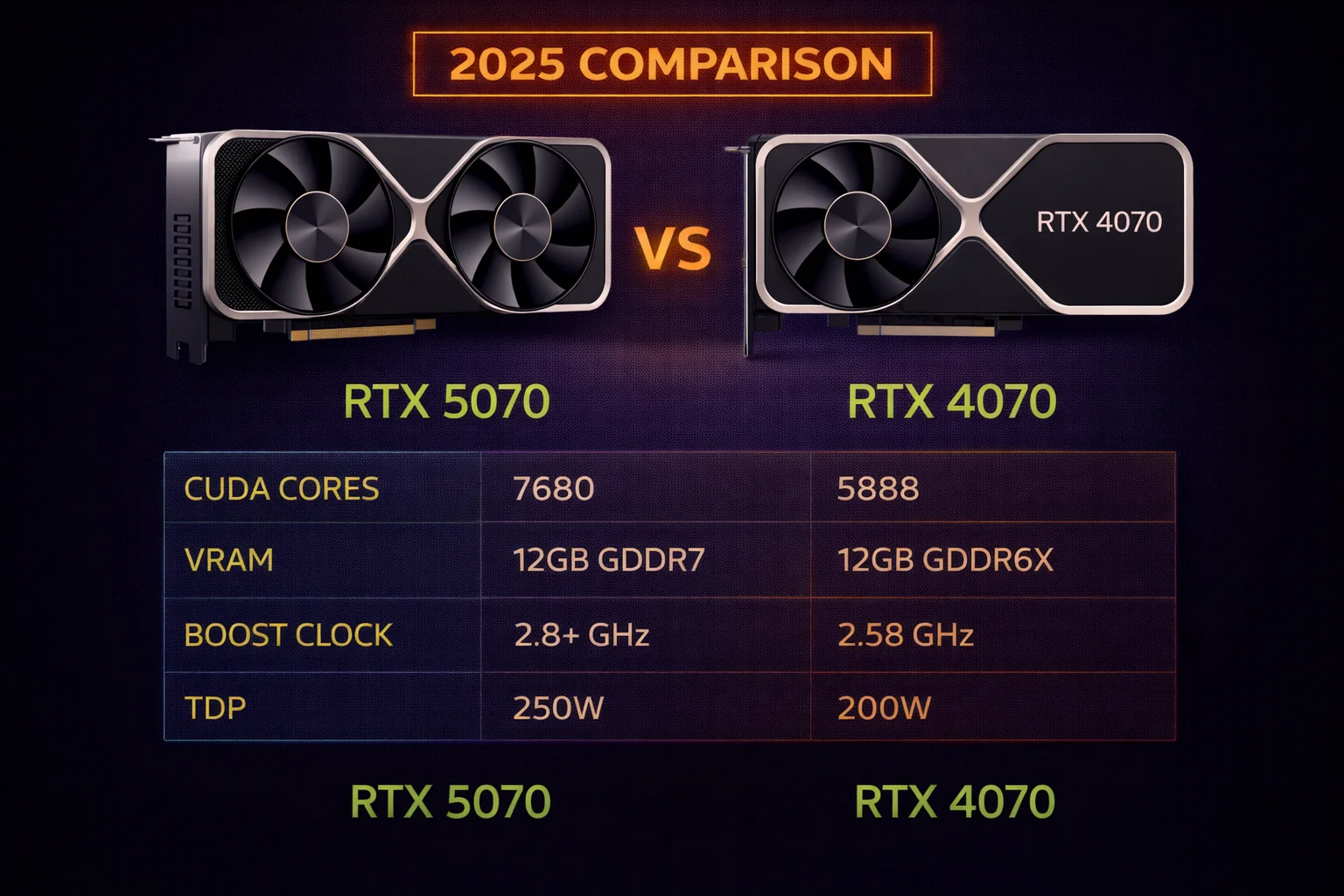
| Specification | RTX 5070 | RTX 4070 |
|---|---|---|
| Architecture | Blackwell (TSMC 4N) | Ada Lovelace (TSMC 4N) |
| CUDA Cores | 6,144 | 5,888 |
| VRAM | 12GB GDDR7 | 12GB GDDR6X |
| Memory Bus | 192-bit | 192-bit |
| Memory Bandwidth | 672 GB/s | 504 GB/s |
| Base Clock | 2,160 MHz | 1,920 MHz |
| Boost Clock | 2,510 MHz | 2,475 MHz |
| TDP | 220W | 200W |
| RT Cores | 4th Generation | 3rd Generation |
| Tensor Cores | 5th Generation | 4th Generation |
| DLSS | DLSS 4 (Multi Frame Gen) | DLSS 3 |
| PCIe | 5.0 x16 | 4.0 x16 |
| Encoder | 9th Gen NVENC (Dual) | 8th Gen NVENC |
| Power Connectors | 1x 12V-2×6 | 1x 8-pin |
| MSRP | $549 | $549 (launched) |
| Street Price | ~$550-700 | ~$480-530 |
Key Specification Analysis
Memory Technology: The RTX 5070’s GDDR7 memory delivers 33% higher bandwidth (672 GB/s vs 504 GB/s) than the 4070’s GDDR6X. This substantial improvement helps the 5070 handle higher resolutions and more demanding textures more efficiently, particularly at 4K.
RT and Tensor Cores: Blackwell’s 4th gen RT cores and 5th gen Tensor cores provide significant improvements in ray tracing performance and AI processing. This translates to dramatically better RT frame rates and higher-quality DLSS upscaling with fewer artifacts.
DLSS 4 vs DLSS 3: The RTX 5070’s DLSS 4 Multi Frame Generation can generate up to 3 additional frames per rendered frame, compared to DLSS 3’s single generated frame. This potentially quadruples perceived smoothness in supported titles.
Power Consumption: The 5070 draws 20W more than the 4070 (220W vs 200W), a modest 10% increase for 40%+ better performance. This represents excellent performance-per-watt improvement from Blackwell architecture.
Rasterization Performance
In native rendering without upscaling, the RTX 5070 delivers impressive gains over the RTX 4070—roughly matching or exceeding the RTX 4080 in most titles. This is a massive generational leap at the same price tier.
1440p Ultra Performance (Native)
| Game | RTX 5070 | RTX 4070 | Difference |
|---|---|---|---|
| Cyberpunk 2077 | 88 FPS | 62 FPS | +42% |
| Alan Wake 2 | 72 FPS | 52 FPS | +38% |
| Spider-Man 2 | 95 FPS | 68 FPS | +40% |
| Hogwarts Legacy | 92 FPS | 65 FPS | +42% |
| Starfield | 78 FPS | 55 FPS | +42% |
| Call of Duty MW3 | 145 FPS | 105 FPS | +38% |
| Avatar: Frontiers | 68 FPS | 48 FPS | +42% |
| Black Myth: Wukong | 65 FPS | 45 FPS | +44% |
| Baldur’s Gate 3 | 115 FPS | 82 FPS | +40% |
| Indiana Jones | 82 FPS | 58 FPS | +41% |
At 1440p native, the RTX 5070 averages 38-44% higher frame rates. The 5070 at $549 MSRP matches or beats the RTX 4070 Super ($600) and approaches the RTX 4070 Ti Super ($800) in raw performance. This represents exceptional value for new builds.
4K Performance (Native)
| Game | RTX 5070 | RTX 4070 | Difference |
|---|---|---|---|
| Cyberpunk 2077 | 52 FPS | 35 FPS | +49% |
| Alan Wake 2 | 42 FPS | 28 FPS | +50% |
| Hogwarts Legacy | 55 FPS | 38 FPS | +45% |
| Spider-Man 2 | 58 FPS | 40 FPS | +45% |
| Starfield | 45 FPS | 30 FPS | +50% |
| Black Myth: Wukong | 38 FPS | 25 FPS | +52% |
At 4K, the gap widens to 45-52%. The higher memory bandwidth helps the 5070 handle 4K textures more efficiently. While neither GPU is designed for native 4K Ultra gaming, the 5070 makes it playable in many titles where the 4070 falls short.
1080p Performance
| Game | RTX 5070 | RTX 4070 | Difference |
|---|---|---|---|
| Cyberpunk 2077 | 125 FPS | 92 FPS | +36% |
| Call of Duty MW3 | 220 FPS | 165 FPS | +33% |
| Fortnite (Competitive) | 350 FPS | 260 FPS | +35% |
| Counter-Strike 2 | 425 FPS | 320 FPS | +33% |
| Valorant | 550 FPS | 420 FPS | +31% |
| Apex Legends | 285 FPS | 215 FPS | +33% |
At 1080p, the gap narrows slightly to 31-36% as CPU bottlenecks begin affecting very high frame rates. Still, the 5070 delivers substantially better performance for competitive gaming on high-refresh monitors.
Ray Tracing Performance
Blackwell’s 4th generation RT cores deliver massive improvements in ray tracing—one of the largest generational leaps NVIDIA has delivered for this technology.
1440p Ray Tracing Benchmarks
| Game (RT Settings) | RTX 5070 | RTX 4070 | Difference |
|---|---|---|---|
| Cyberpunk 2077 (RT Ultra) | 52 FPS | 32 FPS | +63% |
| Cyberpunk 2077 (RT Overdrive) | 38 FPS | 22 FPS | +73% |
| Alan Wake 2 (RT High) | 48 FPS | 30 FPS | +60% |
| Control (RT Max) | 72 FPS | 45 FPS | +60% |
| Metro Exodus Enhanced | 68 FPS | 42 FPS | +62% |
| Spider-Man 2 (RT High) | 62 FPS | 40 FPS | +55% |
| Hogwarts Legacy (RT Ultra) | 58 FPS | 38 FPS | +53% |
The RTX 5070 is 53-73% faster in ray tracing—a transformative improvement. In demanding RT titles like Cyberpunk 2077 RT Overdrive, this translates from unplayable (22 FPS) on the 4070 to smooth gameplay (38 FPS) on the 5070. For ray tracing enthusiasts, this generational leap alone justifies the upgrade.
DLSS 4 vs DLSS 3: The Game Changer
DLSS 4 represents NVIDIA’s most significant upscaling improvement since the technology’s introduction. The RTX 5070’s exclusive access to Multi Frame Generation creates a substantial advantage that fundamentally changes the value proposition.
Multi Frame Generation Explained
DLSS 3 (RTX 4070): Generates 1 additional frame per rendered frame, effectively doubling perceived frame rate. Adds approximately 10-15ms latency (mitigated by NVIDIA Reflex). Quality is excellent but limited to 2x frame multiplication.
DLSS 4 Multi Frame Gen (RTX 5070): Can generate 1, 2, or 3 additional frames per rendered frame. At maximum (4x), this quadruples perceived frame rate. Improved AI models based on transformer architecture reduce latency and visual artifacts compared to DLSS 3. Users can choose 2x, 3x, or 4x frame generation based on their latency tolerance.
DLSS 4 Model Improvements
Beyond Multi Frame Generation, DLSS 4 includes substantial quality improvements in all modes:
- Transformer-based upscaling: Replaces CNN architecture for better detail reconstruction
- Improved temporal stability: Significantly reduced ghosting on fast-moving objects
- Better edge reconstruction: Finer details preserved even at Performance preset
- Per-game optimization: NVIDIA provides optimized models for popular titles
- Reduced shimmer: Less flickering on vegetation, fences, and fine geometry
DLSS Performance Comparison
| Game (1440p) | 5070 + DLSS 4 (4x) | 4070 + DLSS 3 (2x) | Perceived Smoothness |
|---|---|---|---|
| Cyberpunk 2077 | 280 FPS | 105 FPS | +167% |
| Alan Wake 2 | 230 FPS | 88 FPS | +161% |
| Spider-Man 2 | 320 FPS | 115 FPS | +178% |
| Black Myth: Wukong | 200 FPS | 75 FPS | +167% |
With DLSS 4 at maximum settings, the RTX 5070 delivers 2.5-3x higher perceived frame rates than the RTX 4070 with DLSS 3. This is where NVIDIA’s “4090-class performance” claim gains validity.
DLSS Quality Improvements
Beyond frame rates, DLSS 4 improves image quality with better temporal stability (less ghosting), improved detail preservation at aggressive quality presets, and reduced latency through optimized frame timing algorithms.
Power Efficiency and Thermals
| Metric | RTX 5070 | RTX 4070 |
|---|---|---|
| TDP | 220W | 200W |
| Gaming Power Draw | 200-220W | 180-200W |
| Idle Power | 12-15W | 10-12W |
| Gaming Temperature | 65-75C | 60-70C |
| Recommended PSU | 650W | 550W |
| Perf-per-Watt (1440p) | 0.40 FPS/W | 0.31 FPS/W |
The RTX 5070 draws 10% more power but delivers 40% better performance—a significant efficiency improvement. Despite higher absolute power consumption, Blackwell’s performance-per-watt is substantially better than Ada Lovelace at this tier.
VRAM Analysis: 12GB in 2026
Both GPUs share 12GB VRAM, which remains adequate for 1440p gaming but shows limitations at 4K with maximum textures.
| Resolution/Setting | Typical VRAM Usage | 12GB Adequate? |
|---|---|---|
| 1080p Ultra | 6-8GB | Yes |
| 1440p Ultra | 8-10GB | Yes |
| 4K High | 10-12GB | Mostly |
| 4K Ultra | 12-14GB | Sometimes limited |
| Heavy mods (Skyrim, etc.) | 10-16GB | Can be limited |
For 1440p gaming—the target resolution for both cards—12GB is sufficient for 2026 titles. At 4K, consider the RTX 5070 Ti (16GB) for more headroom.
Competitive Gaming Performance
For esports and competitive gaming, both GPUs deliver frame rates far exceeding typical monitor refresh rates, but the 5070’s advantage remains significant.
Esports Titles at 1080p (Competitive Settings)
| Game | RTX 5070 | RTX 4070 | Advantage |
|---|---|---|---|
| Valorant | 650 FPS | 490 FPS | +33% |
| CS2 | 520 FPS | 390 FPS | +33% |
| Fortnite | 420 FPS | 310 FPS | +35% |
| Apex Legends | 340 FPS | 255 FPS | +33% |
| Overwatch 2 | 380 FPS | 285 FPS | +33% |
| League of Legends | 520 FPS | 400 FPS | +30% |
For competitive gamers targeting 240Hz or 360Hz monitors, the RTX 5070’s 30-35% higher frame rates provide more headroom for consistent high-FPS gameplay. The improved 1% lows also translate to fewer frame drops during intense action sequences.
Input Latency Comparison
With NVIDIA Reflex enabled, both GPUs deliver excellent input latency. The RTX 5070’s higher frame rates translate to approximately 2-4ms lower system latency in competitive titles—a subtle but measurable advantage for professional-level play. Combined with DLSS 4’s improved latency handling, the 5070 provides a slightly more responsive gaming experience.
Content Creation and Encoding
The RTX 5070’s 9th gen dual NVENC encoders provide meaningful advantages for streamers and content creators, making it the better choice for users who create content alongside gaming.
| Feature | RTX 5070 | RTX 4070 |
|---|---|---|
| NVENC Generation | 9th Gen (Dual) | 8th Gen |
| AV1 Encoding | Yes (Hardware) | Yes (Hardware) |
| Simultaneous Encode/Decode | Yes | Yes |
| 8K60 Encoding | Yes | Limited |
| Handbrake 4K Export | ~95 FPS | ~68 FPS |
| DaVinci Resolve Export | ~40% faster | Baseline |
| OBS Recording Quality | Better at same bitrate | Baseline |
For streamers, the RTX 5070’s dual encoders enable simultaneous high-quality streaming and recording without impacting gaming performance. The improved encoding efficiency means better visual quality at the same bitrate, which is particularly valuable for YouTube uploads and Twitch streaming where bitrate limits apply.
Video editors benefit from 40% faster exports in DaVinci Resolve and Premiere Pro when using GPU acceleration. For creators who regularly export long-form content, this time savings adds up significantly over weeks and months.
CPU Pairing Recommendations
Best CPUs for RTX 5070
| CPU | Price | Bottleneck at 1440p | Best For |
|---|---|---|---|
| Ryzen 5 7600X | $178 | None | Value sweet spot |
| i5-14600K | $294 | None | Balanced gaming/productivity |
| Ryzen 7 7800X3D | $386 | None | Maximum gaming |
| i5-12400F | $134 | 2-5% | Budget builds |
Best CPUs for RTX 4070
| CPU | Price | Bottleneck at 1440p | Best For |
|---|---|---|---|
| Ryzen 5 5600 | $129 | None | Budget value |
| i5-12400F | $134 | None | Budget Intel |
| Ryzen 5 7600X | $178 | None | Modern platform |
Driver Stability and Software
Driver maturity is an important consideration when comparing new and previous-generation hardware.
RTX 4070 (Ada Lovelace)
The RTX 4070 benefits from over two years of driver optimization. Game-specific optimizations are well-established, DLSS 3 profiles are mature across hundreds of titles, and edge-case bugs have been identified and resolved. For users who prioritize stability over cutting-edge features, the 4070’s proven track record is appealing.
RTX 5070 (Blackwell)
As a new architecture, Blackwell drivers are still maturing. Early reviews noted some initial quirks that have been largely resolved through updates. DLSS 4 support is expanding rapidly as developers update their games. NVIDIA’s track record suggests that any launch-window issues will be resolved within 2-3 months of release. For most users, this minor early-adoption risk is acceptable given the significant performance benefits.
Value Analysis
Price-to-Performance Breakdown
| Metric | RTX 5070 (~$650) | RTX 4070 (~$500) |
|---|---|---|
| 1440p Avg FPS | 85 FPS | 60 FPS |
| Price per FPS | $7.65/FPS | $8.33/FPS |
| RT 1440p Avg FPS | 55 FPS | 35 FPS |
| Price per RT FPS | $11.82/FPS | $14.29/FPS |
The RTX 5070 delivers better value per frame in both rasterization and ray tracing, despite costing more upfront. The 30% higher price yields 42% better performance—a net value win for the newer card.
When RTX 4070 Makes Sense
The RTX 4070 is only recommended at significant discount:
- $350-400: Good value for budget 1440p builds
- $400-450: Acceptable if 5070 unavailable
- $450+: Not recommended—save for RTX 5070
Complete Build Examples
RTX 5070 Value 1440p Build (~$1,350)
- CPU: Ryzen 5 7600X – $178
- GPU: RTX 5070 – $650
- Motherboard: B650 DDR5 – $150
- RAM: 32GB DDR5-6000 – $110
- Storage: 1TB NVMe – $70
- PSU: 650W Gold – $80
- Case: Mid-tower – $90
- Total: ~$1,328
This build delivers excellent 1440p high-refresh gaming with DLSS 4 and ray tracing capability. The Ryzen 5 7600X provides ample CPU performance without bottleneck, making this the sweet spot for mid-range 2026 builds. Expect 80-120+ FPS in demanding titles at 1440p Ultra, with DLSS pushing well beyond 144Hz territory.
RTX 5070 Premium Gaming Build (~$1,700)
- CPU: Ryzen 7 7800X3D – $386
- GPU: RTX 5070 – $650
- Motherboard: B650E DDR5 – $180
- RAM: 32GB DDR5-6000 – $120
- Storage: 2TB NVMe – $110
- PSU: 750W Gold – $90
- Cooler: Tower Air – $55
- Case: Quality Mid-tower – $100
- Total: ~$1,691
Maximum 1440p gaming with the fastest gaming CPU and next-gen GPU technology. The 7800X3D’s cache advantage eliminates any CPU bottleneck, ensuring the RTX 5070 can deliver its full performance potential. Ideal for competitive gamers targeting 240Hz monitors or enthusiasts who want no compromises at 1440p.
Budget RTX 4070 Build (~$1,100)
- CPU: Ryzen 5 5600 – $129
- GPU: RTX 4070 (on sale ~$400) – $400
- Motherboard: B550 – $100
- RAM: 32GB DDR4-3600 – $65
- Storage: 1TB NVMe – $60
- PSU: 550W Bronze – $55
- Case: Budget Mid-tower – $70
- Total: ~$879
If you find the RTX 4070 on clearance at $350-400, this budget build makes sense. The AM4 platform provides excellent value with the mature Ryzen 5 5600. You’ll sacrifice ray tracing performance and DLSS 4, but still get solid 1440p gaming for under $1,000. Only recommended when significant 4070 discounts are available.
Who Should Buy Each GPU
Choose RTX 5070 If:
- You’re building a new PC in 2026
- You want the best 1440p gaming performance under $700
- Ray tracing quality matters to you
- DLSS 4 Multi Frame Generation appeals to you
- You stream or create content regularly
- You want to future-proof for 3-4 years
- You play demanding AAA titles at high settings
- You have a high-refresh 1440p monitor (144Hz+)
- You want to dabble in 4K gaming with DLSS
- Power efficiency improvements matter for noise/heat
Choose RTX 4070 If:
- You find it at $350-400 on clearance or used
- Budget is absolutely constrained and can’t stretch to $550+
- You mainly play esports titles at 1080p (overkill for this use)
- Ray tracing isn’t a priority for your gaming preferences
- You’re upgrading from a much older GPU (GTX 1060, RX 580, etc.)
- DLSS 3’s single frame generation meets your needs
- You prefer mature, well-tested drivers over new releases
- Lower power consumption (200W vs 220W) is important
Frequently Asked Questions
Absolutely. The RTX 5070 is 40%+ faster in rasterization, 60%+ faster in ray tracing, and includes DLSS 4 for dramatically better perceived smoothness. At ~30% higher price, it offers significantly better value per frame.
38-44% faster in rasterization, 53-73% faster in ray tracing. With DLSS 4 Multi Frame Gen vs DLSS 3, the perceived smoothness advantage can exceed 150% in supported titles.
With DLSS 4 Multi Frame Generation at maximum, perceived frame rates can match RTX 4090 levels. In raw performance without DLSS, the 5070 sits between RTX 4070 Ti Super and 4080—still excellent for the price.
For 1440p gaming, yes. Most games use 8-10GB at 1440p. At 4K or with heavy mods, 12GB can become limiting. Consider RTX 5070 Ti (16GB) if VRAM is a concern for your use case.
The 5070 Ti is 15-20% faster with 16GB VRAM at ~$280 more (~$930). For 1440p, the 5070 is sufficient. For 4K gaming or VRAM-heavy workloads, the 5070 Ti’s extra memory justifies the premium.
Ryzen 5 7600X ($178) for value, Ryzen 7 7800X3D ($386) for maximum gaming. Even budget CPUs like i5-12400F work well at 1440p with minimal bottleneck.
RTX 5070 is 25-30% faster in rasterization and dramatically faster in ray tracing. The 7800 XT’s 16GB VRAM is its main advantage. At similar pricing, the 5070 wins for most users unless VRAM is critical.
Only at significant discount ($350-400). At $450+, the RTX 5070’s 40% performance advantage makes it the better value. The generational leap is too large to ignore at near-MSRP pricing.
Final Verdict
The RTX 5070 is the clear winner for 2026 builds. At $549-650 street price, it delivers 40%+ better rasterization, 60%+ better ray tracing, DLSS 4 Multi Frame Generation, and improved efficiency. The value proposition is overwhelming—there’s little reason to buy the RTX 4070 at current pricing unless you find an exceptional clearance deal.
The RTX 4070 only makes sense at significant discount. At $350-400, it’s still a capable 1440p GPU with mature drivers and proven performance. But at $450+, the RTX 5070’s generational leap makes it the obvious choice for anyone building new. The 4070 has become a “wait for a deal” card rather than a go-to recommendation.
For 2026 builds targeting 1440p high-refresh gaming, the RTX 5070 represents the new mid-range standard. NVIDIA delivered on the promise of dramatically better performance at the same price tier, making this one of the most compelling generational upgrades in recent GPU history. If you’re building new, the 5070 is the card to buy.
The only caveat: if you can stretch your budget, consider the RTX 5070 Ti (~$930) for its 16GB VRAM, which provides better longevity for 4K gaming and future titles with higher VRAM requirements.
Related Resources
- PC Bottleneck Calculator
- Best CPU for RTX 5070
- RTX 5080 vs RTX 4080 Super
- RTX 5070 Ti vs RTX 4070 Ti Super
- RTX 4070 Super vs RX 7800 XT
Last Updated: February 2026