RTX 5080 vs RTX 4080 Super: Next-Gen Worth the Upgrade? (2026)

Quick Answer+
Quick Answer: The RTX 5080 (~$1,359) delivers 20-25% better rasterization, 30-45% better ray tracing, and DLSS 4 Multi Frame Generation. The RTX 4080 Super (~$1,100) offers excellent 4K gaming at $259 less. For new builds, the 5080 is worth it; for 4080 Super owners, wait for RTX 6000 series.
The NVIDIA GeForce RTX 5080 represents Blackwell architecture’s assault on the high-end GPU market, while the RTX 4080 Super remains a proven 4K gaming champion from Ada Lovelace. With a $259 price difference and generational improvements to consider, which offers better value in 2026?
This comparison matters because both GPUs target the same user: enthusiasts seeking excellent 4K gaming without paying flagship prices. The 5080 promises meaningful improvements, but the 4080 Super’s mature ecosystem and lower price make it a compelling alternative. Let’s examine the data to determine which deserves your money.
This comprehensive comparison examines gaming performance, ray tracing capabilities, the new DLSS 4 versus DLSS 3, power efficiency, and overall value to help you make the right decision. Use our Bottleneck Calculator to verify CPU pairings with either GPU, or check expected frame rates with our FPS Calculator.
The GPUs at a Glance
NVIDIA RTX 5080 Founders Edition
16GB GDDR7 | 256-bit | DLSS 4 | PCIe 5.0 | 300W TDP
NVIDIA’s Blackwell high-end powerhouse. 20-25% faster than 4080 Super with DLSS 4 Multi Frame Generation and improved ray tracing. Best for new 4K builds.
GIGABYTE RTX 5080 Gaming OC
16GB GDDR7 | 256-bit | DLSS 4 | WINDFORCE Cooling | 300W TDP
Premium RTX 5080 with factory overclock and enhanced WINDFORCE cooling. Higher price but better thermals and acoustics for enthusiast builds.
ASUS TUF Gaming RTX 4080 Super
16GB GDDR6X | 256-bit | DLSS 3 | Military-Grade | 320W TDP
Proven Ada Lovelace 4K performer with military-grade durability. Excellent value at $259 less than RTX 5080 with mature driver support.
Specifications Comparison
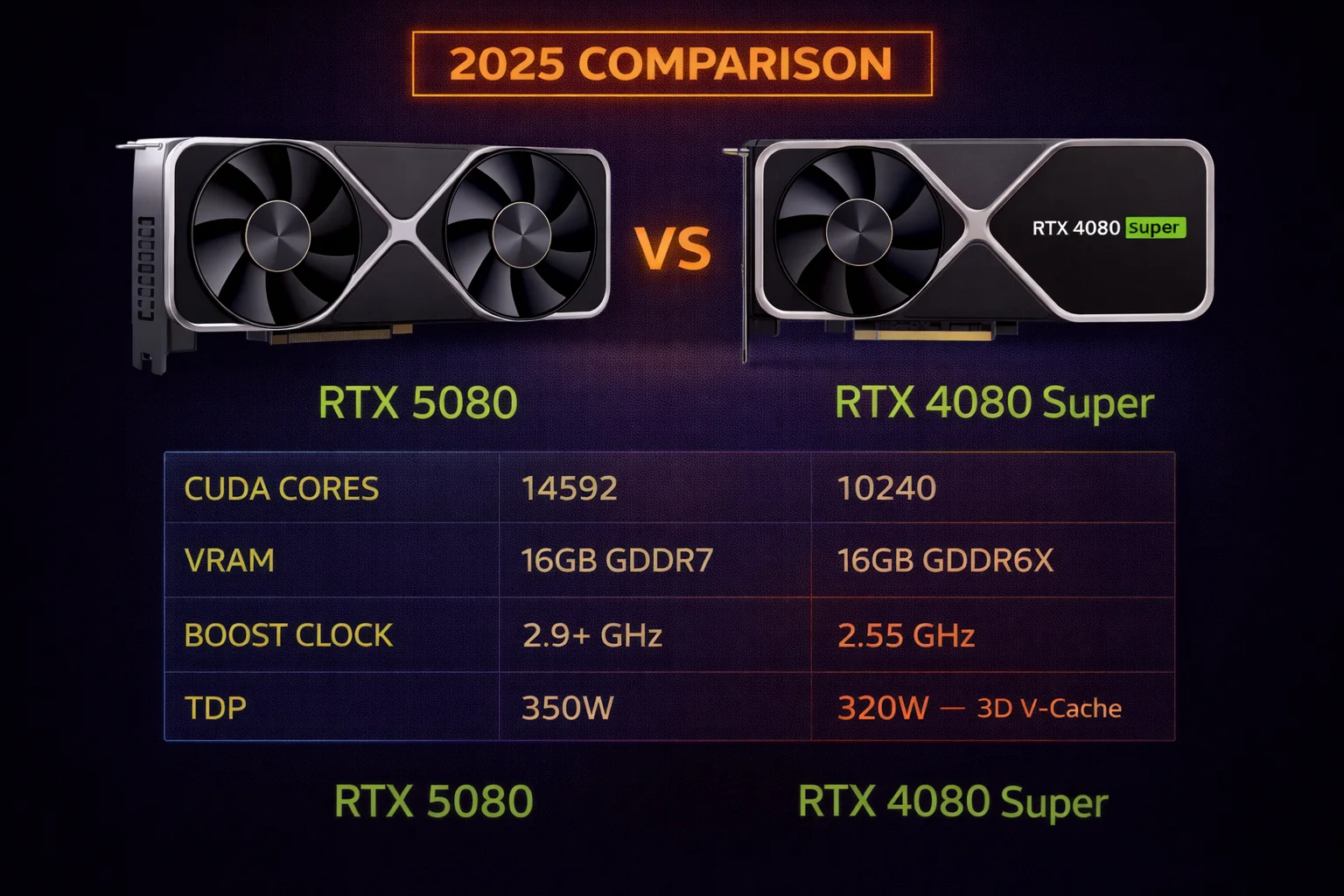
| Specification | RTX 5080 | RTX 4080 Super |
|---|---|---|
| Architecture | Blackwell (TSMC 4N) | Ada Lovelace (TSMC 4N) |
| CUDA Cores | 10,752 | 10,240 |
| VRAM | 16GB GDDR7 | 16GB GDDR6X |
| Memory Bus | 256-bit | 256-bit |
| Memory Bandwidth | 960 GB/s | 736 GB/s |
| Base Clock | 2,295 MHz | 2,290 MHz |
| Boost Clock | 2,620 MHz | 2,550 MHz |
| TDP | 300W | 320W |
| RT Cores | 4th Generation | 3rd Generation |
| Tensor Cores | 5th Generation | 4th Generation |
| DLSS | DLSS 4 (Multi Frame Gen) | DLSS 3.5 |
| PCIe | 5.0 x16 | 4.0 x16 |
| Encoder | 9th Gen NVENC (Dual) | 8th Gen NVENC |
| Power Connectors | 1x 12V-2×6 (16-pin) | 1x 12VHPWR (16-pin) |
| MSRP | $999 | $999 |
| Street Price | ~$1,359 | ~$1,100 |
Key Specification Analysis
Memory Bandwidth: The RTX 5080’s GDDR7 delivers 30% higher bandwidth (960 GB/s vs 736 GB/s). This substantial improvement helps the 5080 handle 4K textures more efficiently and provides headroom for future games with higher memory requirements. The bandwidth advantage is particularly noticeable in texture-heavy games and when using high-resolution texture mods.
Power Efficiency: Despite being faster, the RTX 5080 draws 20W less than the 4080 Super (300W vs 320W). Blackwell’s architectural improvements deliver better performance-per-watt, translating to lower heat output and quieter operation. This efficiency gain is one of the most impressive aspects of the new generation.
RT and Tensor Cores: Blackwell’s 4th gen RT cores and 5th gen Tensor cores provide significant improvements. Ray tracing sees 30-45% gains, and DLSS 4’s transformer-based models deliver superior upscaling quality.
VRAM Parity: Both GPUs feature 16GB VRAM—adequate for 4K gaming in 2026. This means neither has a VRAM advantage, making the performance and feature differences the primary differentiators.
Rasterization Performance
In traditional rasterization without upscaling, the RTX 5080 delivers meaningful but not revolutionary gains over the 4080 Super. The Blackwell architecture improvements translate to 15-25% better raw performance.
4K Ultra Performance (Native)
| Game | RTX 5080 | RTX 4080 Super | Difference |
|---|---|---|---|
| Cyberpunk 2077 | 95 FPS | 78 FPS | +22% |
| Alan Wake 2 | 82 FPS | 68 FPS | +21% |
| Spider-Man 2 | 105 FPS | 88 FPS | +19% |
| Hogwarts Legacy | 98 FPS | 82 FPS | +20% |
| Starfield | 88 FPS | 72 FPS | +22% |
| Call of Duty MW3 | 145 FPS | 125 FPS | +16% |
| Avatar: Frontiers | 78 FPS | 65 FPS | +20% |
| Black Myth: Wukong | 72 FPS | 58 FPS | +24% |
| Indiana Jones | 85 FPS | 70 FPS | +21% |
| Baldur’s Gate 3 | 125 FPS | 105 FPS | +19% |
At 4K native, the RTX 5080 averages 20-22% higher frame rates. This pushes many demanding titles from “playable” to “smooth”—the difference between 65 FPS and 80 FPS is noticeable and meaningful for the gaming experience. The 5080 consistently delivers 4K gaming above 60 FPS in titles where the 4080 Super sometimes struggles.
1440p Ultra Performance
| Game | RTX 5080 | RTX 4080 Super | Difference |
|---|---|---|---|
| Cyberpunk 2077 | 145 FPS | 120 FPS | +21% |
| Alan Wake 2 | 125 FPS | 102 FPS | +23% |
| Spider-Man 2 | 168 FPS | 140 FPS | +20% |
| Hogwarts Legacy | 155 FPS | 128 FPS | +21% |
| Call of Duty MW3 | 245 FPS | 205 FPS | +20% |
| Fortnite | 320 FPS | 265 FPS | +21% |
At 1440p, the RTX 5080 maintains its 20-23% advantage. For high-refresh 1440p gaming (240Hz+), the 5080 pushes more titles into the 150+ FPS range where the difference is felt on fast monitors. Both GPUs are overkill for 1440p 60Hz gaming.
Ray Tracing Performance
Blackwell’s 4th generation RT cores deliver significant ray tracing improvements, making the RTX 5080 a more compelling choice for RT enthusiasts who want to experience games as developers intended.
4K Ray Tracing (RT Ultra/High)
| Game | RTX 5080 | RTX 4080 Super | Difference |
|---|---|---|---|
| Cyberpunk 2077 (RT Overdrive) | 55 FPS | 38 FPS | +45% |
| Alan Wake 2 (RT High) | 52 FPS | 38 FPS | +37% |
| Control (RT Ultra) | 85 FPS | 65 FPS | +31% |
| Metro Exodus Enhanced | 78 FPS | 58 FPS | +34% |
| Spider-Man 2 (RT High) | 72 FPS | 55 FPS | +31% |
| Hogwarts Legacy (RT Ultra) | 65 FPS | 50 FPS | +30% |
| Indiana Jones (RT On) | 58 FPS | 42 FPS | +38% |
The RTX 5080 is 30-45% faster in ray tracing—a larger gap than rasterization. For path-traced games like Cyberpunk 2077 RT Overdrive, this difference is transformative. The 4080 Super struggles at 38 FPS while the 5080 delivers a smooth 55 FPS. For gamers who prioritize RT, this performance gap alone may justify the upgrade.
DLSS 4 vs DLSS 3: Multi Frame Generation
DLSS 4 represents the most significant differentiator between these GPUs. The RTX 5080’s exclusive access to Multi Frame Generation fundamentally changes what’s possible at 4K.
Technology Comparison
DLSS 3/3.5 (RTX 4080 Super): Generates 1 additional frame per rendered frame (2x multiplier). Excellent quality with NVIDIA Reflex latency mitigation. Mature technology with broad game support across 500+ titles.
DLSS 4 Multi Frame Gen (RTX 5080): Generates up to 3 additional frames per rendered frame (2x, 3x, or 4x multiplier). Transformer-based AI models provide better quality and lower latency than DLSS 3. Users can choose their preferred frame generation level based on latency tolerance.
4K DLSS Performance Comparison
| Game (4K) | 5080 + DLSS 4 (4x) | 4080 Super + DLSS 3 (2x) | Difference |
|---|---|---|---|
| Cyberpunk 2077 | 320 FPS | 140 FPS | +129% |
| Alan Wake 2 | 280 FPS | 125 FPS | +124% |
| Spider-Man 2 | 360 FPS | 160 FPS | +125% |
| Black Myth: Wukong | 240 FPS | 105 FPS | +129% |
With DLSS 4 at maximum settings, the RTX 5080 delivers more than double the perceived frame rates of the 4080 Super. For 4K 120Hz+ monitor owners, this is transformative—enabling ultra-smooth gameplay previously impossible at this resolution. For 4K 60Hz displays, the advantage is less pronounced but still valuable for headroom and future monitors.
DLSS 4 Quality Improvements
Beyond frame generation, DLSS 4 improves image quality across all modes:
- Transformer architecture: Better detail reconstruction than CNN-based DLSS 3
- Reduced ghosting: Improved temporal stability on fast-moving objects
- Better edge handling: Less shimmer on vegetation, fences, and fine geometry
- Lower latency: Optimized frame timing reduces perceived input lag
Power Efficiency and Thermals
In a surprising twist, the faster RTX 5080 actually draws less power than the 4080 Super—a testament to Blackwell’s efficiency improvements.
| Metric | RTX 5080 | RTX 4080 Super |
|---|---|---|
| TDP | 300W | 320W |
| Gaming Power Draw | 280-300W | 300-320W |
| Idle Power | 15-18W | 18-22W |
| Gaming Temperature | 68-75C | 70-78C |
| Recommended PSU | 750W | 750W |
| Perf-per-Watt (4K) | 0.28 FPS/W | 0.22 FPS/W |
The RTX 5080 delivers 27% better performance-per-watt—a significant efficiency improvement. This translates to lower electricity costs, less heat output, and potentially quieter operation depending on cooler design. For users concerned about power consumption and thermals, the 5080 is paradoxically the better choice despite being faster.
Content Creation Performance
For streamers and video editors, both GPUs are excellent, but the 5080’s dual 9th gen NVENC encoders provide meaningful advantages that translate to real-world productivity gains.
| Workload | RTX 5080 | RTX 4080 Super | Advantage |
|---|---|---|---|
| Handbrake 4K Export | 125 FPS | 95 FPS | +32% 5080 |
| DaVinci Resolve 4K | Real-time+ | Real-time | More headroom |
| Premiere Pro Export | ~35% faster | Baseline | 5080 wins |
| Blender Cycles (GPU) | ~25% faster | Baseline | 5080 wins |
| OBS Streaming Quality | Better at bitrate | Excellent | Marginal 5080 |
The RTX 5080’s dual encoders enable simultaneous 4K streaming and recording without impacting gaming performance. For professional content creators, the time savings in exports adds up significantly over months of work. A 35% faster export on a 30-minute video saves 10+ minutes per render—multiply that by daily uploads and the productivity gains become substantial.
For Blender and other 3D applications, the 5080’s additional CUDA cores and improved architecture deliver 25% faster GPU rendering. Combined with the faster memory bandwidth, complex scenes render more quickly and viewport performance remains smoother with heavy geometry.
CPU Pairing Recommendations
Both GPUs are powerful enough to expose CPU limitations at 1440p and even 4K in some titles. Choose your CPU carefully to avoid bottlenecking.
Recommended CPUs for RTX 5080/4080 Super
| CPU | Price | Bottleneck at 4K | Best For |
|---|---|---|---|
| Ryzen 7 7800X3D | $386 | None | Maximum gaming |
| i7-14700K | $367 | None | Gaming + productivity |
| Ryzen 9 9800X3D | $444 | None | Ultimate gaming |
| Ryzen 5 7600X | $178 | Minimal | Value builds |
| i5-14600K | $294 | Minimal | Balanced |
For maximum gaming performance with either GPU, the Ryzen 7 7800X3D or 9800X3D are ideal choices. For mixed gaming and productivity, the i7-14700K provides excellent all-around performance.
Driver Stability and Software Ecosystem
Driver maturity is an important consideration when comparing new and previous-generation hardware, especially at high-end price points where stability expectations are elevated.
RTX 4080 Super (Ada Lovelace)
The RTX 4080 Super benefits from over two years of Ada Lovelace driver optimization. Game-specific optimizations are well-established across hundreds of titles, DLSS 3 profiles are mature and stable, and edge-case bugs have been identified and resolved through countless driver updates. For users who prioritize stability and predictability over cutting-edge features, the 4080 Super’s proven track record is reassuring.
RTX 5080 (Blackwell)
As a new architecture, Blackwell drivers are still maturing. Early reviews noted some initial performance inconsistencies that have been largely resolved through rapid updates. DLSS 4 support is expanding as developers update their games, with most major titles already supporting the new features. NVIDIA’s track record suggests any remaining launch-window issues will be fully resolved within 2-3 months. For most users, this minor early-adoption consideration is acceptable given the significant performance benefits.
Competitive Gaming at 4K
While 4K is typically associated with visual fidelity rather than competitive gaming, the rise of 4K 144Hz and 4K 240Hz displays makes high frame rates at 4K increasingly relevant.
Esports Performance at 4K
| Game (4K) | RTX 5080 | RTX 4080 Super | Difference |
|---|---|---|---|
| Valorant | 380 FPS | 310 FPS | +23% |
| CS2 | 320 FPS | 260 FPS | +23% |
| Fortnite | 280 FPS | 225 FPS | +24% |
| Apex Legends | 240 FPS | 195 FPS | +23% |
| Overwatch 2 | 290 FPS | 235 FPS | +23% |
For competitive gamers targeting 4K 144Hz+ displays, the RTX 5080’s consistent 20-25% advantage provides more headroom for stable high-FPS gameplay. The improved 1% lows also translate to fewer frame drops during intense action sequences—critical for competitive play.
Value Analysis
Price-to-Performance Breakdown
| Metric | RTX 5080 (~$1,359) | RTX 4080 Super (~$1,100) |
|---|---|---|
| 4K Avg FPS | 90 FPS | 74 FPS |
| Price per FPS | $15.10/FPS | $14.86/FPS |
| RT 4K Avg FPS | 65 FPS | 48 FPS |
| Price per RT FPS | $20.91/FPS | $22.92/FPS |
In pure rasterization, the 4080 Super offers slightly better value per frame. However, the RTX 5080 delivers better value for ray tracing and includes DLSS 4—features that don’t show up in simple price-per-FPS calculations. For buyers who value RT and DLSS 4, the 5080’s premium is justified.
Upgrade Considerations
New Builds: The RTX 5080 is recommended. The 24% higher price yields 20-25% better rasterization, 30-45% better RT, DLSS 4, and improved efficiency. For a GPU intended to last 3-4 years, the premium is worthwhile.
RTX 4080 Super Owners: Don’t upgrade. The 20-25% gain doesn’t justify the cost. Wait for RTX 6000 series for a meaningful generational leap.
RTX 3080/3070 Owners: Either GPU is a significant upgrade. The 5080 offers 80-100% improvement; the 4080 Super offers 60-80% improvement at lower cost.
Complete Build Examples
RTX 5080 Premium 4K Build (~$2,650)
- CPU: Ryzen 7 7800X3D – $386
- GPU: RTX 5080 – $1,359
- Motherboard: X670E DDR5 – $250
- RAM: 32GB DDR5-6000 – $120
- Storage: 2TB NVMe Gen4 – $130
- PSU: 850W Gold – $120
- Cooler: 280mm AIO – $120
- Case: Premium Mid-tower – $150
- Total: ~$2,635
The ultimate 4K gaming build with no compromises. The 7800X3D’s massive L3 cache ensures no CPU bottleneck, while the RTX 5080 delivers maximum 4K performance with DLSS 4 and excellent ray tracing. The X670E motherboard provides USB4, PCIe 5.0 storage support, and excellent VRM for any future CPU upgrades on AM5. Ideal for 4K 120Hz+ OLED displays where every frame matters.
RTX 5080 Content Creator Build (~$2,900)
- CPU: i7-14700K – $367
- GPU: RTX 5080 – $1,359
- Motherboard: Z790 DDR5 – $280
- RAM: 64GB DDR5-5600 – $200
- Storage: 4TB NVMe Gen4 – $250
- PSU: 1000W Gold – $150
- Cooler: 360mm AIO – $150
- Case: Full tower – $180
- Total: ~$2,936
Optimized for content creators who also game. The i7-14700K’s 20 cores accelerate video rendering and 3D work, while 64GB RAM handles large projects. The 5080’s dual NVENC encoders enable 4K streaming while gaming. Excellent for YouTubers, streamers, and video editors who need professional-grade performance.
RTX 4080 Super Value 4K Build (~$2,250)
- CPU: Ryzen 7 7800X3D – $386
- GPU: RTX 4080 Super – $1,100
- Motherboard: B650E DDR5 – $200
- RAM: 32GB DDR5-6000 – $120
- Storage: 2TB NVMe Gen4 – $130
- PSU: 850W Gold – $120
- Cooler: Tower Air – $60
- Case: Quality Mid-tower – $120
- Total: ~$2,236
Excellent 4K gaming at $400 less than the 5080 build. Proven performance with mature DLSS 3 drivers and established game optimization. The 7800X3D still provides maximum gaming performance, and the B650E offers great value with all essential features. Best for budget-conscious enthusiasts who prioritize value over cutting-edge features while still demanding excellent 4K performance.
Who Should Buy Each GPU
Choose RTX 5080 If:
- You’re building a new high-end PC in 2026
- You have a 4K 120Hz+ monitor or plan to upgrade
- Ray tracing quality is important to your gaming experience
- DLSS 4 Multi Frame Generation appeals to you for ultra-smooth gameplay
- Power efficiency matters (paradoxically, the 5080 is more efficient)
- You create content professionally and value faster encoding
- You want to future-proof for 4+ years of high-end gaming
- You’re upgrading from RTX 3000 series or older
- You play the latest AAA titles with RT Overdrive/Path Tracing
- Budget allows for the best available without paying 5090 prices
Choose RTX 4080 Super If:
- Budget is constrained and $259 savings matters to your build
- You have a 4K 60Hz display (either GPU is overkill)
- Ray tracing isn’t a priority for your gaming preferences
- DLSS 3’s single frame generation meets your smoothness needs
- You prefer mature, well-tested drivers over new releases
- You find it on sale below $1,000 (excellent value at that price)
- You’re risk-averse about new architecture launches
- You mainly play older or esports titles that don’t need cutting-edge
- You want proven performance you can rely on immediately
Frequently Asked Questions
For new builds, yes. You get 20-25% better rasterization, 30-45% better ray tracing, DLSS 4 Multi Frame Gen, and better efficiency for 24% more money. For 4080 Super owners, no—wait for RTX 6000 series.
20-25% faster in rasterization, 30-45% faster in ray tracing. With DLSS 4 Multi Frame Gen vs DLSS 3, the perceived smoothness advantage can exceed 100% at maximum settings.
If you have a high-refresh 4K monitor (120Hz+), absolutely. Multi Frame Generation at 4x pushes demanding games to 200-300+ FPS at 4K. For 60Hz displays, the benefit is less pronounced but still valuable.
The RTX 5090 is 35-45% faster but costs nearly 3x more ($4,000+). For most gamers, the 5080 offers far better value. Only choose 5090 for no-compromise 8K, professional work, or money-is-no-object builds.
750W is recommended minimum. The 5080 draws up to 300W (actually less than 4080 Super’s 320W), leaving headroom for high-end CPUs. 850W provides comfortable margin for overclocking.
The 5080 Super will likely arrive late 2026 or early 2027. If you need a GPU now, the 5080 is excellent. If you can wait 8-12 months, the Super refresh may offer better value or lower prices on standard 5080.
Yes, for 4K gaming. Most games use 12-14GB at 4K max settings. 16GB provides adequate headroom for current and near-future titles. Only 8K or heavily modded games push beyond this.
The RTX 5080 has superior ray tracing and DLSS 4. AMD’s RDNA 4 flagship competes on rasterization and typically costs less. Choose NVIDIA for RT/DLSS priority, AMD for pure raster value if pricing favors it.
Final Verdict
The RTX 5080 is the better choice for new builds. At $259 more than the 4080 Super, it delivers 20-25% better rasterization, 30-45% better ray tracing, DLSS 4 Multi Frame Generation, and improved power efficiency. For a flagship GPU purchase intended to last 3-4 years, the premium is justified by meaningful improvements across the board. The fact that it’s more efficient while being faster is the cherry on top.
The RTX 4080 Super remains excellent value. At $1,100, it delivers outstanding 4K gaming with proven DLSS 3 technology and mature drivers that have been optimized over two years. For budget-conscious enthusiasts who don’t need cutting-edge features, or those who find it on sale below $1,000, it’s still one of the best 4K gaming GPUs money can buy in 2026.
For current 4080 Super owners: Don’t upgrade. The 20-25% gain doesn’t justify selling your current card and spending another $1,300+. Wait for RTX 6000 series, which will likely provide 50%+ improvements and make the upgrade more compelling. Your 4080 Super is still an excellent GPU that will remain relevant for years.
For RTX 3080/3070 Ti owners: Both GPUs represent significant upgrades. The 5080 offers 80-100% improvement over the 3080, while the 4080 Super offers 60-80% improvement at lower cost. Either choice is valid depending on your budget and priorities.
For 4K gaming in 2026, both GPUs deliver excellent experiences. The RTX 5080 represents the new high-end standard with tangible improvements in performance, features, and efficiency. The RTX 4080 Super offers proven, reliable performance at a lower price point. Your choice depends on whether you value having the latest technology or maximizing value per dollar.
Related Resources
- PC Bottleneck Calculator
- Best CPU for RTX 5080
- Best CPU for RTX 4080 Super
- RTX 5070 vs RTX 4070
- RTX 4070 Super vs RX 7800 XT
Last Updated: February 2026