Ryzen 5 5600 vs i5-12400F 2026: Best Budget Gaming CPU

Quick Answer+
Quick Answer: The i5-12400F ($134) is 2-5% faster in gaming and 7-13% faster in productivity at a slightly higher price. The Ryzen 5 5600 ($129) runs cooler, uses less power, and pairs excellently with AMD GPUs via SAM. Both are exceptional budget choices—buy whichever is cheaper or fits your build priorities.
The Ryzen 5 5600 and Intel Core i5-12400F represent the ultimate budget CPU battle in 2026. Both deliver excellent gaming performance, handle productivity tasks competently, and cost under $140. Despite being “previous generation” parts, they remain highly relevant for budget builders who want maximum value without sacrificing meaningful performance.
What makes these CPUs remarkable is how they’ve matured in the market. Launched in 2022, both have seen dramatic price cuts while maintaining strong performance relative to modern titles. The 5600 dropped from $199 to around $129, while the 12400F fell from $179 to approximately $134. These prices make them exceptional value propositions for gamers who don’t need the latest technology to enjoy smooth gameplay.
This comprehensive comparison examines every aspect: gaming benchmarks, productivity performance, power efficiency, platform costs, and upgrade paths. By the end, you’ll know exactly which CPU fits your specific needs and budget constraints. Use our Bottleneck Calculator to verify optimal GPU pairing, or check our FPS Calculator for game-specific performance estimates.
The CPUs at a Glance
AMD Ryzen 5 5600
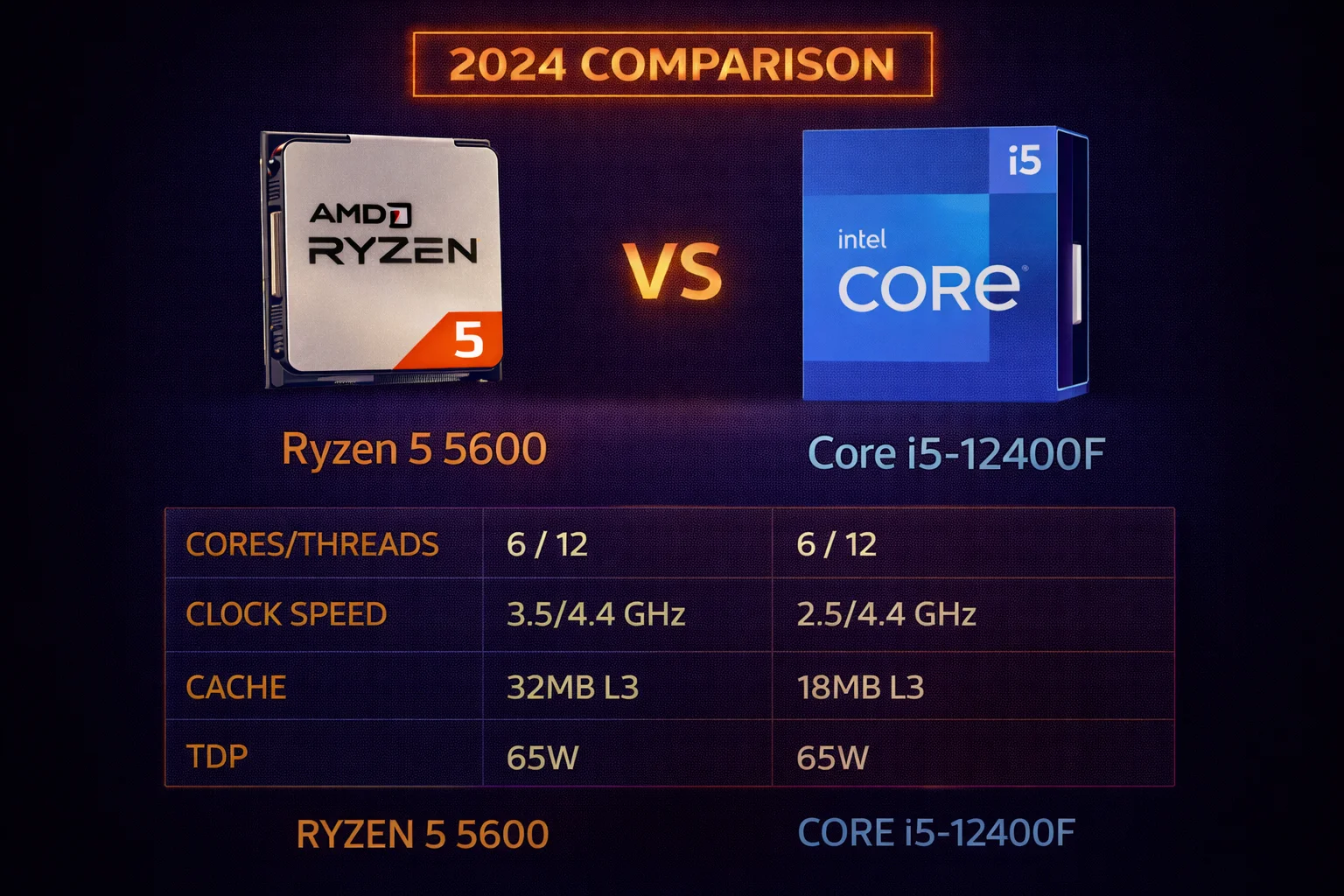
6 Cores | 12 Threads | 4.4 GHz Boost | 32MB L3 | 65W TDP
AMD’s budget gaming legend. Runs cool and quiet on the stock cooler, pairs perfectly with AMD GPUs for SAM benefits. Best for efficient, quiet builds.
Intel Core i5-12400F
6 Cores | 12 Threads | 4.4 GHz Boost | 18MB L3 | 65W TDP
Intel’s budget performance king. Slightly faster gaming and noticeably faster productivity. Best for maximum performance per dollar.
Specifications Comparison
| Specification | Ryzen 5 5600 | Intel i5-12400F |
|---|---|---|
| Architecture | Zen 3 (TSMC 7nm) | Alder Lake (Intel 7) |
| Cores / Threads | 6 / 12 | 6 / 12 |
| P-Cores | N/A (all equal) | 6 |
| E-Cores | N/A | 0 |
| Base Clock | 3.5 GHz | 2.5 GHz |
| Boost Clock | 4.4 GHz | 4.4 GHz |
| L3 Cache | 32 MB | 18 MB |
| L2 Cache | 3 MB | 7.5 MB |
| TDP | 65W | 65W (117W PL2) |
| Actual Power Draw | 70-85W | 90-115W |
| Memory Support | DDR4-3200 | DDR4-3200 / DDR5-4800 |
| PCIe Lanes | PCIe 4.0 (24 lanes) | PCIe 5.0 (x16) + 4.0 (x4) |
| Socket | AM4 | LGA 1700 |
| Integrated Graphics | No | No (F model) |
| Stock Cooler | Wraith Stealth (adequate) | Laminar RM1 (marginal) |
| Manufacturing Process | TSMC 7nm | Intel 7 (10nm ESF) |
| Release Date | April 2022 | January 2022 |
| MSRP (Launch) | $199 | $179 |
| Street Price (Feb 2026) | ~$129 | ~$134 |
Key Specification Analysis
Cache Architecture: The Ryzen 5 5600’s 32MB L3 cache versus Intel’s 18MB provides AMD an advantage in cache-sensitive workloads. This extra cache helps in some games and productivity tasks, though the benefit isn’t as dramatic as the massive L3 on X3D processors. In practice, expect 2-4% gains in cache-heavy scenarios.
Power Consumption: Despite identical 65W TDP ratings, these CPUs differ significantly in actual power draw. Intel’s PL2 allows the 12400F to boost to 117W under load, while the 5600 typically stays under 85W. This 30-40W difference translates to cooler operation, quieter fans, and lower electricity costs for AMD.
Memory Support: Intel LGA 1700 supports both DDR4 and DDR5 (motherboard dependent), while AM4 is DDR4 only. For budget builds, DDR4 remains the value choice—DDR5’s price premium rarely justifies its minimal gaming benefit at this CPU tier.
PCIe Support: Intel offers PCIe 5.0 from the CPU for future NVMe SSDs, while AMD provides PCIe 4.0. In practice, this difference is irrelevant for budget builds—PCIe 5.0 GPUs don’t exist, and PCIe 5.0 SSDs offer minimal real-world gaming benefit while costing significantly more.
Stock Coolers: AMD’s Wraith Stealth is adequate for the 5600’s modest power draw—it keeps the CPU cool and reasonably quiet. Intel’s Laminar RM1 struggles more with the 12400F’s higher power consumption. Budget $20-30 for an aftermarket cooler with Intel for quieter operation.
Gaming Performance
For budget gaming, both CPUs deliver excellent performance that punches well above their price point. The i5-12400F holds a small but consistent lead in most titles due to its slightly stronger single-threaded performance.
1080p Gaming Benchmarks (RTX 4070)
Testing at 1080p with an RTX 4070 to minimize GPU bottlenecks and expose CPU performance differences:
| Game (1080p High) | Ryzen 5 5600 | i5-12400F | Difference |
|---|---|---|---|
| Cyberpunk 2077 | 142 FPS | 148 FPS | +4% Intel |
| Hogwarts Legacy | 118 FPS | 125 FPS | +6% Intel |
| Call of Duty MW3 | 195 FPS | 202 FPS | +4% Intel |
| Spider-Man 2 | 128 FPS | 132 FPS | +3% Intel |
| Starfield | 85 FPS | 88 FPS | +4% Intel |
| Baldur’s Gate 3 | 105 FPS | 108 FPS | +3% Intel |
| Counter-Strike 2 | 385 FPS | 405 FPS | +5% Intel |
| Valorant | 480 FPS | 495 FPS | +3% Intel |
| Fortnite | 245 FPS | 255 FPS | +4% Intel |
| Forza Horizon 5 | 155 FPS | 160 FPS | +3% Intel |
| Alan Wake 2 | 92 FPS | 96 FPS | +4% Intel |
| Black Myth: Wukong | 88 FPS | 92 FPS | +5% Intel |
At 1080p, the i5-12400F averages 3-6% higher frame rates. While consistent, this difference is barely perceptible in practice—both CPUs deliver excellent gaming experiences well above 60 FPS in demanding titles and easily push esports games past competitive refresh rate targets.
1440p Gaming Benchmarks (RTX 4070)
| Game (1440p High) | Ryzen 5 5600 | i5-12400F | Difference |
|---|---|---|---|
| Cyberpunk 2077 | 85 FPS | 87 FPS | +2% Intel |
| Hogwarts Legacy | 78 FPS | 80 FPS | +3% Intel |
| Call of Duty MW3 | 135 FPS | 138 FPS | +2% Intel |
| Spider-Man 2 | 88 FPS | 90 FPS | +2% Intel |
| Starfield | 62 FPS | 64 FPS | +3% Intel |
| Baldur’s Gate 3 | 82 FPS | 84 FPS | +2% Intel |
| Counter-Strike 2 | 320 FPS | 328 FPS | +3% Intel |
| Forza Horizon 5 | 118 FPS | 120 FPS | +2% Intel |
At 1440p, the gap narrows to 2-3% as the GPU becomes the primary bottleneck. At this resolution, CPU choice matters significantly less—both chips deliver nearly identical gaming experiences. Choose based on other factors like efficiency, platform cost, or availability.
1% Low Frame Analysis
Frame time consistency matters for smooth gameplay. Both CPUs deliver excellent 1% lows with minimal stuttering:
| Game (1080p) | 5600 1% Low | 12400F 1% Low | Difference |
|---|---|---|---|
| Cyberpunk 2077 | 98 FPS | 102 FPS | +4% Intel |
| Hogwarts Legacy | 82 FPS | 86 FPS | +5% Intel |
| Starfield | 58 FPS | 62 FPS | +7% Intel |
| Baldur’s Gate 3 | 72 FPS | 75 FPS | +4% Intel |
The 12400F shows slightly better 1% lows (4-7%), suggesting marginally more consistent frame delivery. However, both CPUs provide smooth gaming experiences without noticeable stuttering in properly optimized games.
SAM Benefits: AMD’s Hidden Advantage
When pairing the Ryzen 5 5600 with AMD GPUs (RX 7600, RX 7700 XT, RX 7800 XT), Smart Access Memory provides 3-8% additional gaming performance. This free boost partially closes the gap with Intel and makes all-AMD builds particularly attractive.
| Game (1080p) | 5600 + RX 7700 XT (No SAM) | 5600 + RX 7700 XT (SAM) | Bonus |
|---|---|---|---|
| Assassin’s Creed Mirage | 98 FPS | 105 FPS | +7% |
| Forza Horizon 5 | 142 FPS | 152 FPS | +7% |
| F1 24 | 155 FPS | 164 FPS | +6% |
| Watch Dogs Legion | 82 FPS | 88 FPS | +7% |
With SAM enabled, the Ryzen 5 5600 + AMD GPU combination often matches or exceeds the i5-12400F in gaming performance while running cooler and quieter. This makes AMD the better choice for budget all-AMD builds.
Productivity Performance
For productivity workloads, the i5-12400F shows more substantial advantages thanks to its stronger single-threaded performance and IPC improvements in Alder Lake architecture.
Multi-Threaded Benchmarks
| Application | Ryzen 5 5600 | i5-12400F | Difference |
|---|---|---|---|
| Cinebench R23 (Multi) | 10,850 | 12,250 | +13% Intel |
| Cinebench R23 (Single) | 1,510 | 1,720 | +14% Intel |
| Blender (Classroom) | 425 sec | 385 sec | +10% Intel |
| 7-Zip Compression | 58,500 MIPS | 62,800 MIPS | +7% Intel |
| Handbrake (4K Encode) | 28 FPS | 31 FPS | +11% Intel |
| Adobe Premiere Export | 6:45 | 6:05 | +11% Intel |
| Visual Studio Compile | 145 sec | 132 sec | +10% Intel |
| Geekbench 6 (Multi) | 8,250 | 9,150 | +11% Intel |
| Geekbench 6 (Single) | 2,050 | 2,350 | +15% Intel |
The i5-12400F is 7-15% faster in productivity workloads—a more noticeable advantage than gaming. For content creators, developers, or users who frequently render, encode, or compile, Intel offers meaningfully faster task completion.
Real-World Productivity Impact
Video Editing: The 12400F’s 11% advantage in Premiere Pro and Handbrake translates to saving 30-40 seconds per minute of 4K footage exported. For hobbyist YouTubers, this adds up to 5-10 minutes saved per video.
3D Rendering: In Blender, the 12400F completes renders 10% faster. For casual 3D artists, expect renders to finish a few minutes sooner on typical projects.
Software Development: Compile times are 10% shorter on Intel. For developers working on large projects, this translates to slightly faster iteration cycles.
Office Work: For typical office tasks (Word, Excel, browsing), both CPUs are indistinguishable. The productivity advantage only manifests in CPU-intensive workloads.
Power Consumption and Thermals
Power efficiency is where these CPUs diverge significantly. AMD’s mature 7nm process delivers better performance-per-watt.
| Metric | Ryzen 5 5600 | i5-12400F |
|---|---|---|
| TDP (Official) | 65W | 65W |
| PL2 (Max Power) | ~88W | 117W |
| Gaming Power Draw | 55-70W | 75-95W |
| Multi-Threaded Load | 75-88W | 100-117W |
| Idle Power | 35-45W (system) | 40-50W (system) |
| Gaming Temperature | 55-65°C | 65-78°C |
| Load Temperature | 65-75°C | 75-90°C |
| Stock Cooler Noise | Quiet | Audible |
Cooling Requirements
Ryzen 5 5600: The included Wraith Stealth cooler is genuinely adequate. Gaming temperatures stay in the 55-65°C range, and the cooler remains reasonably quiet. An aftermarket cooler ($25-35) provides even quieter operation but isn’t necessary.
i5-12400F: Intel’s Laminar RM1 stock cooler handles the 12400F but runs louder and warmer. Gaming temperatures reach 65-78°C, and the fan becomes audible under load. Budget $20-30 for an aftermarket cooler (ID-Cooling SE-214-XT, Thermalright Assassin X) for quieter, cooler operation.
Long-Term Efficiency Costs
Over a year of moderate use (4 hours daily gaming, 2 hours light tasks), the i5-12400F’s higher power consumption adds approximately $15-25 to electricity costs compared to the Ryzen 5 5600. The AMD chip also generates less heat, keeping your room cooler during summer gaming sessions.
Platform Cost Comparison
Total platform cost—CPU, motherboard, RAM, and cooler—reveals the true value proposition of each option.
AMD AM4 Platform
| Component | Budget Build | Recommended Build |
|---|---|---|
| CPU (Ryzen 5 5600) | $129 | $129 |
| Motherboard | $70 (A520) | $100 (B550) |
| RAM (32GB DDR4-3200) | $55 | $65 (DDR4-3600) |
| Cooler | $0 (stock) | $30 (aftermarket) |
| Platform Total | $254 | $324 |
Intel LGA 1700 Platform
| Component | Budget Build | Recommended Build |
|---|---|---|
| CPU (i5-12400F) | $134 | $134 |
| Motherboard | $85 (H610) | $120 (B660) |
| RAM (32GB DDR4-3200) | $55 | $55 |
| Cooler | $0 (stock) | $25 (aftermarket) |
| Platform Total | $274 | $334 |
Platform Cost Analysis
Budget Build: AMD saves $20 on the platform while delivering similar gaming performance and better efficiency. The A520 motherboard is basic but adequate for the 5600.
Recommended Build: AMD still saves $10 while offering better upgrade options on B550 (future Ryzen 5000 series chips). Intel’s B660 provides more features but limited upgrade path.
Bottom Line: AMD offers better value at the platform level, partially offsetting Intel’s small performance advantage.
Upgrade Path Comparison
Both platforms are at or near end-of-life, limiting meaningful CPU upgrade options. However, each offers distinct upgrade possibilities worth considering for future-minded builders.
AMD AM4 Upgrades
AM4 is officially end-of-life, but the mature platform offers excellent used and discounted CPU options:
- Ryzen 5 5600X: ~$150, +3-5% gaming (minimal upgrade, not recommended)
- Ryzen 7 5700X: ~$180, +5% gaming, +50% productivity (great value for content creation)
- Ryzen 7 5800X3D: ~$300, +15-20% gaming (significant upgrade, best AM4 gaming CPU)
- Ryzen 9 5900X: ~$280, +5% gaming, +80% productivity (12 cores for heavy workloads)
- Ryzen 9 5950X: ~$350, +5% gaming, +110% productivity (16 cores for maximum multi-threading)
The standout option is the Ryzen 7 5800X3D—the fastest AM4 gaming CPU with 96MB L3 cache thanks to 3D V-Cache technology. If gaming performance becomes limiting in 2-3 years, dropping in a 5800X3D provides 15-20% better frame rates without changing motherboards or RAM. This makes AM4 a strong platform for gamers who want future upgrade flexibility.
Intel LGA 1700 Upgrades
LGA 1700 supports 12th, 13th, and 14th generation Intel CPUs, offering a wider range of upgrade options:
- i5-13400F: ~$190, +15% productivity (adds 4 E-cores), similar gaming
- i5-14400F: ~$210, +15% productivity, +3% gaming (slight clock improvements)
- i7-12700F: ~$260, +50% productivity, +5% gaming (8P+4E cores)
- i7-13700F: ~$320, +70% productivity, +8% gaming (8P+8E cores)
- i7-14700F: ~$340, +80% productivity, +10% gaming (8P+12E cores)
- i9-14900F: ~$470, +100% productivity, +12% gaming (maximum LGA 1700)
Intel’s upgrade path focuses on productivity gains through additional E-cores rather than dramatic gaming improvements. For users whose workloads grow to include video editing, 3D rendering, or software development, Intel offers better scaling options. However, note that LGA 1700 is also approaching end-of-life with Intel’s Arrow Lake (LGA 1851) taking over for future generations.
Upgrade Verdict: AMD offers the 5800X3D for significant gaming upgrades; Intel offers better productivity scaling. Neither platform represents a long-term investment—both are mature and approaching end-of-life. For most budget builders, plan to use your chosen CPU for 3-4 years and then evaluate a complete platform upgrade.
GPU Pairing Recommendations
Both CPUs pair excellently with mid-range GPUs without meaningful bottleneck.
Best GPUs for Ryzen 5 5600
| GPU | Price | Bottleneck | Best For |
|---|---|---|---|
| Intel Arc B580 | $250 | None | Budget 1080p |
| RX 7600 | $270 | None + SAM | 1080p all-AMD |
| RTX 4060 | $300 | None | 1080p DLSS |
| RX 7700 XT | $400 | None + SAM | 1440p all-AMD |
| RTX 4060 Ti | $400 | None | 1440p DLSS |
| RTX 4070 | $500 | 2-5% at 1080p | Maximum |
Best GPUs for i5-12400F
| GPU | Price | Bottleneck | Best For |
|---|---|---|---|
| Intel Arc B580 | $250 | None | Budget 1080p |
| RTX 4060 | $300 | None | 1080p DLSS |
| RX 7600 XT | $330 | None | 1080p value |
| RTX 4060 Ti | $400 | None | 1440p DLSS |
| RX 7700 XT | $400 | None | 1440p value |
| RTX 4070 | $500 | 1-3% at 1080p | Maximum |
Both CPUs handle GPUs up to the RTX 4070 class with minimal bottleneck. Beyond this tier, consider upgrading to a faster CPU to avoid leaving GPU performance on the table.
Complete Build Examples
Ultra-Budget AMD Build (~$700)
- CPU: Ryzen 5 5600 – $129
- GPU: Intel Arc B580 – $250
- Motherboard: MSI B550M PRO-VDH – $100
- RAM: 32GB DDR4-3200 – $55
- Storage: 1TB NVMe – $60
- PSU: 550W Bronze – $50
- Case: Budget Mid-tower – $55
- Total: ~$699
Excellent 1080p gaming under $700. The 5600’s efficiency means the stock cooler and modest PSU are adequate. Best for quiet, efficient budget builds.
All-AMD Value Build (~$900)
- CPU: Ryzen 5 5600 – $129
- GPU: RX 7700 XT – $400
- Motherboard: B550 – $100
- RAM: 32GB DDR4-3600 – $65
- Storage: 1TB NVMe – $60
- PSU: 650W Bronze – $60
- Case: Mid-tower – $70
- Total: ~$884
Excellent 1440p gaming with SAM benefits. The all-AMD combination delivers 3-8% extra performance from Smart Access Memory. Quiet and efficient operation.
Intel Performance Build (~$950)
- CPU: i5-12400F – $134
- GPU: RTX 4060 Ti – $400
- Motherboard: B660 – $120
- RAM: 32GB DDR4-3200 – $55
- Storage: 1TB NVMe – $60
- PSU: 650W Bronze – $60
- Cooler: ID-Cooling SE-214-XT – $25
- Case: Mid-tower – $70
- Total: ~$924
Maximum budget gaming with DLSS 3 support. The aftermarket cooler keeps the 12400F quiet. Better productivity performance than AMD equivalents.
Who Should Buy Which CPU
Choose Ryzen 5 5600 If:
- You’re building an all-AMD system with RX 7000 GPUs for SAM benefits
- Power efficiency and cool, quiet operation are priorities
- You want to use the stock cooler without upgrading
- You’re building a small form factor or low-airflow case
- Platform cost savings matter more than marginal performance
- You want the 5800X3D upgrade option for future gaming boost
- The 5600 is cheaper than the 12400F in your region
- Electricity costs are high in your area
Choose i5-12400F If:
- Maximum gaming performance is your priority (even if marginal)
- You do productivity work that benefits from faster rendering/encoding
- You want the option to upgrade to DDR5 motherboards
- You’re pairing with NVIDIA GPUs anyway (no SAM benefit lost)
- Better single-threaded performance matters for your specific workloads
- The 12400F is the same price or cheaper than the 5600
- You prefer Intel’s ecosystem and driver support
- Future productivity upgrades (13400F, 14400F) are appealing
Frequently Asked Questions
The i5-12400F is 2-5% faster in gaming and 7-13% faster in productivity. The Ryzen 5 5600 runs cooler, uses less power, costs less at the platform level, and has SAM support for AMD GPUs. Neither is definitively better—choose based on your specific priorities.
Absolutely. The 5600 handles 1080p gaming excellently and is very capable at 1440p with appropriate GPUs. It pairs well with cards up to RTX 4070 tier without significant bottleneck. For budget gaming builds, it remains one of the best value options available.
Yes. At ~$134, it remains one of the best value gaming CPUs available. It matches or exceeds most games’ CPU requirements and provides meaningful productivity advantages over AMD alternatives. It’s excellent for budget builds prioritizing performance.
The Ryzen 5 5600 runs significantly cooler. It draws 20-35W less power during gaming and productivity tasks. The stock Wraith Stealth cooler is adequate and quiet, while the 12400F benefits from an aftermarket cooler for optimal noise levels.
Yes. Both create minimal bottleneck (2-5%) with RTX 4070 at 1080p and essentially no bottleneck at 1440p. They’re excellent pairings for mid-range gaming builds and represent the sweet spot for value-oriented gamers.
The 5600X is only 3-5% faster and typically costs $20-30 more. The 5600 offers significantly better value. Only choose the 5600X if it’s the same price or actually cheaper than the standard 5600.
Arc B580 ($250) for budget 1080p, RX 7700 XT ($400) for 1440p with SAM benefits, or RTX 4060 Ti ($400) for 1080p/1440p with DLSS. All pair excellently without meaningful CPU bottleneck.
The 13400F/14400F are 15-20% faster in multi-threaded tasks due to 4 extra E-cores, costing $55-90 more. For pure gaming, the 12400F is nearly identical. For better multitasking and productivity, the 13400F ($190) offers the best balance.
Final Verdict
The i5-12400F is marginally better for pure performance. Its 2-5% gaming advantage and 7-13% productivity lead make it the faster chip overall. For builds prioritizing maximum performance regardless of other factors, Intel wins by a small but consistent margin. The stronger single-threaded performance and IPC improvements of Alder Lake architecture give Intel an edge in both gaming and everyday tasks.
The Ryzen 5 5600 is better for efficiency-focused builds. Its significantly lower power consumption, cooler temperatures, adequate stock cooler, lower platform cost, and SAM support make it ideal for quiet builds, small form factor systems, or all-AMD configurations targeting maximum value. The 5800X3D upgrade path also provides a compelling future option for gamers who want to extend their platform’s lifespan.
In reality, both are exceptional budget CPUs that will serve you well for years. The performance differences are so small that the best advice is: buy whichever is cheaper or more readily available. At $129-134, both chips deliver outstanding value that would have been unthinkable at this price point just a few years ago. You genuinely cannot go wrong with either CPU—both represent the sweet spot for budget gaming and general productivity in 2026.
Related Resources
- PC Bottleneck Calculator
- FPS Calculator
- Best GPU for Ryzen 5 5600
- Best GPU for i5-12400F
- i5-14600K vs Ryzen 5 7600X
- Ryzen 5 7600X vs i5-13400F
Last Updated: February 2026