QNAP NAS Black Friday Deals 2026
Amazon US · USDAmazon sale dates · Nov 19–30, 2026
Amazon Black Friday deals
As an Amazon Associate we earn from qualifying purchases. Prices and availability are accurate as of the time indicated and may change. The price and availability displayed on Amazon at the time of purchase apply.
| Product and offer | Amazon price |
|---|---|
 Amazon Black Friday Deal 21% off QNAP TS-433-4G-US 4 Bay NAS | Quad-core Processor, 4 GB RAM and 2.5GbE Network (Diskless) | $339.00List Price Buy on Amazon |
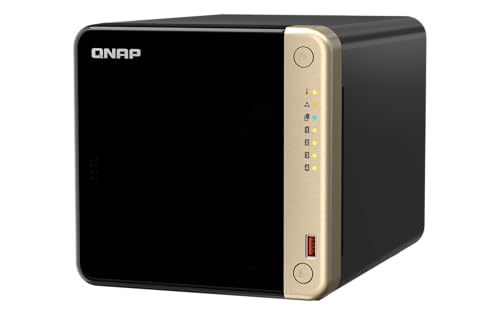
 Amazon Black Friday Deal 19% off QNAP TS-462A-4G 4-Bay Desktop NAS | Intel Quad-Core CPU burst up to 2.9 GHz | $499.00List Price Buy on Amazon |
 Amazon Black Friday Deal 16% off QNAP TR-004 4 Bay USB Type-C Direct Attached Storage (DAS) with hardware RAID (Diskless) | $184.00List Price Buy on Amazon |
Regular listings
| Product and offer | Amazon price |
|---|---|
$199.00Typical price Buy on Amazon | |
$299.00Checked Buy on Amazon | |
$486.89Checked Buy on Amazon | |
$637.99Checked Buy on Amazon | |
$749.00Checked Buy on Amazon | |
$749.00Checked Buy on Amazon | |
$799.00Checked Buy on Amazon | |
$895.74Checked Buy on Amazon | |
$1,109.57Checked Buy on Amazon | |
$1,181.99Checked Buy on Amazon | |
$1,299.00Checked Buy on Amazon | |
$1,419.99Checked Buy on Amazon | |
$1,745.99Checked Buy on Amazon | |
$1,999.00Checked Buy on Amazon |






Frequently asked questions
How do I know if a QNAP NAS is compatible with specific hard drives or SSDs?
Consult the official compatibility list on QNAP’s website for your NAS model, which details supported drive models, capacities, and interface types. Always verify using the exact model code of your intended storage drive before purchasing.
Is it better to buy a populated QNAP NAS or a diskless one and add drives separately?
Diskless models offer flexibility and let you select drives with the endurance and warranty you prefer. Pre-populated units are convenient but can restrict customization and may be harder to upgrade or repair. Choose based on your upgrade plans.
Related Black Friday guides
60 guides
NAS, DAS and enclosures
- NAS hardware
- 2-bay NAS
- 4-bay NAS
- 6-bay NAS
- 8-bay NAS
- 10GbE NAS
- All-flash NAS
- Rackmount NAS
- ASUSTOR NAS
- ASUSTOR AS5402T
- ASUSTOR AS5404T
- ASUSTOR AS6702T
- ASUSTOR AS6704T
- QNAP TS-253E
- QNAP TS-264
- QNAP TS-453E
- QNAP TS-464
- QNAP TS-664
- QNAP TS-673A
- QNAP TS-832PX
- QNAP TS-873A
- QNAP TS-932PX
- Synology NAS
- Synology DS1525+
- Synology DS1825+
- Synology DS223
- Synology DS224+
- Synology DS225+
- Synology DS423
- Synology DS423+
- Synology DS425+
- Synology DS620slim
- Synology DS725+
- Synology DS923+
- Synology DS925+
- TerraMaster NAS
- TerraMaster F4-425
- TerraMaster F6-425 Pro
- UGREEN NAS
- UGREEN DH2300
- UGREEN DXP2800
- UGREEN DXP2800 GT
- UGREEN DXP4800 GT
- UGREEN DXP4800 Plus
- UGREEN DXP4800 Pro
- UGREEN DXP480T Plus
- UGREEN DXP6800 Pro
- UGREEN DXP6800 Ultra
- UGREEN DXP8800 Plus
- UGREEN DXP8800 Ultra
- Drive enclosures
- Sabrent drive enclosures
- NVMe enclosures
- Direct-attached storage
- 4-bay DAS
- 5-bay DAS
- QNAP TR-004
- TerraMaster D4-320
- Mac mini docks
- Mac mini Thunderbolt 5 docks