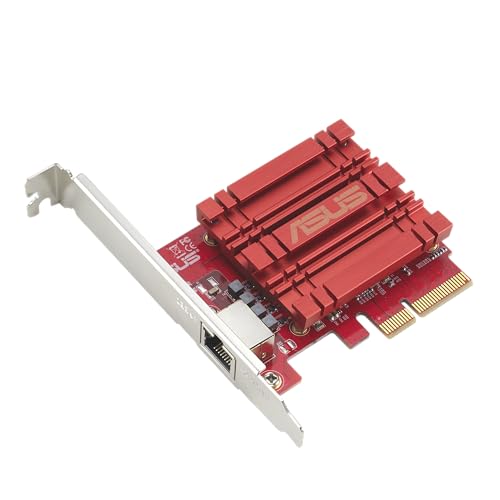
10GbE network cards Black Friday Deals 2026

Amazon US · USDAmazon sale dates · Nov 19–30, 2026

Amazon Black Friday deals

As an Amazon Associate we earn from qualifying purchases. Prices and availability are accurate as of the time indicated and may change. The price and availability displayed on Amazon at the time of purchase apply.

Product and offerAmazon price
$50.39Typical price $69.99Checked
Buy on Amazon
Amazon Black Friday Deal 24% off
10GbE SFP+ PCIe Network Card, Realtek RTL8127ATF | Open SFP+ Port, PCIe 4.0 x1

New · BZIZU · Ends

$38.21List Price $49.98Checked
Buy on Amazon
$53.99List Price $69.99Checked
Buy on Amazon
$45.59Typical price $53.99Checked
Buy on Amazon

Regular listings

Product and offerAmazon price
$45.99Checked
Buy on Amazon
$45.99Checked
Buy on Amazon
$49.99Checked
Buy on Amazon
$52.99Checked
Buy on Amazon
$59.99Checked
Buy on Amazon
$59.99Checked
Buy on Amazon
$62.98Typical price $69.98Checked
Buy on Amazon
$64.99Checked
Buy on Amazon
$69.99Checked
Buy on Amazon
$84.99Checked
Buy on Amazon
$99.99Checked
Buy on Amazon
$129.99Checked
Buy on Amazon
$244.99Checked
Buy on Amazon
$278.39Checked
Buy on Amazon
$418.38Checked
Buy on Amazon

Buying guide

Choosing the right 10GbE network interface card (NIC) can unleash workstation or server performance for file transfers, backup, or virtualization. Fitting the correct slot, matching cabling and making sure of driver support takes careful reading of listings and system documentation. This guide explains which details will make the difference when selecting a 10GbE NIC for your needs.

Determining System Compatibility and Slot Fit

Begin by examining your device’s available expansion slots. Most 10GbE NICs use PCI Express x8 or x4; some enterprise cards require PCIe 3.0 or 4.0 for full bandwidth. Check the slot’s physical width and electrical lanes using your system’s documentation or motherboard diagram to ensure compatibility before buying.

Server buyers should confirm open PCIe slots and power/cooling capabilities. Some rack servers need low-profile or mezzanine cards. Desktop users may need full-height brackets or driver support for non-Windows platforms. Cross-check the NIC’s form factor, required PCIe lanes, and OS support against your device’s official specs for trouble-free installation.

Choosing Port Types and Cabling

10GbE NICs use two main port types: SFP+ for optical or direct attach copper (DAC) connections and 10GBase-T for standard RJ45 copper cabling. Choose SFP+ for short, high-performance or optical runs in enterprise settings; use 10GBase-T if you want to reuse existing Cat6a/Cat7 Ethernet infrastructure.

Review the exact model code and data sheet for the NIC to confirm port configuration—single, dual, quad—plus any bundled SFP+ transceivers. Note that some cards support both SFP+ and RJ45 via modular design; check documentation for compatibility and required modules. Consider future upgrades if multi-port adaptability is needed in your workflow.

Evaluating Performance, Endurance, and Use Case Fit

Not all 10GbE NICs deliver identical performance under load. Chipset, onboard RAM, and driver maturity affect network consistency, particularly for intensive tasks such as iSCSI, NVMe over Fabric, or heavy virtualization. Choose server-grade (Intel X710, Broadcom, Mellanox) chipsets for critical uptime or larger multi-core systems.

For demanding environments, consult vendor release notes and support forums for known driver or firmware issues before buying. Confirm advertised features—such as receive side scaling, VLAN tagging, SR-IOV or RDMA—are supported by your operating system and motherboard. Avoid cards with uncertain or no driver support if stability or advanced features are critical.

Reading Listings and Buy/Warn Signals

Read each listing carefully, checking the exact part number, port count, bus interface, and supported cabling. Avoid vague or generic descriptions. Look for included brackets, SFP+ modules, or software support. Ensure warranty status is clearly listed if buying refurbished or used cards, and search vendor sites for updated datasheets or documentation.

Consider waiting if your current setup is not fully 10GbE ready, or if only one device needs higher throughput. Prices for popular chipsets may decline after major product line refreshes; if your main use case is not time-sensitive, monitor recent releases and inventory to match needs against sales cycles rather than over-buying immediately.

Frequently asked questions

Will a 10GbE NIC work in any PCIe slot?

No, it requires an x8 or, in some cases, an x4 PCIe slot with enough bandwidth. Always check both the NIC’s requirements and your motherboard or server documentation to ensure compatibility with your available slots.

Are driver updates important when selecting a NIC?

Yes, especially for new operating systems or enterprise deployments. Reliable, up-to-date drivers ensure full feature support and stability. Confirm the NIC is supported by your target OS and review driver documentation before purchasing.

Related Black Friday guides

Browse all Black Friday categories